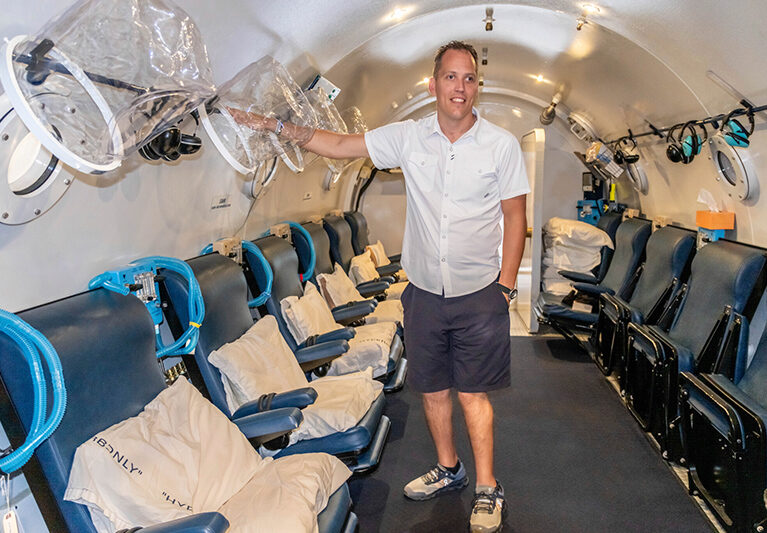
The “new kid on the block” that effectively treats a host of medical conditions has actually been around since the late 1600s. But its ever-evolving technology and list of successful medical applications is changing life for the better for scores of people.
Physicians started using hyperbaric oxygen therapy (HBOT) to treat a variety of different medical conditions in 1662 when the first pressurized room to treat pulmonary and digestive conditions was built.
Dr. Tyler Sexton, president of the American College of Hyperbaric Medicine, says, “Hyperbaric oxygen therapy is one of the oldest continuously used medical technologies and has evolved into a scientifically grounded, highly specialized treatment used worldwide.”
“HBOT is a medical treatment where a patient breathes 100-percent oxygen inside a pressurized chamber – at pressures higher than normal atmospheric pressure,” says Dr. Sexton, who also is medical director of Brevard Regional Hyperbaric Center.
“By increasing both the concentration of oxygen and the pressure, HBOT dramatically raises the amount of dissolved oxygen in the blood and tissues. Benefits of this include:
- Improving oxygen delivery to hypoxic or injured tissue
- Promoting new blood vessel growth
- Enhancing white blood cell function and bacterial killing
- Reducing certain types of edema
- Supporting collagen synthesis and wound repair
Mayo Clinic concurs, stating that the goal of hyperbaric oxygen therapy is to get more oxygen to tissues damaged by disease, injury or other factors. In a hyperbaric oxygen therapy chamber, the air pressure is increased two to three times higher than normal air pressure, allowing the lungs to gather much more oxygen than would be possible breathing pure oxygen at normal air pressure.
“HBOT is not a wellness fad – it’s a physician-directed, protocol-based medical therapy,” explains Dr. Sexton.
He says that medical conditions it is used to treat include:
- Diabetic foot ulcers
- Chronic refractory osteomyelitis
- Radiation tissue injury
- Compromised skin grafts and flaps
- Acute carbon monoxide poisoning
- Decompression sickness (the bends)
- Arterial gas embolism
- Necrotizing soft tissue infections
- Crush injuries and acute traumatic ischemias
- Certain acute ischemias of the skin and subcutaneous tissues
It’s important to note that, although it is widely well tolerated, the therapy is not appropriate for everyone.
Johns Hopkins University reports that anyone who has certain types of lung diseases (because of an increased risk of collapsed lung) already has a collapsed lung, has a cold or a fever, has had recent ear surgery, or has claustrophobia should not receive HBOT treatment.
Dr. Sexton adds that caution should be used if a patient is being treated with certain chemotherapy agent, has significant, uncontrolled COPD with CO₂ retention or large bullae, suffers from a poorly controlled seizure disorder or severe upper respiratory infection or Eustachian tube dysfunction, or has uncontrolled high fever. Pregnant woman should not be treated in a hyperbaric oxygen chamber, either, unless to address a life-threatening scenario.
“HBOT is generally safe when properly prescribed and monitored, but like any medical treatment, it has risks,” explains Dr. Sexton
“Common side effects include ear pressure, fullness or discomfort during pressurization (similar to when flying or diving), fatigue or mild headache after sessions, and temporary, short-term nearsightedness.”
One of the most important things a prospective patient can do is make sure the person he or she is being treated by has the proper credentials and training.
Dr. Sexton explains, “HBOT is a powerful, physiologic therapy – not magic, not hype. It can heal wounds for which other doctors would recommend amputation or other extreme treatment.
“If properly indicated, carefully prescribed, and closely monitored, it’s highly effective and often limb- or lifesaving in certain well-defined conditions.
“Referrals and collaboration with other providers are key, because HBOT is always part of a multidisciplinary care plan, never part of a stand-alone therapy.
“In my practice, I work closely with wound care teams, infectious disease specialists, radiation oncologists, vascular surgeons, primary care providers and – when indicated, pulmonologists and cardiologists.”
Tyler D. Sexton, MD, CHT, DMT, MAPWCA, CHWS, has an MBA from Eastern Washington University, did a pediatric residency at University of South Alabama’s Children’s and Women’s Hospital, has MD and BMS degrees from Sint Eustatius School of Medicine and a Bachelor of Biomedical Science degree from University of South Florida. He is medical director of Brevard Regional Hyperbaric Center, 1698 W Hibiscus Blvd., Suite B, Melbourne. Call 321-676-3200.