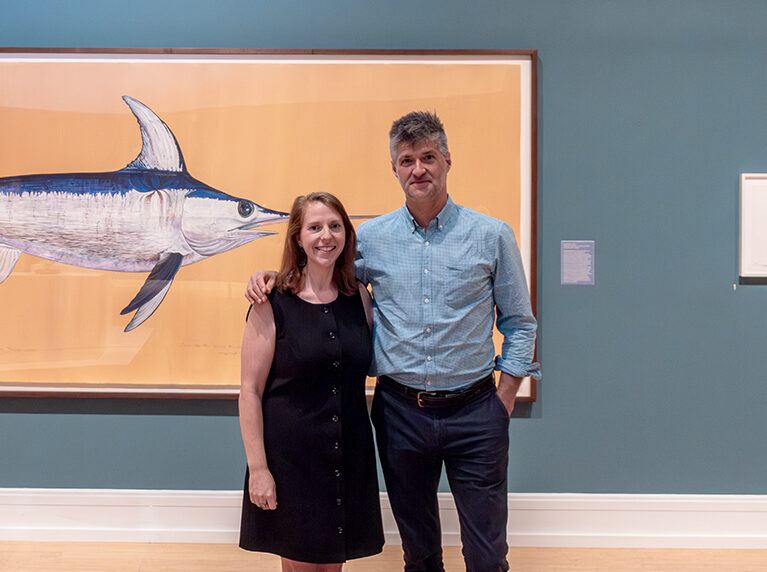
The new Vero Beach Museum of Art exhibition – James Prosek: At Work – offers an engrossing look at nature through his paintings, drawings and sculptures. It is on view through Oct. 25.
Over the past 30 years, the artist, author and avid naturalist has traveled the globe to document, through extensive field study and finely detailed depictions, the plants and animals that share our world.
“I just like beautiful things in nature, and somehow drawing things that I find beautiful is a way of getting closer to it. Through close observation, that love becomes deeper,” says Prosek.
“What really makes me want to keep going is I love researching new topics. I love learning about stuff. I love traveling and meeting people along the way.”
Prosek’s fascinating exhibit includes 70-plus artworks of fish, eels, birds, plants and even his own hybrid interpretations using a mix of mediums, such as watercolor, gouache, colored pencil, graphite, powdered mica and taxidermy.
Caitlin Swindell, VBMA senior curator, says the exhibition reflects just how prolific Prosek is.
“It’s organized into four sections, but part of what is so central to James’ practice is that sections, naming conventions, and ways that we categorize nature, are really just us doing that to what is kind of boundaryless,” she adds.
“Drawing is the most consistent thread that’s run through my life. I’ve been drawing for as long as I could pick up a pen or hold a pencil, and I’ve continued to draw,” says Prosek, who was raised and still lives in Easton, a rural Connecticut town.
He says that “obsessed with fishing” from age 9, his father suggested the library when he wanted to learn more about trout. However, finding no books on the subject, he decided to write and illustrate his own field guide. First, he needed a list of species.
Prosek wrote letters to numerous wildlife departments and discovered that no two biologists could agree on the numbers or types of species there were because they “had evolved in a very messy way.”
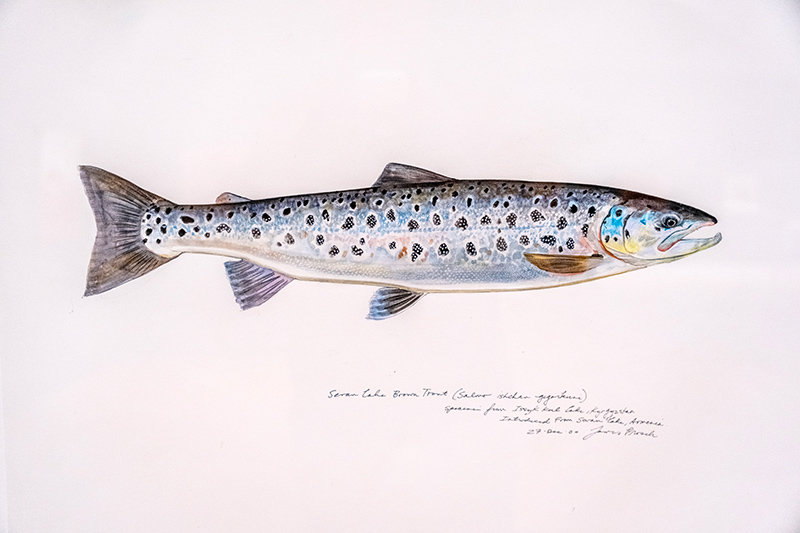
That project developed into “Trout: An Illustrated History,” published in 1996 by Knopf when he was a junior at Yale; the first of his 15 books. The show contains illustrations of 15 trout species from 11 countries, made from 2000 to 2016.
Just beyond the entrance hangs “Abstract Nature No. 8” 2018, a large Sumi ink on paper made by inking a dead freshwater eel to make repeated impressions.
“There’s eels in rivers here in Florida and Connecticut that were born in the middle of the Atlantic Ocean. It’s one of the most amazing migrations of any creature on the planet,” says Prosek.
As eels have never been observed spawning in the wild, he says it’s a wonderful mystery.
“I was trying to simulate movement in the water, the aggregation of eels. They must aggregate in tight balls out there when they spawn, because fish spawn externally and if they’re not close enough, you don’t get fertilization.”
To challenge the Linnean system of naming and classifying organisms, positing instead that nature is a continuum of change and interconnectivity, Prosek traveled the same route of Swedish biologist Carl Linnaeus.
Three 2016 works came from that trip. Swedish Lapland No. 2 and No. 3 depict a grayling and an Arctic char, a close relative our native trout. Swedish Lapland No. 1 is the Sami reindeer herder hut where he ate “really good” smoked Arctic char.
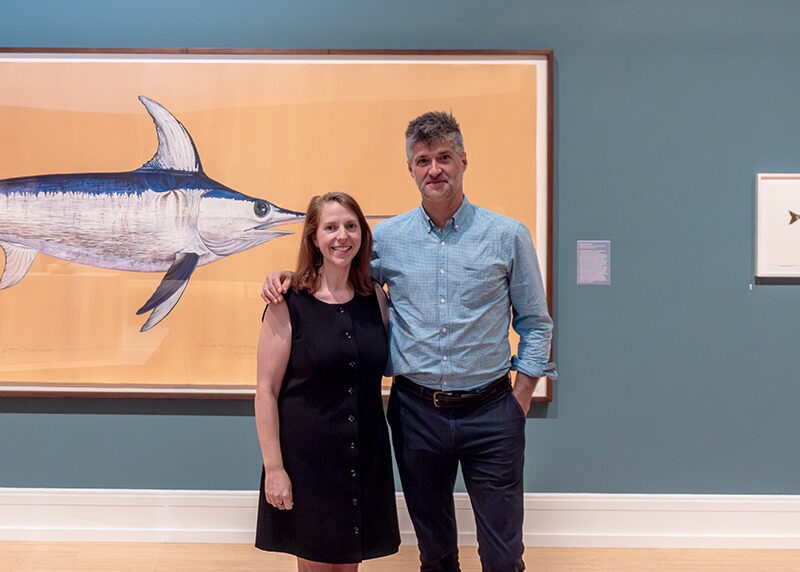
Traveling from Nova Scotia to the Cape Verde Islands, Prosek documented newly caught ocean fish to capture their colors and individual markings, such as the life-sized “Swordfish” 2010 and “Great White Shark with Oyster” 2015.
“Their experiences are written on their bodies. And then, because a lot of these fish are reflective, I would see my reflection in the fish and I would paint that in. I didn’t want to extract myself because it’s not just the fish, but my experience with the fish,” says Prosek, pointing to his image within the swordfish eye.
“Bird Spectrum” 2019, is an intriguing photograph of an installation he completed for a Yale University Art Gallery show. It contained 222 bird specimens from the collection of the Yale Peabody Museum of Natural History arranged in a color spectrum as another challenge to neat categories.
“There’s no such thing as red or orange, or yellow or green. We name those segments of the continuum, but there’s no place where red ends and orange begins. It’s a spectrum. It’s a continuum, an interconnected, constantly changing thing,” says Prosek.
“The human mind creates order, what it perceives to be order, but a lot of the societal issues that we encounter, whether they’re racial or gender identity or whatever, is people not accepting that these lines don’t exist. We’re biologically similar but we’re all different,” he explains.
“Memory of Life” 2019 is a separate collage of the comprehensive specimen tags.
“The stories behind each of these birds, to me, are incredible,” says Prosek, sharing that Ian Flemming chose the name James Bond after seeing a book by an ornithologist of that name.
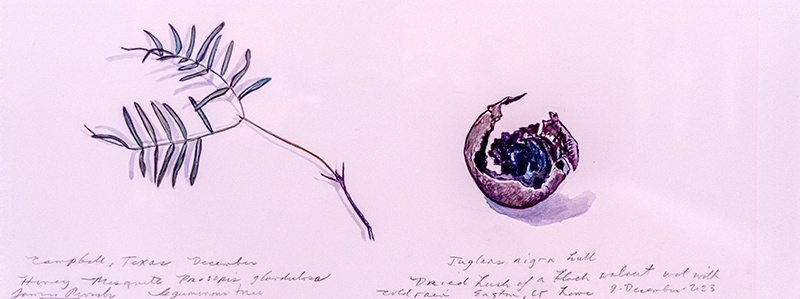
The Grasses and Prairies section, with its delicate drawings of wildflowers and grasses, speaks to the complex ecosystems of these endangered species, many of which are now completely gone.
“Some of these plants don’t really thrive unless the ground is burned every at least five or 10 years, but because there’s houses everywhere now, we can’t burn tens of thousands of acres like they used to.”
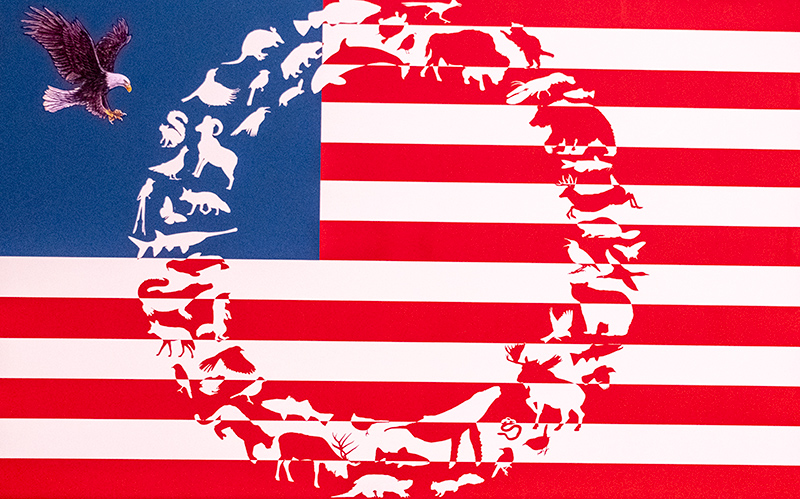
“Grasslands Composition No. 1” 2025, an acrylic on canvas, is a predominantly silhouetted depiction of the countless species that once inhabited those lands.
A selection of hybrid creatures presents literal riffs on names, such as the colorful “Parrotfishe” 2009, with the head of a parrot and tail of a fish, and “Turtledove” 2005, a passenger pigeon and box turtle combination.
Some are doubly represented, such as 2009’s “Drill Duck with Pitcher Plant Flowers” (painting) and “Drill Duck with Pitcher Plants” (taxidermy), a drill bit extending the bill of the Hooded Merganser in each.
“They’re creatures that have become their names in protest of people trying to make sense of them through language. They’re literal representations of the names we gave things,” Prosek explains.
For more information, visit VBMuseum.org.
Photos by Joshua Kodis