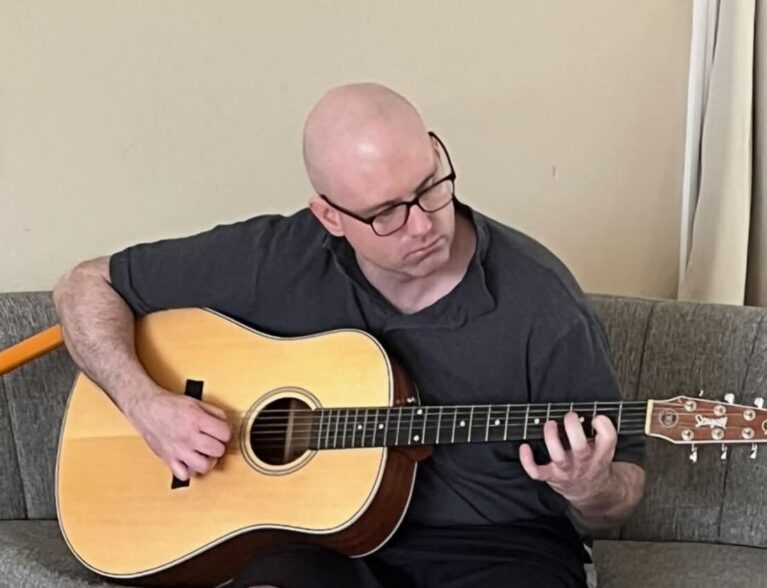
The mother of a Sebastian man shot and killed during an officer-involved confrontation last month recalled her son as a kind man who loved playing the guitar and spending time communing with nature.
Now, Minna W. Servis is preparing funeral arrangements for her 41-year-old son Keaton Daucher, a Washington State native who relatives said cherished family, his dogs, fishing and other outdoor activities.
“I can’t think of anyone who tried harder than Keaton to be well and have a good life,” said Servis, who added that her son suffered concussions while playing football back in high school.
“He suffered too many profound losses and disappointments. I believe he is now at peace in heaven with his dad, his grandpa and his dog Logan…and is happy.”
Daucher, carrying a shotgun, was killed in the Sept. 17 shooting in front of his home in the 500 block of Joy Haven Drive. Two police officers responded to a loud noise complaint at the residence.
The officers spoke to Servis while a man’s voice could be heard yelling from inside the home. Moments later, Daucher walked out from the residence with the shotgun, according to police. Then officers shot Daucher.
Servis, 74, who lived at the residence with Daucher, said she was standing inches from her son when he collapsed at the front door, fatally wounded by the officers. The mother said Daucher did not point the gun at the officers or fire any shots.
“There was no command to drop the gun. In addition to my witness statement, there are two police body cams to corroborate this fact,” Servis said. “Keaton would never hurt police officers because he has numerous family members who have been or currently are in law enforcement.”
Police have not confirmed if Daucher shot the gun or pointed it at the officers. The officers who fired their weapons – Sgt. Bryan Melius and Cpl. Devin Keskinen – remained on paid administrative leave Oct. 1, said Sebastian interim police Chief Tim Wood.
Neither officer was injured, police said.
Both officers’ body cameras were activated during the shooting, Wood said. It was unclear if the footage would be released.
The case was turned over to the Florida Department of Law Enforcement which typically provides independent investigations of officer-involved shootings statewide. Police declined to discuss further details pending the release of findings from the state investigation.
Who was Keaton Daucher?
Daucher grew up in Gig Harbor, Washington State, where he avidly trekked through the mountains and forests, according to his obituary. He enjoyed fishing, camping, hiking and mountain climbing, including scaling Mount Baker.
Daucher was co-captain of the varsity football team at Charles Wright Academy – a private, college preparatory school in Washington State – and also served as a graduation speaker. His classmates remembered him for his sense of humor and kindness to all, his obituary shows.
History and geo-politics sparked Daucher’s interests. He graduated with honors from the University of Washington, Seattle campus with a bachelor of arts in law, society and justice.
Daucher volunteered with Heroes for the Homeless through outreach efforts by bringing supplies and food to the chronically homeless in downtown Seattle, his obituary shows. He also volunteered in a center for refugee resettlement in Denver, where he helped refugees from Myanmar, Asia, prepare for job interviews and independent living.
Daucher had a deep knowledge of computer science, was committed to fitness, ate organic food, read the Bible and prayed every day, according to his obituary.
Daucher moved to Florida in 2015 to take care of his grandparents and became a resident in 2016, said Servis, who also moved to the state the following year.
Servis said her son believed he suffered from Chronic Traumatic Encephalopathy (CTE), a progressive, degenerative brain disease caused by repeated blows to the head over an extended period of time while playing football.
“Keaton increasingly struggled with his ability to think well and believed he had CTE,” Servis said. “I have donated his brain to the CTE Research & Brain Bank at Boston University’s School of Medicine and have directed donations to that research program.”
CTE can only be diagnosed through an autopsy with an examination of brain tissue.
The medical examiner in Fort Pierce conducted Daucher’s autopsy. His brain tissue was sent to Boston University’s CTE Center to determine if he had CTE, Servis said.
A date for Daucher’s funeral service has not yet been set.