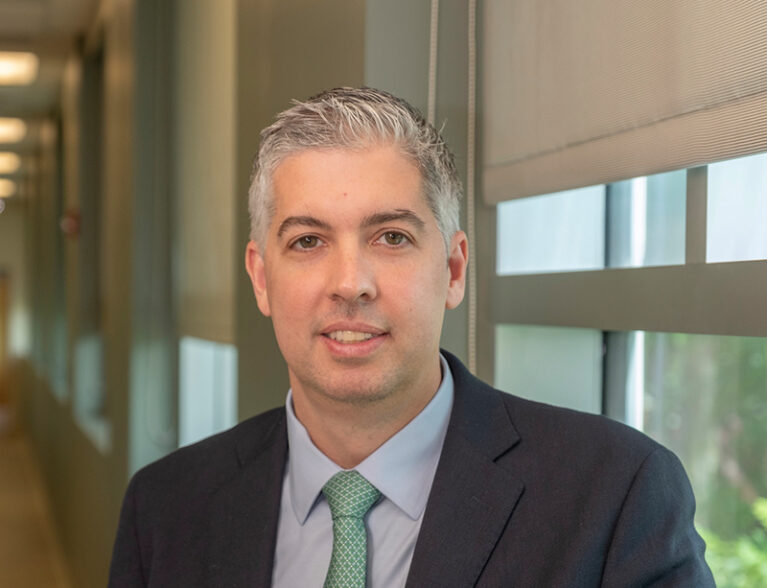
Cleveland Clinic Tradition Hospital neurosurgeon Mauricio Mandel, MD, Ph.D., began using a groundbreaking minimally invasive surgical procedure to treat brain aneurysms less than two years ago. Called transorbital surgery, it is performed regularly at the hospital these days.
In addition, Dr. Mandel says, there are also new tools evolving to aid in treating the 6.7 million people in the United States who have an unruptured brain aneurysm.
“Pre-op planning has definitely changed,” he says. “It’s exciting to have these new tools available to help us determine the best approach to use in treating a brain aneurysm. AI and 3-D exams have led the trend and we’re continually exploring 3-D printing as well.”
The nonprofit Brain Aneurysm Foundation, a globally recognized leader in brain aneurysm awareness, education, support, advocacy and research funding, reports that aneurysm growth is one of the critical signals that clinicians consider when assessing rupture risk and determining whether to monitor or intervene.
If AI tools can consistently detect growth that might otherwise be missed, patients may benefit from earlier identification of increased risk, more confident treatment decisions, improved monitoring over time, and earlier, life-saving intervention before rupture or stroke.
This is important because, as Dr. Mandel explains, “many people who are diagnosed with brain aneurysms can go years without treatment, although we monitor them to check for changes.”
The American Heart Association says that newer, non-invasive 3-D imaging devices are far superior to traditional 2-D technology.
“Early and accurate diagnosis is a key to successful treatment,” says Dr, Mandel. “It’s not unusual for people to be unaware they have a brain aneurysm. Most of the time, there are no symptoms, making it tricky if yours should get to the point where it needs treatment and you’re unaware of your condition.”
And 3-D printing, too, continues to evolve as an important tool for the future of brain aneurysm treatment.
One of earliest reported uses of the technology took place in April 2019, when clinicians at Cleveland Clinic’s Cerebrovascular Center performed one of the first reported brain aneurysm repairs guided by preoperative and intraoperative use of a 3-D-printed replica of the aneurysm.
“It’s exciting for us to have these new options emerging,” says Dr. Mandel. “Although many people have brain aneurysms, funding for new research is hard to get. It’s easier to get funding for endovascular research, in which the aneurysm is accessed via a catheter inserted into arteries in the arm or groin.”
Small metal coils are inserted into the aneurysm through the catheter. The coils remain in the aneurysm; they are not removed. They stop blood flowing into the aneurysm and therefore reduce the risk of a rupture.
Between 2 percent and 5 percent of the general population have an unruptured brain aneurysm, according to the Brain Aneurysm Foundation. Each year, approximately 30,000 Americans suffer a brain aneurysm rupture.
Half of them will not survive and, of those who do, nearly two-thirds are left with permanent neurological damage. Despite that, federal research funding amounts to less than $3 annually for every person impacted by the disease.
Dr. Mandel says it is crucial for people to be aware of the risk factors for brain aneurysms, which include family history, high blood pressure and smoking. “Clearly, the most important is smoking. There is 20 times greater risk not just in getting it, but in it rupturing if you smoke.
“If your family history includes relatives who have had brain aneurysms, you should be screened as young as age 30.”
Mauricio Mandel, M.D., Ph.D., earned his medical degree, did his neurosurgery residency, got a clinical Ph.D. focused on minimally invasive neurosurgery, and worked as an attending neurosurgeon in Brazil. In 2019, he moved to the United States, joined Stanford University as a clinical instructor and underwent further training in Epilepsy Surgery at Yale University. His office is located in Tradition HealthPark Two, 10080 SW Innovation Way, Port St. Lucie, where he treats patients from the entire Treasure Coast. Call 877-463-2010 for an appointment.