Stage 4 cancer is the disease’s most advanced stage. It means cancer has spread from where it started to distant parts of the body, a process called metastasis.
It remains a grim diagnosis, but the good news is that the outlook for surviving Stage 4 cancer has improved substantially in the past 10 years, and for some cancers the change has been dramatic.
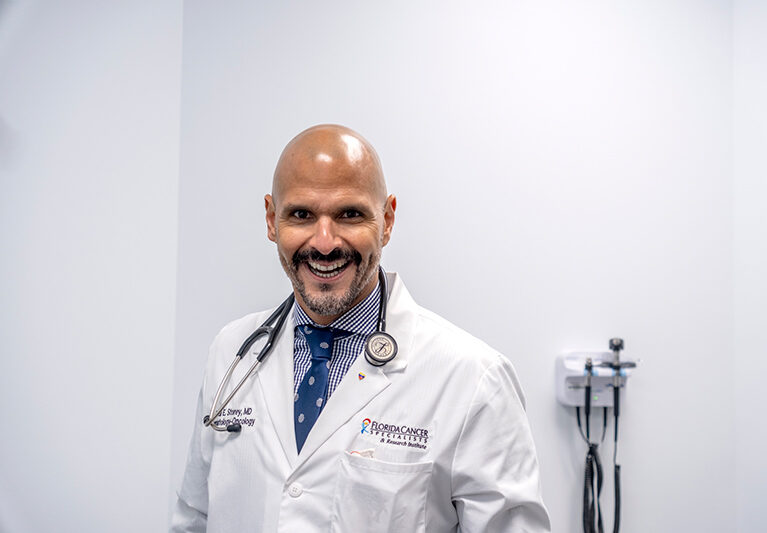
Dr. Raul Storey, an oncologist with Florida Cancer Specialists & Research Institute in Vero Beach and Sebastian, explains, “Stage 4 cancer, also called metastatic cancer, occurs when cancer cells spread from the original site where they started to other parts of the body.
“For example, breast cancer may spread to the bones, liver or lungs, while colon cancer may spread to the liver or other organs.”
He continues, “Historically, a diagnosis of Stage 4 cancer was viewed as terminal and associated with a limited life expectancy.
“While metastatic cancer remains a serious condition, the reality today is very different from what it was even 10 or 15 years ago. Many patients are now living significantly longer, and in some cases thriving, for years with Stage 4 disease.”
The American Cancer Society (ACS) says two things are primarily responsible for improved survival rates: advances in cancer treatment and earlier diagnosis.
“We’re living through one of the most exciting periods in the history of cancer treatment,” says Dr. Storey. “Several major breakthroughs have transformed the way we care for patients.”
He explains that they include:
- Immunotherapy. Helps the body’s own immune system recognize and attack cancer cells. It has dramatically improved the survival rate in diseases such as melanoma, lung cancer, and kidney cancer, among others.
- Precision medicine. We can now analyze genetic makeup of a tumor and identify specific mutations that drive cancer growth. When we find these targets, we can often prescribe highly effective medications designed specifically for those abnormalities.
- Targeted therapies. Unlike traditional chemotherapy, which attacks rapidly dividing cells, targeted therapies focus on specific molecular pathways within cancer cells. These treatments are often more precise and, in many cases, easier for patients to tolerate.
- Better chemotherapy and supportive care. Chemotherapy has also improved with more effective drugs, better anti-nausea medications, and better ways to manage side effects.
Patients today often maintain a much higher quality of life while receiving treatment.
Even improved cancer treatments cause side effects that vary from person to person. “But,” says Dr. Storey, “the encouraging news is that we have become much better at preventing, recognizing and managing these side effects. Many patients continue working, traveling, exercising, and enjoying their normal activities while undergoing treatment.”
Certain cancers have seen the most significant advances.
Antoni Ribas, M.D., Ph.D., professor at UCLA and Cancer Research Institute Scientific Advisory Council member, says that when we look at metastatic melanoma survival improving from 16 percent to 35 percent in just 25 years, we’re witnessing the direct impact of the new forms of immunotherapy.
Dr. Storey concurs, stating, “Several cancers have experienced remarkable progress over the past decade, including cancers of the lung, breast, kidneys and prostate, chronic leukemias and lymphomas and certain gastrointestinal cancers.”
One of the adjustments that Stage 4 cancer patients must make is living their lives without a definite timeline.
“There is no single answer to the question of how long someone will live because every cancer is different,” explains Dr. Storey.
“Some metastatic cancers remain difficult to treat, while others can be controlled for many years.
“Today, it’s not uncommon for patients with certain Stage 4 cancers to live five or 10 years, or even longer, after diagnosis. Some patients continue working, raising families, traveling and pursuing their goals while receiving treatment.
“Quality of life has become just as important as length of life. Modern oncology focuses not only on helping patients live longer but also on helping them live better.
“Many treatments are now given as pills, injections or short outpatient infusions, allowing patients to spend more time living their lives and less time in hospitals.”
CancerLifeLine, which optimizes the quality of life for all people living with cancer, says living with cancer can be filled with twists, turns and unexpected loops.
Beyond the physical challenges of treatment and managing symptoms, the emotional toll can be profound. From fear, anxiety and depression to moments of hope and resilience, navigating the emotional roller coaster of cancer requires strength, support and community.
Where and how can you, your family and your caregivers find that strength and support?
“Support comes in many forms, and there is no one-size-fits-all approach,” explains Dr. Storey.
“For some people, faith and spiritual communities provide strength and meaning. Others benefit greatly from support groups, counseling, psychotherapy, meditation, exercise programs, or simply connecting with others who understand what they are going through.
“The medical team plays a critical role as well. The best cancer care is multidisciplinary, involving oncologists, nurses, nurse practitioners, pharmacists, social workers, nutritionists, counselors, palliative care specialists and many others working together.
“Patients do best when they feel informed, supported, and empowered to participate in their own care.”
Dr. Storey believes that the most important question of all may be “how do people survive the emotional and psychological impact of living with uncertainty? How do they stay positive and plan for a future that is unknown?
“One of the greatest challenges of living with metastatic cancer is learning to coexist with uncertainty.
“Patients often wonder:
- How long will this treatment work?
- What will my next scan show?
- What will life look like next year?
“The truth is that none of us knows exactly what the future holds. Cancer simply makes that uncertainty more visible. The patients who do best emotionally are often those who learn to focus on what they can control today rather than what they cannot control tomorrow.
“That doesn’t mean ignoring reality. It means choosing to continue living fully, despite uncertainty.
“I encourage patients to keep making plans, celebrating milestones, traveling, spending time with loved ones, pursuing meaningful goals and creating memories.
“Hope is not pretending everything will be perfect. Hope is believing that life can still be meaningful, joyful, and worthwhile, even while we are facing challenges.
“The biggest misconception is that Stage 4 cancer automatically means the end of life is near. That’s no longer true for many patients.
“While metastatic cancer remains a serious diagnosis, advances in science are happening at an unprecedented pace. Every year we gain new treatments, new technologies, and new insights into how cancer behaves.
“Today, more patients than ever are living longer and living better with Stage 4 cancer. As oncologists, our mission is not simply to add years to life, it is to add life to those years. And increasingly, we are able to do both.”
Dr. Raul Storey-Rojas attended medical school at Universidad De Carabobo (UC) in Valencia, Venezuela, and completed his residency and fellowship at University of Louisville, James G. Brown Cancer Center. He is board-certified in medical oncology and internal medicine and is affiliated with American Society of Hematology and American Society of Clinical Oncology. During his residency and fellowship, he gained experience with the MD Anderson Cancer Center and Bone Marrow Transplantation and Cellular Therapy Department. He can be reached at Florida Cancer Specialists & Research Institute, 3730 7th Terrace, Vero Beach, 772-567-2332; or in Sebastian at 13060 U.S. 1, 772-589-0879.