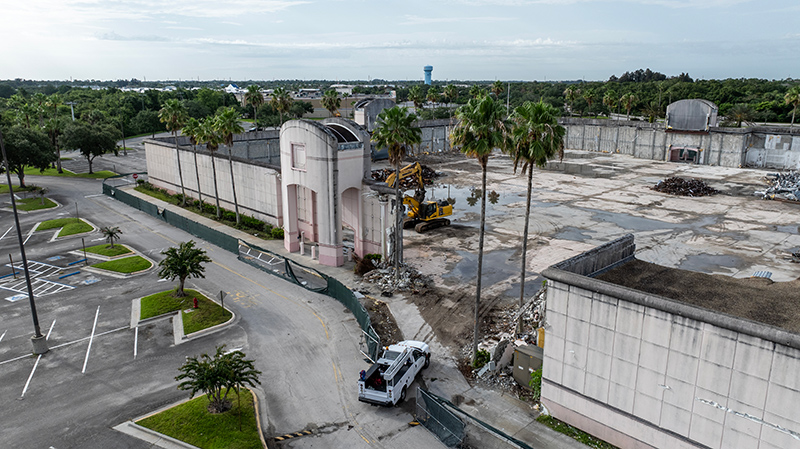
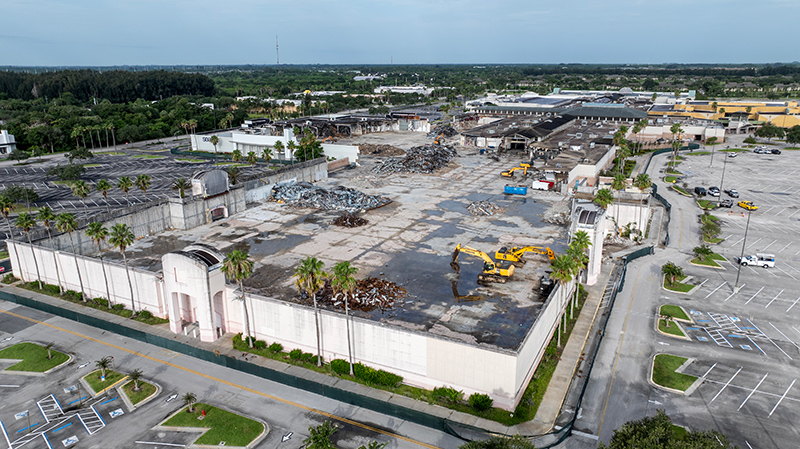
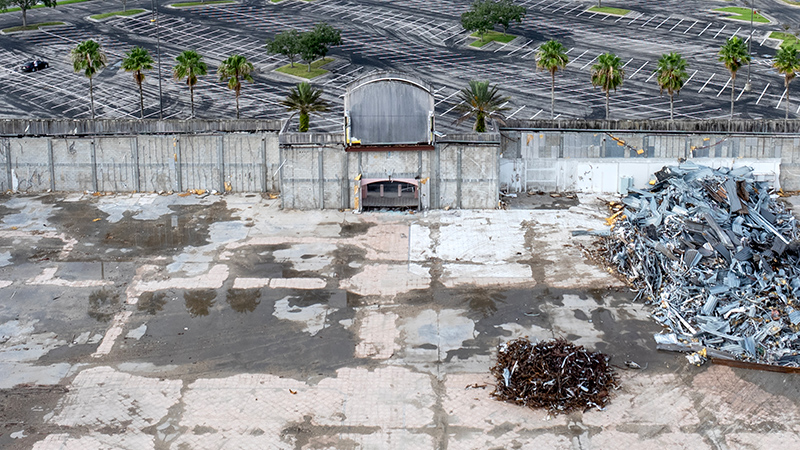
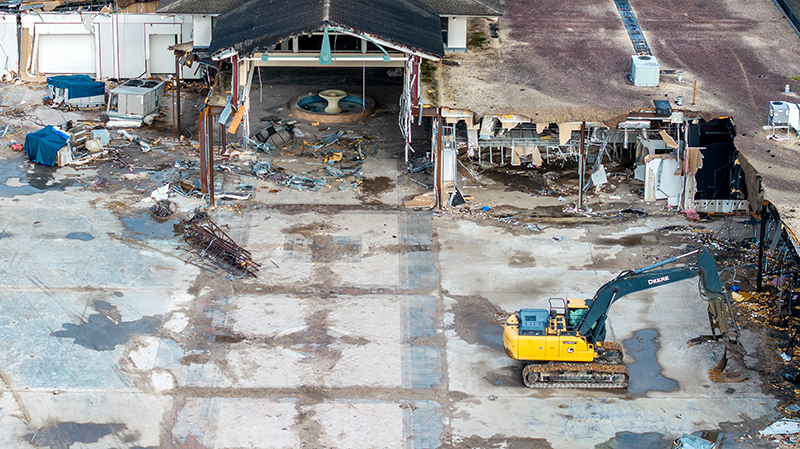
Demolition of the star-crossed Indian River Mall got underway last month and much of the eastern half of the property is roofless and gutted. As the walls come tumbling down, 30 years of memories of happier times are tumbling with them. Times when malls were the epitome of fun, one-stop retail shopping where you could buy a trendy new outfit, a pair of shoes to go with it, pick up a bestselling novel, and grab some lunch before catching a movie.
The mall was built in 1996, late in the golden age of American malls, by Edward J. DeBartolo Corporation. It had an impressive four anchor stores, including Dillards, JC Penny, Sears and Burdines, later rebranded as Macy’s. The 24-screen movie theater was added the following year, and the property enjoyed 15 years of relative prosperity, with a busy food court full of vendors and diners, teenagers hanging out on weekends and families crowding in to visit Santa and shop at Christmas.
Economic anemia set in during the early 2010s, however, as the mall fell victim to changing consumer preferences and the advent of online shopping. The fading retail mecca was foreclosed upon and sold at auction in 2015. Sears abandoned ship in 2019, and Macy’s and Victoria’s Secret departed in 2020.
Then came the pandemic, which delivered a death blow to many retail and dining establishments.
In recent years, the mall has mostly been a ghost town, with only a couple of vendors left in the food court and an ever increasing roster of empty storefronts.
Illinois-based developer DTS Properties bought the mall in May 2024 for $14.8 million with plans to transform it into a more timely and profitable destination. DTS had previously purchased the empty Macy’s and Sears buildings and property west of the mall complex for $4.75 million.
In June, American Demolition & Environmental Services of Fern Park, Fla., began tearing down the 104,000-square-foot Macy’s building and 120,000-square-foot Sears store. They have since gutted another 150,000 square feet, everything east of the once bustling main front entrance.
They are making way for the first phase of a new hybrid retail concept – a mixed use “lifestyle center” where people will shop, eat, live and play, and maybe even attend church or school.
“It’s taken two years to get to this point, but I think people are going to love what we have done,” said DTS project manager Joseph Scarfone. “I certainly didn’t invent this idea. Other developers are following the same idea, breathing life back into dying malls across the country.”
Instead of one long hallway lined with indoor shops and dotted with kiosks, the new concept will combine some features of a traditional mall with larger retail spaces that open directly to the outside, Scarfone said.
When the former Macy’s and Sears stores and the rest of the eastern wing of the mall are gone, DTS will erect a building with five retail spaces measuring from 18,000 square feet to 25,000 square feet each. Though each unit will have its own entrance, a covered walkway will provide shade as shoppers move between the stores. The parking lots will be redesigned to include trees and other landscaping features, according to construction plans.
Sprouts, an upscale grocery market, will lease one of those spaces. The other four spaces are spoken for, as well, but said it’s too soon to reveal their names, Scarfone said.
Phase 1 of the project also includes constructing a free-standing 4,500-square-foot drive-through restaurant east of the five retail storefronts. No one has stepped up yet to lease that space, Scarfone said.
“So it will still have the mall atmosphere [in the surviving west wing] for those who are nostalgic for that, along with some exciting new shopping opportunities,” Scarfone said. “I think after the pandemic people decided they wanted to get off their phones and get outside more. This is a response to that.”
Oceans Unite Christian Centre, which had occupied a dozen or so retail shops in the east wing, is temporarily meeting at Vero Beach High School Performing Arts Center until its new worship center is completed on 29 acres it owns on 66th Avenue.
Any remaining east wing tenants have either ceased operating or moved into the west wing. The Dillard’s and JCPenney anchor stores, which are not owned by DTS, will remain open, as will AMC Classic Indian River 24 movie theatres and Casa Amigos Mexican Kitchen.
The Garden Grove food court is now empty and walled off. The arcade has moved out and a new tenant that features “family entertainment” will occupy the food court area, according to Scarfone.
The former main entrance on the south side of the property that faces Route 60 will remain closed throughout the project. Shoppers must use the two mall entrances on the north side – one is between Dillard’s and the theaters, and the other is between the theaters and Casa Amigos.
Shoppers can also still enter the west wing through JCPenney and Dillard’s.
However, several of the few remaining vendors in the west wing say the sights and sounds of demolition have slowed foot traffic dramatically, possibly because many people believe the entire mall is closed.
Ronnie Raza has owned and operated the Jewelry Palace kiosk since 2019. His monthly sales averaged $10,000 last year but dropped to around $2,000 a month this year after plans for redevelopment became known. That doesn’t even cover the rent or pay for the gas to travel back and forth from his home in Port St. Lucie, he said.
Raza’s lease expires at the end of July, but mall management won’t let him leave early, he said.
Other shop owners, who declined to speak on the record for fear of reprisal, said management has canceled its security contract and reduced its cleaning staff, leaving common areas messy. A GoLine bus stops at an entrance to the west wing and riders, some of them unkept, often sleep outside and loiter inside to stay cool, which is off-putting to shoppers, two proprietors said.
Scarfone said management is not taking applications for any new leases until the noise and dust of demolition is over. He said business will pick up for everyone when the first phase of construction is complete and new stores open. He estimates that will be in late 2027 or early 2028.
“Everyone has different ideas about what they’d like to see happen with the property,” he said. Earlier concepts included open-air shops, specialty restaurants, a 130-room hotel, a 9,775-square-foot school, and five residential buildings with 56 units in each building.
Although it’s unlikely that DTS will pursue the hotel idea, there is always demand for affordable housing, Scarfone said. Florida’s Live Local Act, enacted in 2023, provides funding, tax exemptions and relaxed local zoning restrictions – including increased density and allowing residences in commercial zones – for developers who construct affordable dwellings.
“There are a number of programs we can tap,” Scarfone said. “We’re happy to look at all of them.”
Photos by Joshua Kodis