Florida Department of Transportation contractors have been doing prep work for construction of the new Sebastian Inlet bridge for more than a month now, but many island residents are still wondering why the project is projected to take six years.
Though FDOT hopes to get the job done sooner than that, the official timeline extends into 2032. By comparison, the new bridge FDOT is finishing up at the other end of the barrier island in Fort Pierce opened to traffic three years after construction began.
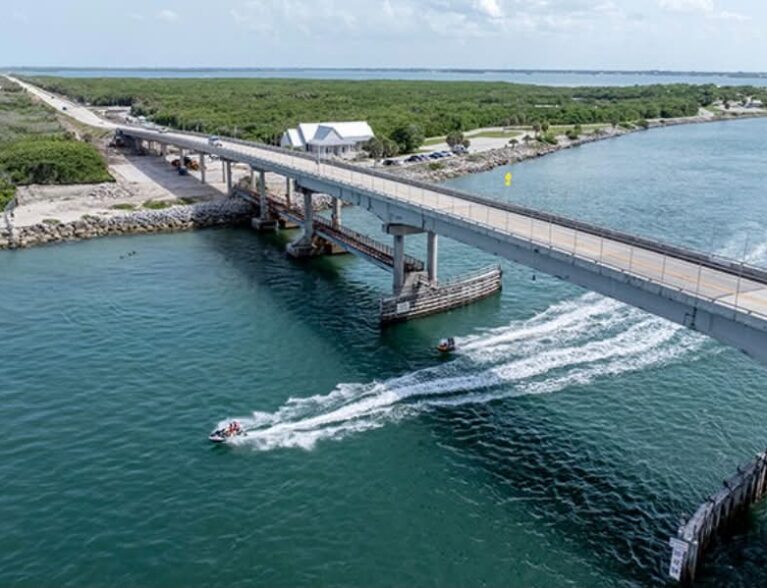
And that bridge is nearly three times as long – 4,150 feet compared to 1544 feet, crossing the Indian River Lagoon where it is almost half a mile wide. By contrast, the Sebastian Inlet is only about 525 feet wide where the new bridge will cross.
So why is northern bridge projected to take almost twice as long and cost almost as much?
Turns out the difference has to do with the width of the FDOT right of way – the swath of land where the agency has a legal right to build.
In Fort Pierce, the right of way was wide enough that the existing drawbridge could remain in place, carrying traffic east and west across the lagoon, while the new bridge was built beside it.
At the Sebastian Inlet, the right of way is much narrower. So narrow that the new bridge must occupy some of the same space the existing bridge occupies now.
Because of that, the new bridge will have to be built in two phases, which will make the job more challenging, expensive and time consuming, according to Senior Project Engineer Bill Stuckey.
“It makes it harder, there is no doubt, but it is totally doable,” he says.
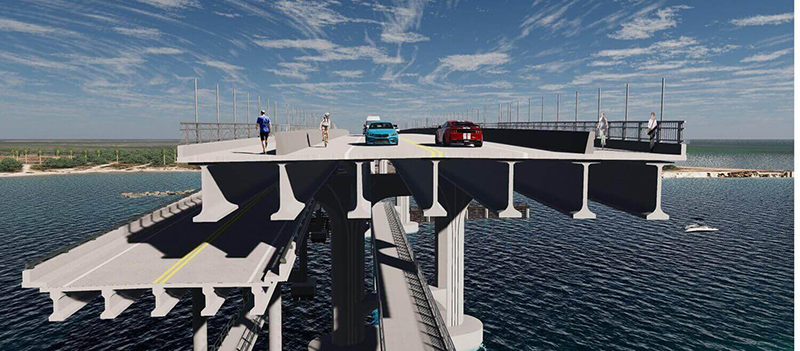
In the first phase, most of the foundation work will be done and a 34-foot-wide slice of the new bridge will be built all the way across the inlet while the existing span continues to carry the 4,000 or so vehicles that cross the inlet daily, heading south toward Vero Beach or north toward Indialantic and Cocoa Beach. Construction will begin on the south side of the Inlet east of the existing bridge.
Once that section is complete, traffic will be rerouted onto the fresh concrete, and the old concrete and steel bridge, which was built in 1964, will be carefully dismantled and hauled away, with much of the rubble going to expand offshore reefs.
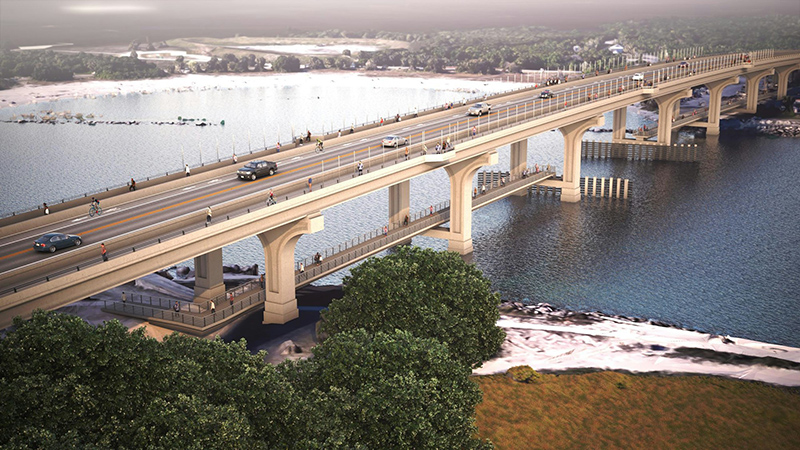
When the old bridge is gone, the second slice of the new bridge will be built in the space the old bridge occupied for more than 60 years. It will be built tight against the first slice, forming a unified 68-foot-wide structure when complete.
“The bridge deck will be monolithic, because rebar extending from the side of the first section will be tied to rebar in the second pour,” says Ian Biava, an engineer with project design consultant GFE, an architecture, engineering and construction firm that prides itself on possessing “ingenuity that shapes transportation.”
“You will see a single bridge structure when we are finished,” says Biava.
He says building the bridge in two sections instead of all at once added about 20 percent to the cost of the project, bumping the estimated budget up to $102 million. The much longer Fort Pierce bridge has an estimated final cost of $117 million. Both numbers include related roadwork, signage and other project elements as well as the cost of the bridges.
Biava says FDOT could have used its power of eminent domain to acquire additional right of way to simplify the construction process if it wanted to. But the agency and its consultants determined early in the six-year planning process that it could get the job done within the existing right-of-way without taking property from the state park that borders both sides of A1A near the bridge.
“The right of way we have is sufficient for the project we are building here,” Biava says. “We are building in Sebastian Inlet State Park, an environmentally sensitive area, and we don’t want to expand our footprint more than we need to. FDOT wants every design to be as environmentally friendly as possible.”
“It takes longer to build this way, but there is a benefit in not impacting this pristine environment,” says Stuckey. “About a million people visit the inlet each year and the quality of this natural area is very important to them – and to us.”
The existing bridge was deemed structurally deficient in 2018 and planning for the new bridge began in 2019.
One of the first decisions the FDOT team made was that traffic flow had to be maintained throughout the project. There will be years of lane closures, with flagmen and orange barrels, and possibly some brief complete closures, but this was not a crossing that could be shut down for the duration.
Biava says if you were south of the inlet and wanted to go to the north side, it would require a 53-mile detour to do so if the bridge was out. Someone north of the inlet who wanted to go to Vero Beach would be in a similar situation. They would have to drive 20 miles north to the bridge between Indialantic and Melbourne, east to U.S. 1, and then all the way back south.
“The detour could take up to an hour and half, depending on traffic conditions, and that is not acceptable,” Biava says. “We didn’t want to do that.”
The two-part building process complicates demolition as well as construction.
Concrete is fragile when first poured, gaining strength day by day as it cures. Curing is a chemical reaction between cement – the glue in concrete – and water. It binds the sand and rock that make up the bulk of wet concrete together into the hard, durable, rock-like substance that makes up much of the modern world.
FDOT Project Manager Binod Basnet, PE, says the contractor will wait about a month to let the newly poured concrete gain what is called “28-day strength” before rerouting traffic off the old bridge onto the new structure.
Even then, workers will have to be extremely careful during demolition, limiting vibrations caused by heavy equipment that could damage the new bridge before the concrete gains its ultimate strength, and taking great care not to bang into the recently poured columns or deck with hydraulic-powered steel or chunks of rubble.
Some of the demolition cranes and concrete cutters will be mounted in barges, and some of the rubble will be loaded into other barges, which will be challenging to control in the inlet’s swift current, according to Stuckey.
“That is a huge consideration,” he says. “Being so close to the new structure, they’ll have to be very careful. This is a dangerous inlet with strong currents,” when powerful tides are flooding in or out of the lagoon through the narrow channel.
FDOT will require a highly detailed demolition plan from the contractor, which will be reviewed by all the engineers involved to be sure that the demolition process is as efficient and safe as possible – for workers, the new bridge and the park environment.
Webber, the general contractor on the job, should be up to the challenge. Founded in 1963 – one year before the existing bridge was built – Webber is a major road and bridge-building company with 4,000 employees currently working on more than 60 heavy infrastructure projects.
Now a subsidiary of Ferrovial, an international company based in Madrid, Spain, “Webber has access to a global network of skilled engineers, best-in-class technology and vast resources,” according to its website.
The new bridge will be much more bicycle and pedestrian friendly than the old one.
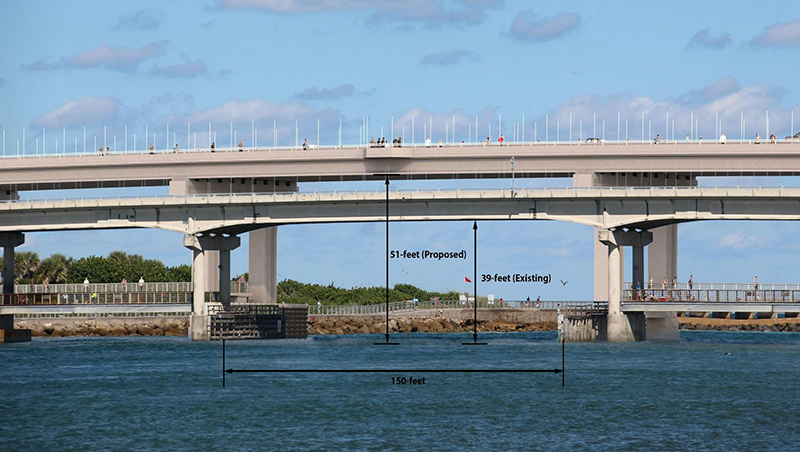
When it is completed in 2032, it will be about 4 feet shorter, 12 feet higher and twice as wide as the 1964 span, 68 feet compared to 34 feet. Clearance under the apex of the existing bridge is 39 feet. Clearance will increase to 51 feet with the new bridge, allowing higher masts to pass beneath.
The bridge deck will still have just one northbound lane and one southbound lane, but each of those lanes will have 8-foot-wide shoulders. Outside of the shoulders will be a 12-foot-wide shared-use path, on both sides, for pedestrian and bicycle traffic. Three-foot-high concrete barriers will separate the shoulders from the shared-use paths.
Four-foot-high aluminum railings will be installed at the outer edges of the bridge, with three semi-circle lookout areas extending from each side, where people can stop to enjoy views of the inlet and Atlantic Ocean out of the path of pedestrian and bicycle traffic.
“I think the bridge design is magnificent, a real work of art with the viewing areas,” said Indian River County Commissioner Laura Moss, whose district includes most of the barrier island.
There will be two observation decks/fishing piers underneath the bridge, one extending from the south shore, one from the north shore. They will be 5 feet higher than the existing observation decks to protect them from salt and wave action.
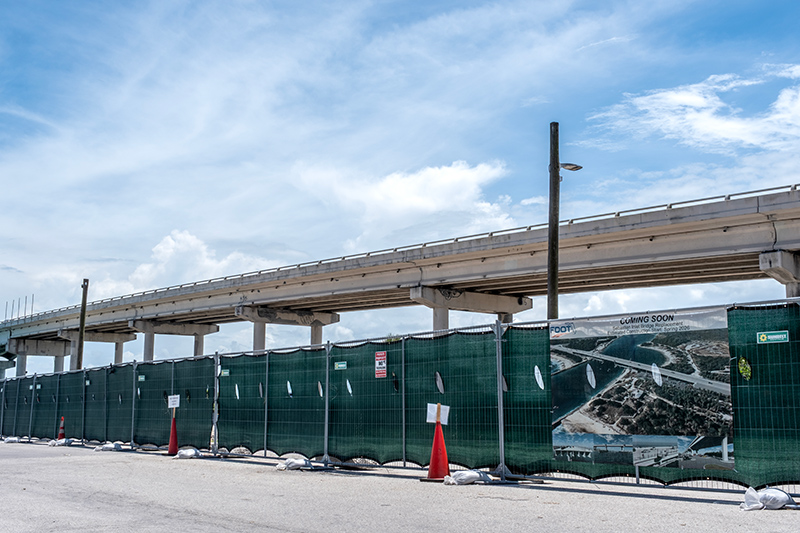
Sebastian Inlet State Park will remain open on both sides of the inlet throughout construction, but some parking lots and other features will be closed for construction staging. That includes the main parking lot on the north side of the inlet, which will be fenced off until the project is completed.
Marine traffic through the inlet will be maintained during construction, aside from occasional temporary restrictions for safety reasons, according to James Gray, executive director of the Sebastian Inlet District.
Completion of the existing bridge was a huge event, linking two counties and transforming the Sebastian Inlet from a remote location visited by small numbers of surfers and fishermen to a major Florida tourist spot.
More than 8,000 people – equivalent to 25 percent of Indian River County’s population at the time – turned out for the ribbon cutting in February 1965. Navy Jets made low, roaring passes overhead while state and local politicians made speeches and shook hands before the red, white and blue banner was snipped by State Representative James H. Pruitt, who was “instrumental in shepherding the bridge into reality,” according to the Sebastian Inlet District.
But James Pruitt is long gone, along with most of the adults who attended that gala event, and the graceful, steeply arched bridge they celebrated has reached the end of its lifespan, too.
“It is in very poor condition and is very expensive to maintain,” says Stuckey. “It has to be replaced.”
-

- PHOTO BY JOSHUA KODIS

-

- PHOTO BY JOSHUA KODIS
-

- PHOTO BY JOSHUA KODIS

-

- PHOTO BY JOSHUA KODIS

-

- PHOTO BY JOSHUA KODIS

-

- RENDERING PROVIDED
-
- RENDERING PROVIDED
-
- RENDERING PROVIDED

-

- RENDERING PROVIDED