It’s hard enough when a woman hears the words “breast cancer,” but when it’s followed by the word “mastectomy,” the mind often races to one overwhelming reality: loss. Loss of health. Loss of certainty. Loss of identity. But another word soon enters the conversation – “reconstruction.”
And in that step toward healing, one small device often plays a surprisingly large role – the breast tissue expander.
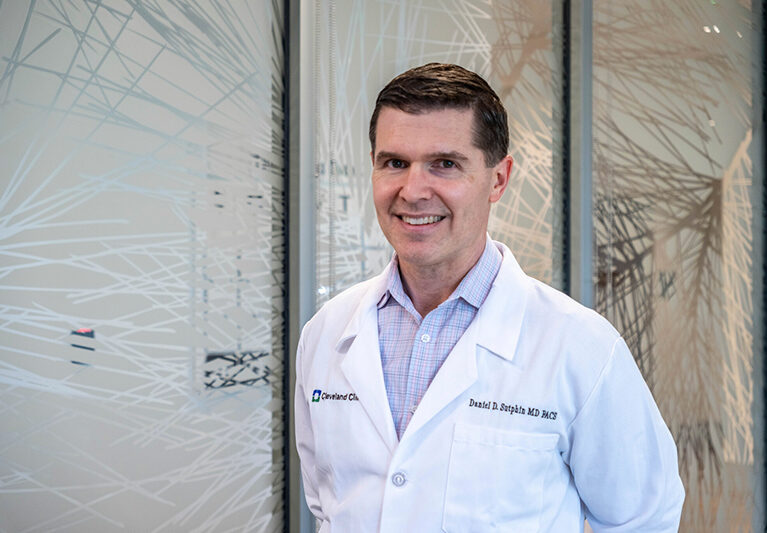
“After a mastectomy, breast tissue expanders are commonly used as a temporary step in breast reconstruction,” said Dr. Daniel Sutphin, a plastic surgeon at Cleveland Clinic Indian River Hospital. “They help create space for a future implant by gradually stretching the skin and soft tissue of the chest into a greater size and capacity that what naturally exists.”
A tissue expander is typically placed beneath the chest muscle or under the skin at the time of mastectomy, though in some cases it may be inserted later. It is not a permanent implant.
Instead, it acts as a temporary placeholder, preparing the area for permanent reconstruction.
Several weeks after surgery, patients return for office visits where the expander is gradually filled with saline through a small internal port. Each fill gently increases volume, allowing the body to adapt over time.
“The expander shell is made of silicone, but it must be accessed in a way that does not cause leakage,” Dr. Sutphin said. “That is why it contains a fill port. Historically, these ports contained metal, and surgeons often used an external magnet to locate them.”
That design brought a significant limitation, limiting MRI scans. Traditional expanders with metallic ports are generally considered unsafe for MRI because of concerns about movement, heating or displacement. Newer metal-free expanders allow many patients to safely undergo MRI imaging during the expansion process.
Breast reconstruction can be performed immediately after mastectomy or delayed until later.
Timing often depends on whether a patient needs chemotherapy, radiation or additional treatment. Radiation in particular can affect skin elasticity and healing, making reconstruction more complex.
“In some cases, the woman is not certain she wishes to proceed with reconstruction, so the process is delayed,” he said. “There is really no disadvantage to waiting.”
For many women, the concept of expansion sounds more intimidating than the reality.
Appointments are usually brief, and while some patients experience pressure or tightness afterward, severe pain is uncommon. Still, the experience can vary depending on anatomy, surgical technique and individual sensitivity.
“The expander can be positioned in front of the pectoralis muscle or behind it,” Dr. Sutphin said. “Both locations have advantages and disadvantages.”
Placing the expander in front of the muscle often means less postoperative pain because the muscle is left undisturbed. The tradeoff is that support comes primarily from the overlying skin and soft tissue, which may stretch over time. Positioning the expander behind the muscle provides greater coverage and support, but it can be more uncomfortable.
“We are really beholden to the patient’s anatomy and how thick that skin envelope is,” he added.
Most patients see their surgeon within the first week after surgery. Surgical drains are often used temporarily to remove fluid that can collect around the expander. Expansion usually begins within the first two weeks.
The expander stage may last several weeks or several months, depending on the desired size, healing progress, and whether other cancer treatment is needed.
“Once the patient reaches her desired fill volume, we give her a couple of weeks to let the body rest,” he said. “Then she returns to the operating room to remove the expander and replace it with a definitive implant, which is much softer and more comfortable.”
Despite their usefulness, tissue expanders are not without drawbacks. They can feel more firm and less natural than permanent implants. Sleeping positions may need adjustment. Tightness across the chest is common. Many women describe the process as living in an in-between stage, no longer where they were, but not yet where they hope to be.
Complications can occur, including infection, fluid buildup, delayed healing, or, rarely, expander loss requiring removal. Smoking, diabetes, obesity and prior radiation can all increase the risk of complications. Another common long-term issue is capsular contracture, in which scar tissue forms around an implant and tightens over time.
“At times it can stiffen to the point that it creates a deformed shape,” Dr. Sutphin said.
“Sometimes we remove the scar tissue and exchange or reposition the implant. Studies show that after 10 years, 50 percent or more of women may develop a contraction and will need some form of revision in the future.”
For women recovering from cancer surgery, reconstruction is rarely just cosmetic. It can represent closure, normalcy, and the reclaiming of control after months of frightening medical decisions.
“The psychosocial perspective can be a real burden for the woman, especially if she is used to an attractive breast appearance,” Dr. Sutphin said. “I encourage patients not to lose sight of the proverbial forest for the trees. Her overall health, wellness and survival benefit are imperative above the presence of the breast for a brief season.
“I’m thrilled that we now have these newer expanders that safely allow patients to receive MRI imaging when needed. Having advanced technology and a team of physicians working together under one roof helps us provide the best care possible and make her journey back to normalcy as comfortable as possible.”
Daniel Sutphin, MD, is board certified by the American Board of Plastic Surgery and has extensive postgraduate training, including a fellowship at the University of California, San Francisco, where he served as a Microsurgical Fellow and Clinical Instructor in the Division of Plastic & Reconstructive Surgery. Dr. Sutphin’s specialties include oncoplastic and implant-based breast reconstruction, management of breast implant complications such as capsular contracture and rupture, body contouring after massive weight loss, and the management of soft tissue and skin malignancies, including melanoma, Merkel cell and squamous cell carcinomas. He sees patients at the Scully-Welsh Cancer Center on the campus of Cleveland Clinic Indian River Hospital, 3555 10th Court, Vero Beach. Call 866-223-8100 to make an appointment.