Last year, AAAIP (Association of Animal-Assisted Intervention Professionals) reported that therapy and facility dogs are becoming more and more common in medical settings like hospitals, nursing homes and oncology centers.
That is the case with two local hospitals. Although Orlando Health has had a corporate pet therapy program in place for several years, the service is relatively new at Orlando Health Sebastian River and Melbourne Hospitals.
Patients, families and staff all enjoy trained dogs’ friendly, calming presence. Whether it’s easing stress, distracting from pain, or reminding patients of pets at home, therapy and facility animals bring comfort to many.
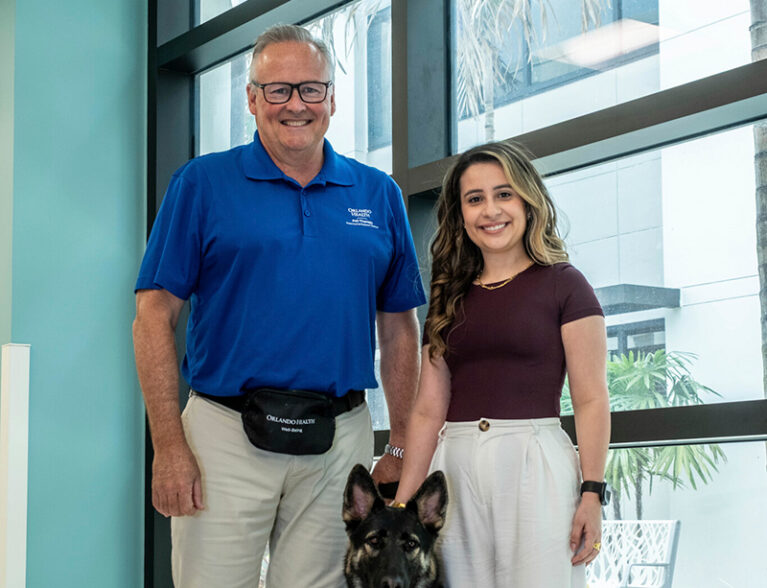
Alejandra Velasquez Perez, B.S., M.S., is coordinator of Pet Therapy at the Sebastian and Melbourne hospitals. She says the hospitals are eager to attract as many volunteer handlers as possible.
“The more handlers we have, the more patients and staff we can interact with. Dogs work two-hour shifts and we want to reach as many people as possible.”
Garrett Lamp, EMS (emergency medical services) liaison for Pet Therapy at both hospitals, explains that therapy dogs are owned by the people who bring them to the hospital. “A lot of time and training goes into getting the dogs ready for certification.
“My dog, Chloe, is certified by Alliance of Therapy Dogs.” Lamp continues. “She shadowed visits in healthcare-based environments, getting used to wheelchairs and beds [as part of her training]. When she has her kerchief and name tag on, she knows she’s going to work.”
Dogs don’t just benefit patients and their families, who love to see a wagging tail coming down the hospital hall. The animals also help doctors and nurses who often experience high levels of stress driven by their experiences at work.
They and other healthcare colleagues face high rates of depression, anxiety, suicidal ideation and burnout. Nearly half of health workers reported often feeling burned out in 2022, according to the Centers for Disease Control and Prevention.
“No matter how many amazing things a doctor or nurse does, sometimes bad things happen. That’s why it’s imperative that staff – especially ER personnel – get to interact with therapy dogs,” says Lamp.
“I can’t tell you how many times I hear, ‘Chloe made my whole day better.’”
Velasquez Perez says there’s flexibility in the dogs’ visits. “Sometimes a family requests a dog visit their loved one when they learn about the program, but a lot of times they just become acquainted when the dog is making its regular rounds.
“When they arrive, Garrett and the other handlers usually head right to the nurse’s station so they can be made aware of any special requests or concerns – like allergies that might present a problem.
“It doesn’t matter the age of the patient,” she adds. “Young child or elderly – everyone loves to spend time with Chloe or any of our other pet therapy dogs.”
UCLA Health says there’s abundant evidence, both scientific and anecdotal, that interacting with a dog or other therapy animal can be beneficial to hospital patients.
Studies have found that when someone makes physical contact with a therapy animal, whether patting, stroking or hugging, it prompts their body to release beneficial hormones and chemical messengers. These include serotonin, oxytocin and prolactin, all of which play a role in feeling calm, relaxed and happy.
Chloe was headed to a shelter when Lamp found her and fostered her. Now he says it’s great to be in at the start of this special program in Orlando Health’s East Region.
Nursing Made Incredibly Easy Journal says that pet therapy can be used in a variety of settings from pediatrics to geriatrics. Therapy animals visit patients in hospitals, long-term care settings, hospice centers and schools.
Says Lamp, “We can do so much good with something so uncomplicated.”
Alejandra Velasquez Perez, B.S., M.S., is coordinator of Pet Therapy at Orlando Health Melbourne Hospital and Orlando Health Sebastian River Hospital. She has a B.S. in biomedical sciences from University of Central Florida and an M.S. in biotechnology and bioinformatics from Harvard University. Garrett Lamp, an advanced paramedic with a specialty in emergency medicine, is EMS Liaison for Pet Therapy at Orlando Health Melbourne Hospital and Orlando Health Sebastian River Hospital. For information, contact [email protected].