For anyone living with the relentless pain of hip arthritis, simply walking across the room, climbing a flight of stairs or getting a good night’s sleep can be a struggle. Fortunately, advances in joint replacement surgery have made hip replacement one of the most successful procedures in modern medicine, restoring mobility and relieving pain for hundreds of thousands of Americans every year.
More than 540,000 hip replacement surgeries are performed annually in the United States, and that number is expected to climb steadily as the population ages and people remain active later in life. While most patients focus on choosing the right implant, another important decision is how the surgeon reaches the damaged joint. Hip replacement can be performed through several surgical approaches, but the two most common are the anterior approach from the front of the hip and the posterior approach from the back.
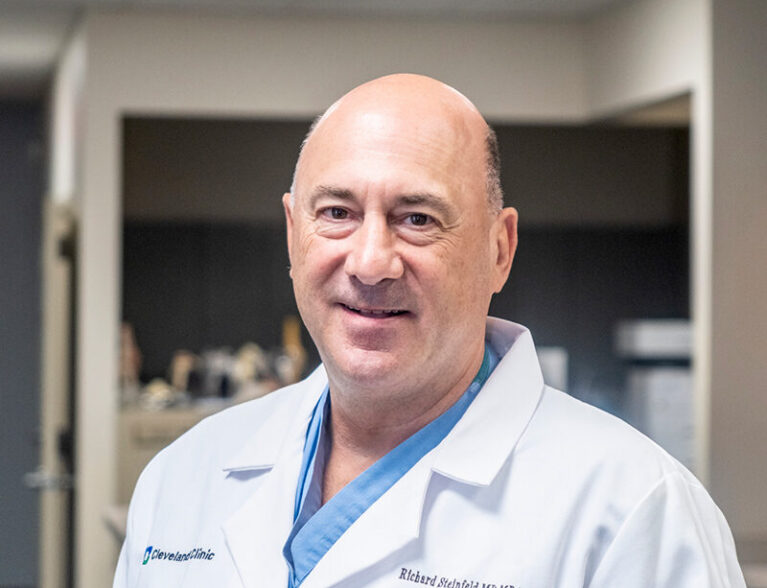
“There’s actually four or five different approaches that a surgeon can use for a hip replacement,” said Dr. Richard Steinfeld, orthopedic surgeon with Cleveland Clinic Indian River Hospital. “The difference is really how you get from the skin down to the hip joint. The anterior approach has become much more popular over the last decade because studies, including research from Mayo Clinic, have shown patients often get up quicker, may have less pain, rely less on walkers or canes and regain a normal walking pattern sooner than with the posterior approach.”
The American Association of Hip and Knee Surgeons, which has been tracking surgeons’ preferred approaches for years, reports a remarkable shift in surgical practice. Among members of the American Association of Hip and Knee Surgeons, use of the anterior approach increased from 12 percent in 2009 to 56 percent in 2022, making it the most commonly used approach for the first time.
An analysis by SmartTRAK predicts that 77 percent of U.S. surgeons could be using the anterior approach for appropriate primary hip replacements by 2030 if the current trajectory continues.
Despite the different routes to the joint, the replacement itself is essentially the same. During surgery, the damaged ball of the hip joint and worn cartilage are removed and replaced with a prosthetic joint consisting of a titanium stem inserted into the femur and a metal or ceramic ball that fits into a new socket. The goal is identical regardless of the approach – relieve pain, restore function and provide a durable joint that can last for decades.
For many years, the posterior approach was considered the standard technique. The surgeon makes an incision behind the hip to access the joint. While a few small muscles and tendons must be released to reach the joint, most of the surrounding muscles are preserved and repaired before the operation is completed.
With the anterior approach, the incision is made in front of the hip near the groin. Rather than releasing muscles, the surgeon works through a natural interval between muscle groups, allowing many of the major muscles surrounding the hip to remain undisturbed.
“We don’t really cut through muscles during either surgery,” Dr. Steinfeld explained. “Muscles are very delicate tissue. Trying to repair them would be like trying to sew the ends of a paintbrush back together. With the anterior approach, we’re able to slip between the muscles to reach the joint with less disruption. The posterior approach requires a little more splitting of tissue.”
The location of the incision differs as well.
“For the posterior approach, the incision is curved over the upper part of the buttock, and its length depends on the size of the patient,” he said. “With the anterior approach, the incision is generally about five inches long and located toward the front of the thigh. In some patients we can even make it a horizontal ‘bikini incision’ that can be hidden beneath a swimsuit.”
Dr. Steinfeld also believes the anterior approach offers certain advantages in the operating room.
“When the patient is lying flat on their back, it’s much easier to use X-ray imaging during surgery,” he said. “That helps us accurately position the implants and check leg length before we finish the procedure. Those things can be more challenging when the patient is lying on their side.”
Quicker recovery is another plus for the anterior technique.
“Patients generally seem to get up faster, move more comfortably and report less pain after the anterior approach,” Dr. Steinfeld said. “Today, most hip replacements are outpatient procedures, and most patients are walking and going home the very same day.
“It generally takes about six weeks from surgery until patients have completed therapy and are functioning independently,” Dr. Steinfeld said. “Golfers can usually begin with short-game practice around three or four weeks and work back up to a full round by about six weeks.
Swimming is often possible after about two weeks, as long as the incision has healed.”
One misconception Dr. Steinfeld is eager to correct is that one approach automatically produces a better long-term result.
“You should have an excellent outcome from a well-performed hip replacement whether it’s done from the front or the back,” he said. “It’s not the approach, it’s the surgeon. There’s a significant learning curve with both techniques. A surgeon probably needs around 75 cases to become proficient. Choose your surgeon carefully and have an open discussion about which approach is best for you.”
Research largely supports that advice. While many studies have shown the anterior approach can provide earlier mobility, less postoperative pain and a quicker return to normal walking during the first several weeks after surgery, long-term studies consistently show little difference between anterior and posterior approaches in overall function, complication rates or patient satisfaction one year after surgery. The best choice often depends on a patient’s anatomy, medical history and the surgeon’s experience.
For patients considering hip replacement, the decision shouldn’t begin with asking whether the incision should be in the front or the back. It should begin by finding a surgeon they trust; one who is experienced with the procedure, willing to answer questions and committed to choosing the approach that best fits the individual sitting in front of them.
Dr. Richard Steinfeld was awarded his Medical Degree from the University of Medicine and Dentistry of New Jersey-The New Jersey Medical School and completed his internship in General Surgery at Mayo Clinic in Rochester, Minnesota. After U.S. Naval Flight Training at the Naval Aerospace Medical Institute, he spent three years as Flight Surgeon and Head of Aviation Medicine at Naval Air Station Key West. Dr. Steinfeld returned to Mayo Clinic and completed his residency in Orthopedic Surgery. He was then chosen for a Clinical Fellowship in knee surgery with John Bartlett, MD, in Melbourne, Australia, finishing in June 2001. He also continued his education at the University of Tennessee-Physician Executive MBA Program and was awarded an MBA in 2010. His practice, Orthopedic Center of Vero Beach, recently became part of Cleveland Clinic. Dr. Steinfeld continues to see patients at 1285 36th St., Suite 100, Vero Beach. For appointments, call 772-778-2009.