For generations, braces have been considered almost a rite of passage for many children. Experts estimate that between 50 percent and 70 percent of American kids will receive orthodontic treatment before adulthood, with more than 3.5 million children and teenagers receiving orthodontic care each year.
Recognizing that a child’s jaw is still developing, the American Association of Orthodontists recommends an initial orthodontic evaluation by age 7. Early “Phase 1” treatment can correct problems such as a narrow palate or cross bite while the jaw is still growing, often making future orthodontic treatment shorter, simpler and less likely to require permanent tooth extractions.
But what if a child’s jaw could be guided to develop properly from very early on, creating enough room for permanent teeth to erupt naturally and reducing or even eliminating the need for braces?
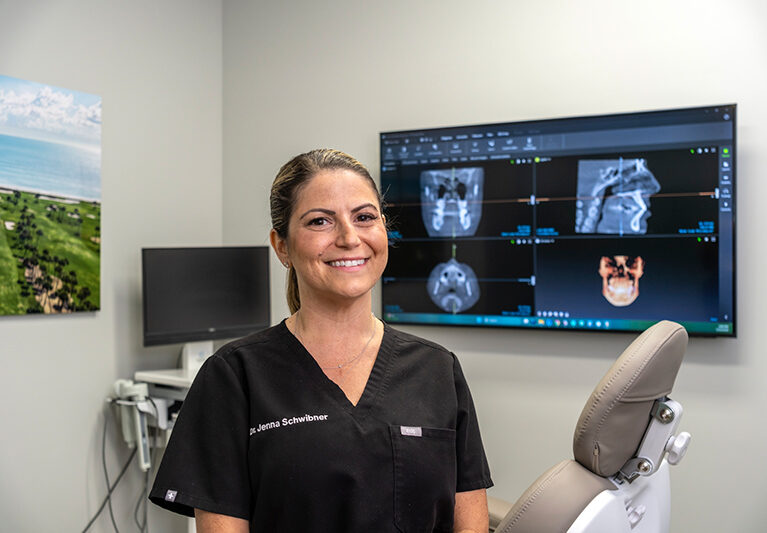
According to Jenna Katz Schwibner, DMD, co-owner of Dental Partners of Vero Beach, the answer may begin not with the teeth, but with the airway.
“Most people think crowded teeth are simply a cosmetic issue,” explained Dr. Schwibner, a recognized leader in airway health-focused dentistry and founder of Foundation First Airway Center. “In many children, they’re actually a sign that the jaw hasn’t developed the way it should.”
Crowded teeth are one indicator of possible airway problems. Mouth breathing, chronic snoring, restless sleep and grinding or clenching teeth at night can also signal an underdeveloped jaw or an obstructed airway – problems that often go unnoticed or are dismissed as normal childhood habits.
Yet a healthy airway affects far more than a child’s smile.
Every breath supplies oxygen to the brain, muscles and every organ in the body. When the airway is restricted, children may experience poor-quality sleep, difficulty concentrating, chronic fatigue and behavioral problems. Over time, untreated airway problems can also increase the risk of cardiovascular disease, metabolic disorders and other chronic health conditions.
“If we diagnose and treat an obstructed airway during early childhood, there’s the possibility that we can improve their sleep while guiding normal jaw development,” said Dr. Schwibner.
“We like to see children as young as possible because we can often prevent more serious issues later, including overcrowded teeth and chronic sleep problems. By age 6, the jaw is already about 80 percent developed, and by age 8 it’s nearly 90 percent developed.”
Airway-focused dentistry looks at how the entire face is growing.
“Most orthodontists begin treatment around age 11 or 12,” Dr. Schwibner said, after a child’s permanent teeth have come in. “We like to evaluate children much earlier, when their baby teeth are coming in. Baby teeth should have space between them. Those early signs tell us a great deal about how the jaw is developing.”
In some cases, treatment can begin as early as age 3.
“We’re not just moving teeth,” Dr. Schwibner said. “We’re guiding growth. We use many of the same orthodontic tools, but through an airway-focused lens.”
That approach also evaluates how the tongue, lips and facial muscles function.
“Crowded teeth are often a sign of improper muscle function,” she explained. “We assess whether the tongue and lips are working the way they should. Specialized appliances can help train those muscles so that, as the child grows, the jaw develops more naturally. Traditional braces primarily straighten the teeth, but they don’t always address the underlying cause.”
Although early intervention offers the greatest opportunity to influence jaw growth, airway health remains important throughout life.
According to the American Academy of Sleep Medicine and the National Institutes of Health, approximately 30 million Americans have obstructive sleep apnea, while an estimated 50 million to 70 million experience some type of chronic sleep disorder.
“Adults benefit from airway treatment, too,” Dr. Schwibner said. “Many people struggle with snoring, sleep apnea or poor sleep without realizing their jaw may be contributing to the problem.”
Foundation First Airway Center professionals work closely with sleep physicians, ear, nose and throat specialists, chiropractors and other healthcare providers to determine the source of each patient’s breathing difficulties.
“If the problem isn’t related to the jaw, we’ll make sure patients get to the right specialist,” she said. “Our goal is simple – to help people breathe better, sleep better and ultimately live healthier lives.”
Dr. Schwibner offers minimally invasive adult maxillary expansion in addition to comprehensive airway expansion for infants, children, adolescents and adults. Her practice collaborates with sleep physicians to provide custom nighttime oral appliances as an effective alternative to CPAP therapy for many patients with obstructive sleep apnea and utilizes medical insurance whenever possible for these services.
Parents often think of straight teeth as the goal of early orthodontic care. Airway focused dentistry has a more comprehensive goal – helping children breathe well, sleep soundly and develop healthy jaws from the very beginning. A beautiful smile may be one of the benefits that follow.
A Vero Beach native, Dr. Jenna K. Schwibner is co-owner of Dental Partners of Vero Beach and founder of Foundation First Airway Center, both located at 3790 7th Terrace, Suite 101. She attended St. Edward’s School and Sebastian River High School before completing her undergraduate studies at Vanderbilt University and earning her Doctor of Dental Medicine degree from Nova Southeastern University. She is a Diplomate of the American Board of Dental Sleep Medicine and serves on the faculty of Airway Health Solutions, LightScalpel, and Awaken2Sleep. She lectures nationally on airway-focused dentistry, oral appliance therapy, laser dentistry and airway orthodontics. For more information or to schedule an appointment, you can call 772-410-4332.