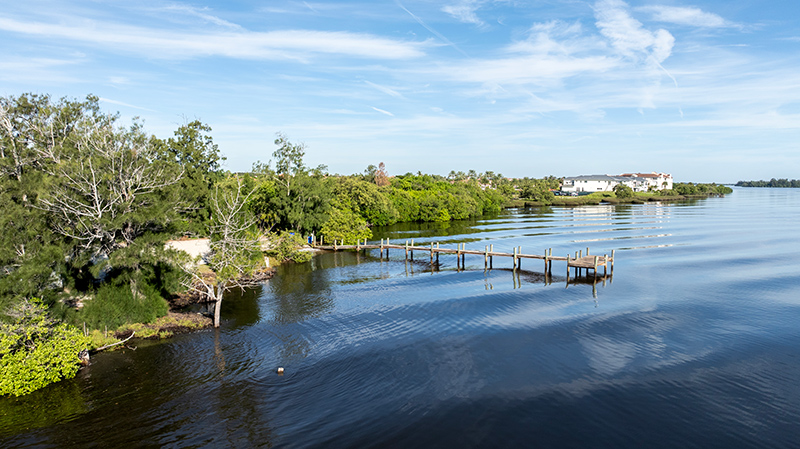
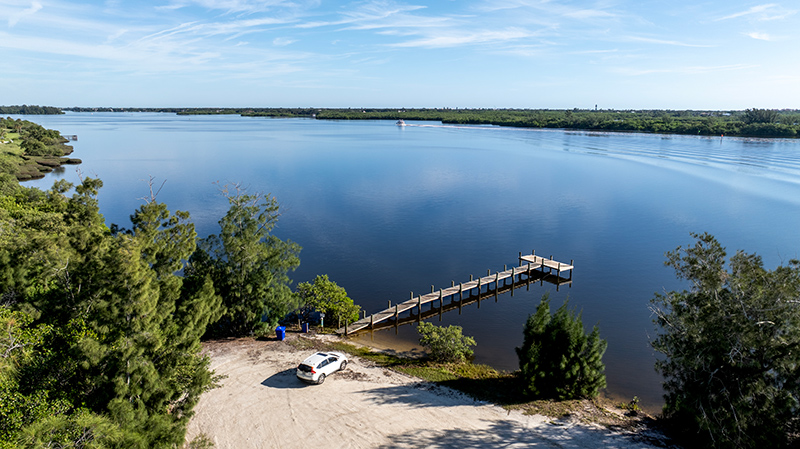
The historic Gifford Dock, which opened up the Vero Beach area to settlers in the 1880s, is getting a pavilion and boat rental operation, thanks to a matching grant from the state of Florida and some help from the city.
The 110-foot-long dock, extending eastward from the bank of the Indian River Lagoon at the end of 45th Street, is a popular fishing spot, especially for residents of the nearby Gifford community.
Current amenities are limited to the dock, which has been rebuilt and repaired many times over the years, a small, sandy beach for launching kayaks, canoes and paddleboards, and a parking area.
That will change soon.
Plans to improve the small park started in 2018, soon after the City of Vero Beach received permission from Indian River County to run an 18-inch irrigation water main 60 feet under the county-owned dock site and the lagoon to deliver reclaimed stormwater to John’s Island’s golf courses and lawns.
In exchange for the easement, the city agreed to build a picnic pavilion at the site and designed a typical, free-standing park structure.
Since then, the county has obtained a 15-acre tract adjoining the south side of Gifford Dock Park through its Environmental Lands Acquisition Program. The county paid $1.64 million for the site in March, with plans to develop the property for passive recreation and environmental education in conjunction with improvements at Gifford Dock.
“We started to look at applying for a Florida Inland Navigation District (FIND) grant for both the conservation area and the Gifford Dock Park as one project,” said Wendy Swindell, the county’s assistant director of parks and conservation.
On Sept. 22, Vero Beach City Council members approved an interlocal agreement with the county to contribute $50,000 to the project in lieu of the city building the pavilion itself.
Two days later, FIND informed the county that it has approved a $75,000 grant for engineering design and permitting. The county must kick in $75,000 in matching funds, Swindell added.
After design and permitting are complete, the county can go back to FIND and apply for construction funding.
“The county is excited about the opportunity to plan and implement improvements at Gifford Dock Park and the recently acquired conservation area to the south,” said Beth Powell, the county’s director of parks, recreation and conservation. “This is a special place that is deeply connected to the heritage of Indian River County. We look forward to enhancing these properties in a way that honors their history while creating greater opportunities for residents and visitors to enjoy this valuable public resource.”
The most notable improvement will be a kiosk where people can rent kayaks and canoes for a nominal fee, giving all visitors the chance to get out on the water, where manatees, bottlenose dolphins, herons and other water birds abound. The pavilion will be built on the dock itself instead of elsewhere in the park to minimize erosion and allow more room for parking, Swindell said.
The county will also construct a walkway connecting the park to the conservation area and install a living shoreline to prevent future erosion, Swindell said.
Along with the now-defunct Quay Dock in Winter Beach about 4.5 miles to the north, Gifford Dock was a primary entry point for early settlers immigrating to the area, said local historian Ruth Stanbridge.
“Before roads and before the railroads, the river was the highway,” Stanbridge said. The area was part of Brevard County in the 1880s when the docks were built with local government funding.
People came to what now is Indian River County seeking 160-acre settlement grants from the federal and state governments. Local governments built the docks to make it easier to travel here by boat, she said.
When the Florida East Coast Railroad came through a few years later, laying tracks from Jacksonville to Miami, the rail company built employee housing along the way and neighborhoods began to sprout around these areas, Stanbridge said.
“Many of those early homesteaders were Black families that moved here after the Civil War and found work on railroad crews and as farmers,” she said.
The docks were very important to commercial trade for these early inhabitants. Crops were shipped to market from the docks and settlers also sold fish, oysters and clams. At the same time, merchant boats tied up at the docks periodically, selling materials and supplies needed by early residents, including tools, equipment, household wares and food staples not produced in the area, Stanbridge said.
Stanbridge hopes that once the site is improved there will be an educational display to inform people about the dock’s historical significance, so that visitors can enjoy a sense of the county’s colorful past as well as the present beauty of nature.
Photos by Joshua Kodis