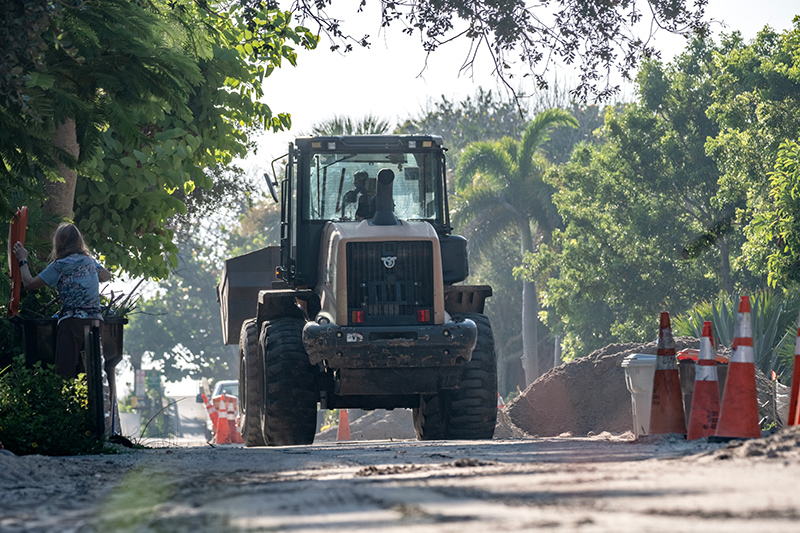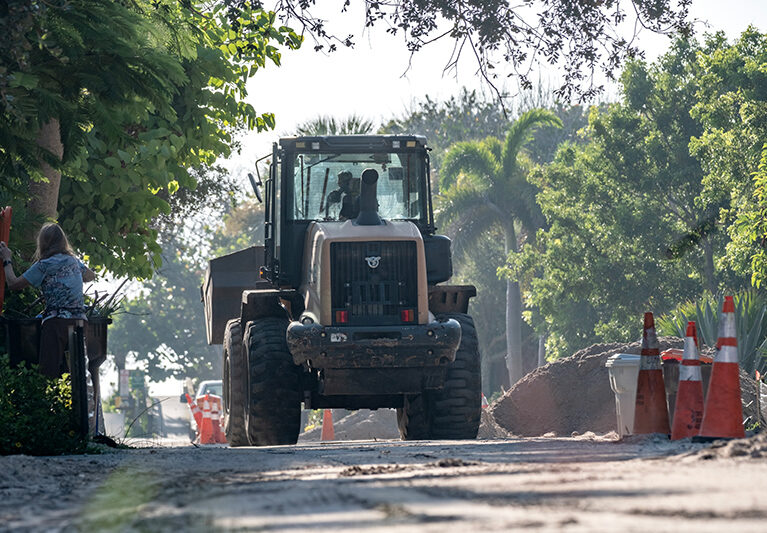
For any passing motorists still wondering, nothing is being built on the empty lot across Highway A1A from the Shores town government center at the intersection of A1A and Beachcomber Lane.
Rather, the jumble of construction equipment, pipe sections and raw dirt have to do with the lots temporary use as a staging site for the heavy sewer infrastructure and road replacement work that has been underway the past couple of months.
The driving force behind the sewer work is a state law passed in 2023 that created an unfunded mandate to connect septic-tank homes to municipal sewer systems by July 1, 2030, to protect the Indian River Lagoon and other environmentally sensitive waterways and water bodies in Florida.
Aging septic systems are prone to leak nitrogen, phosphorous and other harmful chemicals into groundwater and nearby surface waters, and they have been identified by local scientists at Harbor Branch Oceanographic Institute as a major source of pollution in the Indian River Lagoon.
So the idea embodied in the law is a smart one – but the state did not provide any funding for the hugely expensive conversion process, leaving it up to town, city and county governments to figure out how to pay for it.
Led by its innovative Water and Sewer Director Rob Bolton, the City of Vero Beach got a headstart on the problem well before the law was passed. Since 2015, Vero has been steadily connecting septic tanks to its main sewer network with STEP systems, a hybrid technology that leaves septic infrastructure in place while channeling sewage to city sewers with small pipes that are relatively easy and inexpensive to install. It has since converted more than half of the septic systems in its service area and plans to finish the project and have all homes hooked up to sanitary sewers by 2028.
Now it is time for Indian River Shores – and its residents – to pay the piper.
But island communities are not alone in facing this problem. Neither is Florida.
The United States has a huge sewer problem. The U.S. Environmental Protection Agency estimates that over $630 billion is needed over the next 20 years to maintain and modernize existing wastewater and clean water infrastructure. That includes building new sewer lines, repairing worn out lines, converting septic to sewer and improving treatment systems.
A striking example of just how costly the process is for some local governments can be seen in Stuart, where the current capital plan includes $240 million for sewer system improvements over the next five years.
By comparison, The Shores sewer problem is relatively minor. Only about 170 of its 3,500-plus dwellings rely on septic systems. About half of those properties are direct waterfront – on the ocean, lagoon or waterways leading to the lagoon – making them especially dangerous for the environment. With ongoing sea level rise, waterside systems are increasingly prone to inundation and complete failure – meaning sewage in the water where bottlenose dolphins, West Indies manatees and game fish swim.
Many of the properties are located on Ocean Road, from Turtle Trail Beach Access south to near the main entrance to John’s Island. Others are on Holoma Drive just north of Beachcomber Lane; Reef Lane and Surf Lane on the east side of A1A further south; and Indian Lane and Seminole Lane on the west side of A1A. The homes were mostly built in the 1960s and 1970s before sewer lines were extended to the community.
Construction crews are still finishing work on Beachcomber Lane across A1A from The Shores town hall – right by the cluttered lot – and will tackle the homes along Pebble Lane, half a mile south, in the first phase of the project. That phase should be finished by the end of September barring unforeseen snags, according to Shores Town Manager Jim Harpring.
The town received three bids for the sewer and roadwork along Beachcomber and Pebble Lanes and awarded the contract to the low bidder, GRSC, Inc. of Stuart, FL, in the amount of $1.14 million for Beachcomber Lane and $805,000 for Pebble Lane. All three bids received were within about $60,000 of each other, but GRSC was considered a “responsible vendor” for its extensive experience along the Treasure Coast in underground utilities, drainage and concrete work.
Harpring said the town’s fiscal year budget for 2026/2027, which starts this fall, includes engineering expenses for similar projects along other town streets where sewers need to be installed. No priority list has been created to determine the order in which the projects will be tackled.
Owners of the affected homes will pay much of the cost of sewer conversion and 70 or so residents have petitioned the town to find ways to reduce the financial burden on homeowners, which they say could run as high as $40,000 per property.
Harpring says the town has already tried to help residents in multiple ways.
The town combined sewer conversion with regular repaving, curbing and stormwater runoff infrastructure, which also benefits the lagoon because it prevents stormwater runoff including road oil from entering the lagoon. The town is paying 100 percent of that part of the construction project, according to Harpring.
If the two projects had not been scheduled together, “property owners would have to pay for road construction associated with sewer installation in addition to the septic-to-sewer costs,” he says.
“Additionally, with two road projects and two sewer projects, bids were likely better than bidding the projects individually.”
Harpring says the final allocation of costs was divided into three parts – direct roadway costs to be borne by the town, direct sewer costs to be borne by individual homeowners, and some shared costs. Additional costs for homeowners will include an impact fee paid to the City of Vero Beach and one-time central sewer hookup costs.
Harpring said he met with a group of affected residents for more than an hour last month and agreed to take their pleas for more financial help to town decisionmakers.
At the town council’s regular monthly council meeting in July, resident Theresa Morgan asked for more help from the town to pay for the septic-to-sewer conversion, which she said is costing the 31 households in the first phase of the project more than $1 million.
While the homeowners can’t afford these costs, Morgan said, the town is flush with cash and should help more by assuming a larger share of allocated costs.
She came away empty-handed when Mayor Brian Foley said he had all possible sympathy for the residents, but that he was legally constrained from using the town’s reserves, which belong to all taxpayers, to benefit a few.
“We’ve done all we can to ease your pain, but we can’t remove all the pain,” Foley said.
Indian River Shores doesn’t produce its own water or sewer service, but contracts with the City of Vero Beach for water and sewer under a so-called Interlocal Cooperation and Coordination Agreement. For the next couple of years, the sewers now being built in The Shores will flow back to Vero Beach’s sewage treatment facility at the western end of the 17th Street Bridge. In 2028 and thereafter, effluent from The Shores will be routed to the Vero’s One Water Campus by the airport, now under construction.
Photos by Joshua Kodis