The thumb is necessary for actions ranging from threading a needle to swinging a tennis racket or opening a pickle jar, which makes it tough for millions of Americans afflicted with thumb arthritis, a condition that can severely limit the remarkable range of motion and strength that make the thumb so essential to daily life.
One of the most common forms of hand arthritis, thumb arthritis affects women more frequently than men and becomes increasingly common after age 40.
For decades, patients suffering from severe thumb arthritis had two choices – live with chronic pain or undergo a surgical procedure that required removing a small wrist bone and enduring months of recovery. Today, advances in joint replacement technology are offering a new alternative – one that allows most patients to regain strength, motion, and function more quickly than traditional procedures.
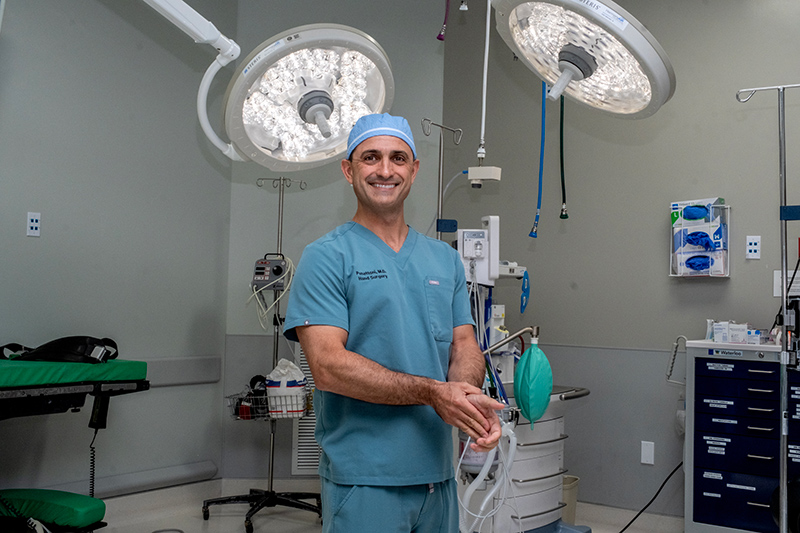
“Hand surgeons throughout the United States are very excited about a new thumb joint replacement implant that has been performed in Europe for several years but was only recently approved by the FDA for use in the United States,” said Dr. Joao Panattoni, a hand surgeon with Vero Orthopaedics. “The success rate in Europe is about 95 percent, and I can’t wait to achieve the same results for my patients.”
The TOUCH Dual Mobility CMC-1 Prosthesis is changing the way surgeons approach this debilitating condition.
For years, the gold-standard surgical treatment for advanced thumb arthritis has been trapeziectomy with ligament reconstruction and tendon interposition, commonly known as LRTI.
During this procedure, the trapezium bone at the base of the thumb is removed and a portion of a tendon is used to stabilize the joint. While the procedure has a long track record of success, recovery tends to be lengthy. Patients often spend weeks in a cast or splint and may require months of therapy before regaining strength and function.
“By removing the small bone in the wrist, we create space between the base of the thumb and the surrounding wrist bones,” Dr. Panattoni explained. “That decreases pain because the bones are no longer grinding against each other. But to create that space, we have to interpose a tendon or sometimes use a suture anchor. The amount of dissection involved results in a longer recovery period and can be quite painful for the patient.
“Some patients have to wait a long time for scar tissue to form and provide stability to the joint, so we keep them protected in a splint for about six weeks. Only then can they begin working on pinching and range of motion. It can take several months before they recover close to normal hand function.”
He emphasizes that the traditional procedure is designed primarily to relieve pain.
“The goal of this surgery is to control pain, not necessarily to give the patient a completely normal thumb. The best-case scenario is a thumb with good grip function and no pain,” he said.
The TOUCH prosthesis takes a different approach.
Rather than removing the joint and relying on scar tissue and tendon reconstruction, surgeons replace the arthritic joint with a prosthetic implant designed to mimic normal thumb mechanics.
The implant incorporates a “dual mobility” design, a concept first developed for hip replacements.
It features two articulating surfaces that provide greater stability while also reducing the risk of dislocation. Unlike thumb fusion, which eliminates joint motion, or trapeziectomy, which removes the joint entirely, the prosthesis is designed to preserve natural movement.
“The recovery is much faster with this procedure,” Dr. Panattoni said. “It’s essentially a miniature hip replacement using many of the same concepts and technologies. The dual-mobility design includes two articulating components and a socket that move together, restoring stability and range of motion. Because there is less dissection, patients experience less pain and recover much faster.
“Patients are using the thumb and working on pinching exercises within two weeks after surgery. Many times, we don’t even need to use a splint because the implant itself provides immediate stability.”
Recent studies have produced promising results. A European study involving 37 patients who received the TOUCH prosthesis found significant improvements in pain, strength, mobility and overall hand function one year after surgery, with a patient satisfaction rate of 95 percent. In a larger study that followed 150 patients who received dual-mobility thumb prostheses gave the procedure high marks after four years, with 98 percent of those who completed long-term follow up said they would choose the same surgery again.
As with any joint replacement procedure, complications can occur. In the one-year TOUCH study, researchers documented several tendon-related problems and one implant dislocation.
Experts agree that proper patient selection and surgeon experience are critical factors in achieving successful outcomes.
The ideal candidate is someone with severe thumb arthritis who has not been helped by conservative treatments such as topical or oral anti-inflammatory medications, steroid injections and splints, Candidates often include active adults, golfers, tennis players, musicians, craftspeople, and others who rely heavily on hand function.
As hand surgery continues to evolve, the conversation is shifting from simply eliminating pain to restoring normal function. For those who have spent years avoiding handshakes, struggling with jar lids, or giving up favorite hobbies because of thumb pain, this new generation of thumb replacements may offer an opportunity to use their hands naturally again.
Dr. Panattoni received his medical degree and internship training from Marília Medical School in Marília, Brazil. He completed an orthopaedic surgery residency at Municipal Hospital of Tatuapé in São Paulo, Brazil, followed by specialized residency training in hand surgery at Campinas State University. His training continued with advanced fellowship training in hand surgery and microsurgery at the Christine M. Kleinert Institute for Hand and Microsurgery in Louisville, Kentucky, and a one-year fellowship in hand and reconstructive microsurgery at National University Hospital in Singapore.
Dr. Joao Panattoni is currently undergoing training in Belgium to learn this new technique and will be one of the first surgeons in the area authorized to utilize the TOUCH prosthesis. He will present a free public seminar on the procedure Monday, July 20, from 6 p.m. to 7 p.m. at Vero Orthopaedics, 3955 Indian River Blvd. Visit [email protected] to reserve a seat. You can call 772-569-2330 to schedule an appointment.
Photos by Joshua Kodis