Vero residents are fortunate to live close to Fort Pierce’s HCA Florida Lawnwood Hospital, which operates the region’s only Level II trauma center, serving five counties, including St. Lucie, Indian River, Okeechobee and parts of Martin and Highlands counties.
Research consistently shows that patients treated at trauma centers have significantly higher survival rates than those treated at hospitals without specialized trauma capabilities.
According to studies published in the Journal of the American Medical Association, treatment at a trauma center can reduce the risk of death from serious injuries by as much as 25 percent compared to treatment at other hospitals.
In May, there was a celebration of those odds as former Lawnwood trauma patients walked through the doors with their families to attend a survivors reunion. Some used canes for assistance, some were in wheelchairs, and others looked like nothing had ever happened to them.
They were there to celebrate life and meet some of the first responders and emergency staff they had never expected to see again. They had arrived at the hospital in the first instance fighting for their lives. Now they had returned, not as victims, but as inspirational survivors.
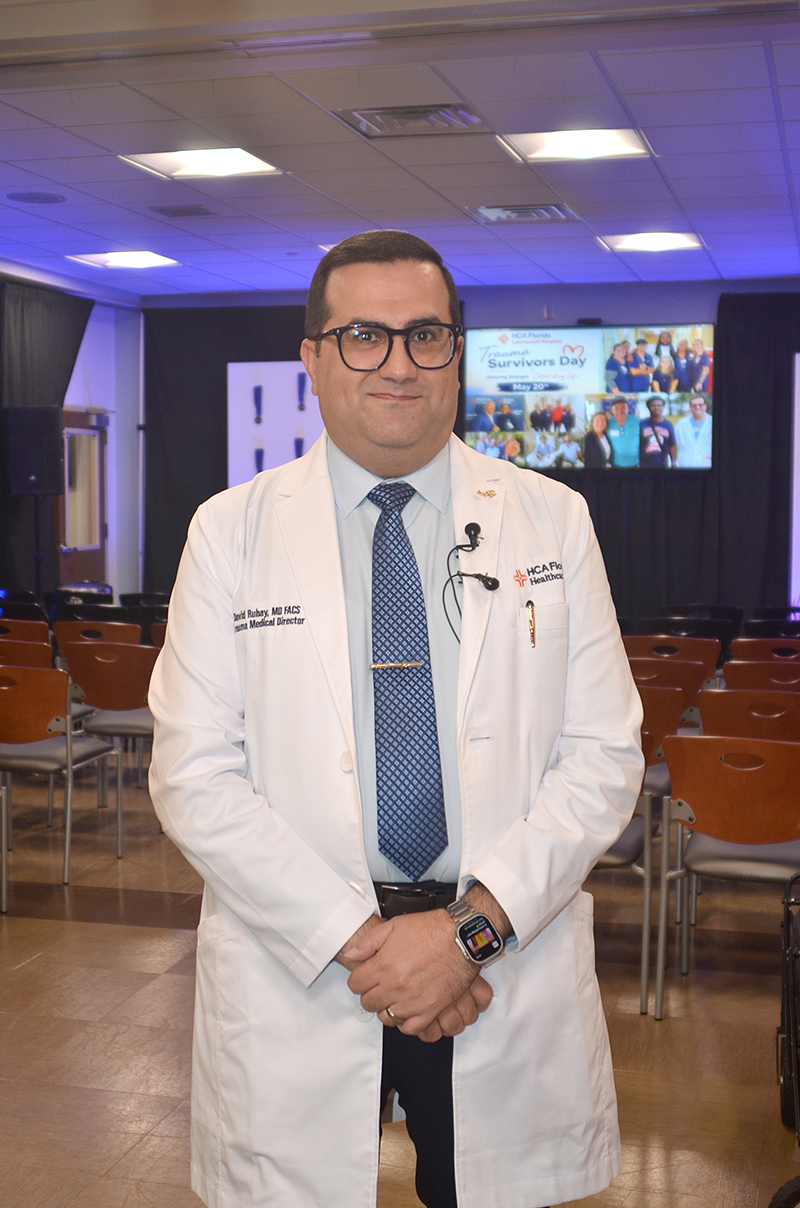
“Trauma is not a normal disease,” said Dr. David Rubay, chief of trauma and emergency services at the hospital. “It’s a very hard process that patients go through, and it comes with emotions like anger, disbelief and fear. Our trauma team has many resources to improve the care of those patients and help bring them back to being effective members of the community. Today we come together to celebrate not only the survivors, but also the families, first responders and healthcare workers who helped save them.”
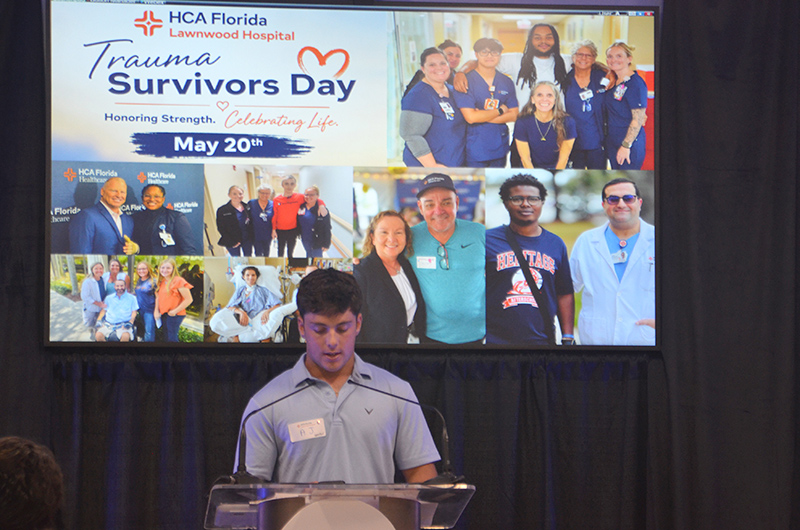
The annual Trauma Survivors Day celebration at Lawnwood highlights the importance of having a high-level trauma center close to home. This year more than a dozen former patients attended the ceremony, each with a harrowing story of near-death and dramatic rescue.
Nineteen-year-old Vincent Luna was among them. He survived a gunshot wound to the chest and was initially given only a 1 percent chance of survival. He arrived at the celebration in a wheelchair, grateful simply to be alive.
“My son was here at Lawnwood for five weeks and then spent another four weeks at Brooks Rehabilitation Hospital in Jacksonville,” said his mother, Annett Luna. “After that came months of physical therapy and counseling while we tried to figure out our new life.”
She recalled the uncertainty and fear that followed the shooting.
“In the beginning, we didn’t know if he would survive,” she said. “Then we had to learn how to adapt to him being paralyzed and relying on a wheelchair. We want to thank everyone involved from the police officers who answered the panicked phone call, to the EMS crews who kept him alive long enough to get to the hospital, and the surgeons and nurses who brought him back to life.
“They treated not only his injuries, but his emotional trauma as well. They helped our entire family focus on healing instead of tragedy. My son is alive today because all of those people worked together.”
Another survivor who attended the celebration, AJ Wydra, had been pursuing a promising baseball career when a freak spear-fishing accident nearly killed him.
“The spear impaled me through my upper abdomen, through my liver and out my back,” Wydra recalled. “I remember sitting on the cooler wondering if it would be the last moment of my life.”
The accident happened at the end of a long wooden dock, forcing rescuers to carefully carry him hundreds of feet before reaching the waiting ambulance.
“Even though I was terrified, I had this strange sense of peace,” he said. “The paramedics kept reassuring me I was going to be OK, but honestly, I had my doubts.”
His injuries required two major surgeries and a medically induced coma. One day he had been pitching baseballs and planning his future. The next, he was learning how to walk again with a walker.
“I’m standing here today because of the health professionals in this room and the unwavering support of my family,” he said.
After months of rehabilitation, Wydra returned to the baseball field as a starter in one of the nation’s top Division II conferences. Although his dream of becoming a professional athlete changed, he recently graduated from Florida Institute of Technology and got engaged.
“I’ve learned that success isn’t always about where you end up,” he said. “It’s about the people who carry you when life takes everything away from you.”
Medical experts often refer to the first 60 minutes after a serious injury as the “golden hour,” a narrow but critical window when rapid diagnosis, emergency surgery, blood replacement and advanced critical care can dramatically improve a patient’s chances of survival and recovery.
It is in that hour that Lawnwood Hospital shines.
“As a trauma center, we have to be prepared every second of every day,” Dr. Rubay explained.
“That means having a trauma surgeon available 24/7, anesthesiologists in the hospital, operating rooms ready at a moment’s notice and highly trained nurses, pharmacists, radiologists and therapists ready to care for the patient from the emergency room to intensive care. Every person has a specific role, and every second counts.”
When a catastrophic accident occurs, the treatment process begins long before a patient arrives at the hospital. Police officers, firefighters and EMS crews are typically first on the scene, stabilizing injuries, controlling bleeding and preparing patients for transport by ambulance or helicopter. By the time those patients reach the trauma bay, an entire team is waiting.
“We see every kind of trauma imaginable,” Dr. Rubay said. “We’ve treated shark bites, alligator attacks, gunshot wounds and near drownings. Car crashes and now E-bike accidents – which are among the most common injuries we see – but virtually any traumatic injury that can happen in this community has come through our doors.”
As the May 20 ceremony concluded, survivors embraced nurses, paramedics and physicians. For the trauma team, the event offered a chance to see a positive ending, something they rarely get to witness in the chaos of emergency medicine.
“The stories we heard today are incredibly powerful,” Dr. Rubay said. “The courage and resilience of these survivors inspire all of us. To see them here, living their lives again, gives our team the motivation to keep doing this work year after year.”
Dr. David Rubay graduated from Florida Atlantic University for general surgery and from the University of Florida for trauma and critical care. He can be reached at 772-462-3939.
Photos provided