Florida Inland Navigation District executive director Janet Zimmerman drove up to Vero from Jupiter last week to meet with residents upset about a dredge material storage site FIND plans to build next door to Provence Bay condominiums.
As Vero Beach 32963 reported in November, Provence Bay residents were angry and fearful when they found out last fall about FIND’s plan to store as much as 163,000 cubic yards of muck dredged from the Indian River Lagoon in a massive earthen structure 100 feet from their property line.
Homeowners said they feared construction noise and dust, foul smells from the muck FIND plans to remove from the Intracoastal Waterway, toxic material, flooding, swarms of mosquitoes due to standing water, and reduced property values.
“My level of concern is 10 out of 10,” said Jeff Clay, a dentist who owns a home on Monaco Place in Provence Bay that backs up to FIND’s 54-acre parcel – which stretches from the Indian River to Indian River Boulevard on the south side of Provence Bay.
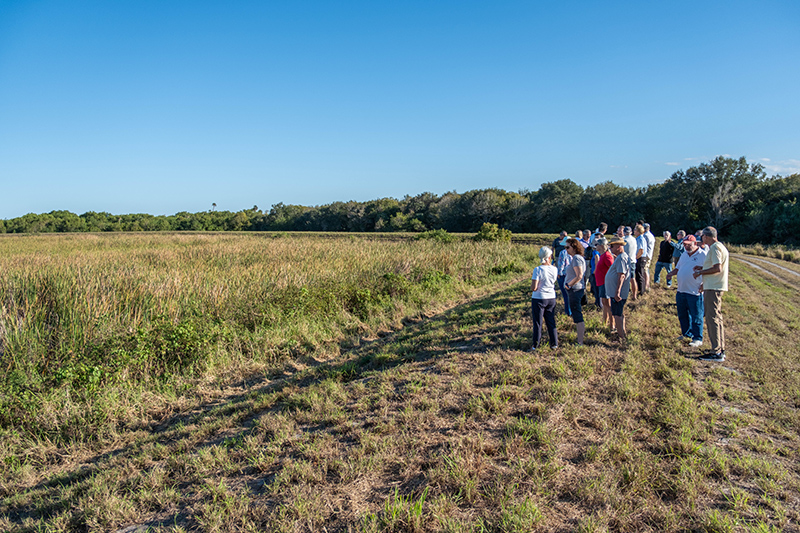
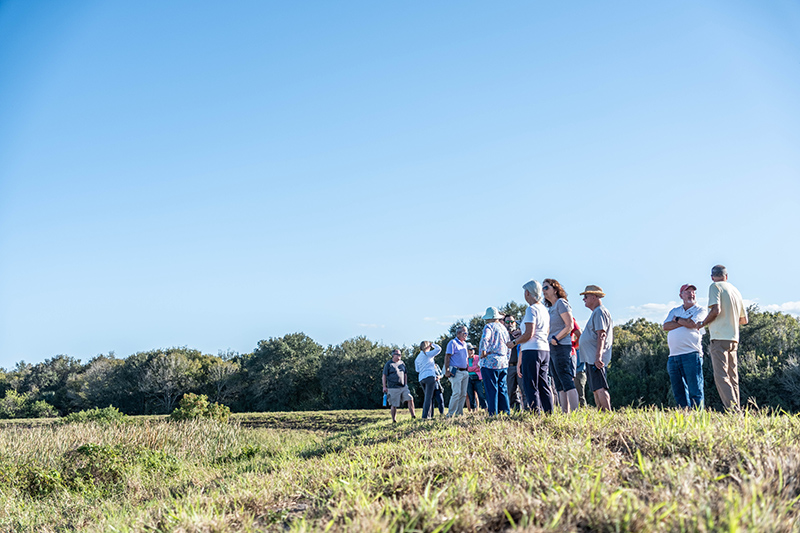
Arriving Wednesday afternoon with an engineer and third staff member, Zimmerman gave a presentation about the upcoming project, answered questions and gave residents a tour of an existing dredge storage material site in Sebastian.
Some Provence Bay residents who showed up for the presentation and tour said they felt better about the project afterward while others were unconvinced by Zimmerman’s assurances that their community will not be harmed, but most everyone seemed grateful – and somewhat surprised – that the executive director and other FIND personnel traveled 75 miles to meet with them in person to address their concerns.
The meeting, attended by about two dozen residents, was held at a field tent next to a dredge material storage site built by FIND in 2011-12 on the east side of U.S. 1, two miles south of Sebastian.
Zimmerman picked that spot so she and her staff could better explain the details of the project planned next to Provence Bay and let residents see what a muck storage area looks like 14 years after completion.
Also on hand were engineers and a biologist from Taylor Engineering, which designed and will oversee construction of the Provence Bay site, which is called a dredge material management area (DMMA) in FIND documents.
Zimmerman used large poster illustrations of the planned and existing structures to show residents how muck storage areas are built and operated.
In a nutshell, sand and muck that has begun to fill in the channel of the Intracoastal Waterway is sucked out of the channel by barges with pumps and transported to the storage site as slurry in temporary pipes. In the DMMA, sand and sediment settle out of the clarifying water, which gradually drains out of the storage structure through carefully engineered weirs.
Zimmerman said the wet material can have a sulfur smell because of decaying organic material in the muck, but that the smell goes away as the material dries.
She said the only complaints FIND has gotten over the years came before and during the construction process, which can be noisy and dusty. She repeatedly assured residents that the agency has never had complaints about bad smells or anything else after a DMMA is finished.
Provence Bay residents seemed most reassured by FIND’s responsiveness and by seeing the 14-year-old storage site, which was green and peaceful when seen from the top of berm, more like a natural wetland than an industrial site.
“There is a comfort to having boots on the ground,” said Troy Westover, a Dale Sorensen Real Estate team leader who lives in Provence Bay. “We are hearing from FIND leadership in person and we can see, smell and hear a comparable site. I mean, it looks like something Audubon Society would build. There is clearly aquatic life and birds nesting in the reeds.
“It is quiet and beautiful [compared to condo complex or subdivision]. When you live in a community, you are always concerned about traffic and congestion, so the thought of having another 500 homes with lots of cars go in south of us – or this – it doesn’t seem so bad.
“Sure, there’s going to be a short-term inconvenience, but also some long-term benefit. I love the fact that we’ll have our own little nature preserve next door.”
Mike White, a past president of the Provence Bay HOA, said he was grateful for FIND’s outreach, but still had concerns about flooding.
“I am impressed that leadership came to talk with us in person and hear our concerns, and treat those concerns respectfully, but I am still worried about how water will flow on the site and whether the berm will cause it to back up on our property.”
“While I was happy that they provided us with a tour, I was concerned they dodged my question about the distance from the DMMA to residences,” said Lisa Scardino, whose home abuts FINDs property. “In their original master plan, Taylor Engineering stated clearly that any DMMA should not be constructed any closer to a residential community than 350 feet. Their newly revised plan has this thing less than 100 feet from my front door! Janet Zimmerman didn’t answer repeated questions about that change. So, frankly, I don’t trust them at all.”
Zimmerman said FIND expects to have all needed permits for the Provence Bay DMMA this year and to build the storage structure next year. She said construction will take about six months and that, after completion, it will be three to five years before any dredging is done.
The Provence Bay site will contain muck dredged between Grand Harbor and the St. Lucie County line. Dredging will occur every seven to 10 years after the first time, Zimmerman said.
FIND’s property includes parts of the Lagoon Greenway Trail. The trail will not be permanently obstructed by the DMMA, which occupies about a third of FIND’s acreage, but it may be closed temporarily when dredging takes place and slurry pipes cross the trail.
The Indian River Lagoon is a designated aquatic preserve, which might seem like a strange place to build a hulking muck storage basin, but inland storage of dredged material actually began due to environmental concerns.
During and before the 1960s, when FIND dredged the Indian River navigation channel, it piled the muck up outside the channel to create the many “spoil islands” that dot the lagoon, and to fill wetlands that were wanted for development. Riverside Park was created out of swampland by this means, according to Indian River County Historian Ruth Stanbridge.
By the 1970s, scientists had determined that creating spoil islands and filling wetlands damaged the aquatic environment and laws were passed that required dredge material to be stored inland to sequester any toxins or materials that could cloud the lagoon’s then Key West-clear water.
Then and thereafter, FIND began to plan for inland storage and acquire dredge material management areas up and down the length of the Intracoastal Waterway.
It acquired and vetted most of its sites in the 1990s, when most of the shoreline was undeveloped, securing zoning and approvals to build earthen storage structures.
“FIND has purchased properties at various intervals along the lagoon to make dredging more efficient,” Zimmerman told Vero Beach 32963. “You can only pump the material so far before you have to add booster pumps and it becomes more difficult and expensive to get the dredging done.”
As part of that process, FIND selected three sites in Indian River County, including the site by Provence Bay, which is designated DMMA IR-14 in official documents. The third site, which has not been developed, is on the west shore of the lagoon half a mile south of route 510.
Land acquisition and approvals took place years before Provence Bay existed. The community’s earliest phases were built in 2007, so the neighborhood was not considered in FIND’s initial examination of the property.
Residents say much of their concern and anger about the project is due to them not being informed about the planned DMMA when they bought their homes in Provence Bay. Several said realtors assured them the area south of their community was a preserve that would never be developed.
“We were lied to!” one resident told Zimmerman at the meeting.
“Not by us,” she said.
Photos by Joshua Kodis