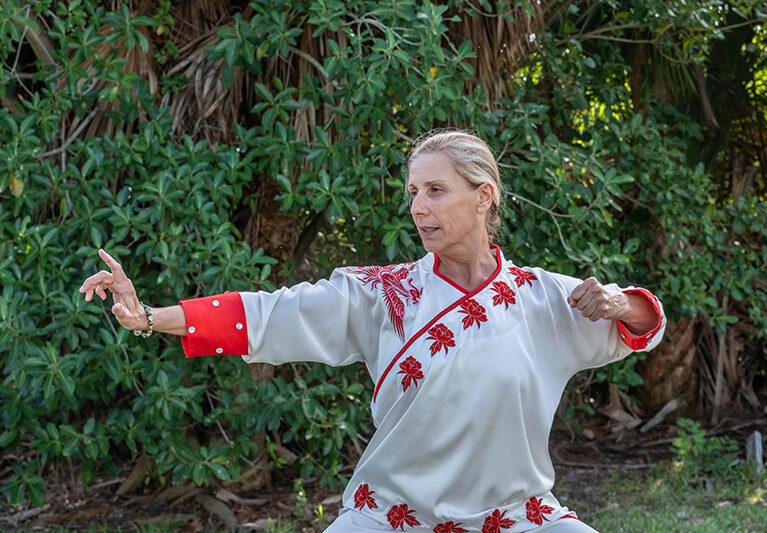
Tai chi originated as an ancient form of martial art in China that was widely considered the most effective of all combat techniques because of its ability to turn an opponent’s force against them.
In recent decades, however, it has been practiced mainly for its wide-ranging mental, emotional and physical health benefits, which are documented in more than 500 published medical studies.
Peter Wayne, director of the Osher Center for Integrative Medicine at Harvard Medical School and at Brigham and Women’s Hospital in Massachusetts, is on record as stating that “medical research has catalyzed tai chi’s popularity in the West.”
Angela Watson, a certified personal trainer who has taught tai chi and qi gong for decades and has a Vero Beach studio, says, “Both qi gong and tai chi work with the internal energy of the body through the practice of various movements, as well as meditation. The movements are slow and mindful, with everything working together to benefit the whole.”
Mayo Clinic says tai chi is sometimes described as “meditation in motion” because it promotes serenity through gentle choreographed movements that bring the mind and body into harmony.
It is a powerful practice for stress reduction and helps with many other health conditions, with proven ability to:
- Reduce anxiety and depression
- Improve balance, flexibility and muscle strength
- Reduce falls in older adults
- Improve sleep quality
- Lower blood pressure
- Improve cardiovascular fitness in older adults
- Relieve chronic pain
- Increase energy, endurance and agility
- Improve overall feelings of well-being
Watson says one of the beauties of tai chi is that anyone can practice it. “At the two age extremes, my daughter began coming to tai chi classes when she was 13 and I have students who are close to 90.”
One of those students is Vero Beach resident Tom Jackson, who started attending Watson’s tai chi classes approximately eight years ago. “I’m 80 now,” he says, “and although I was what I’d consider reasonably fit at the time I began tai chi, I saw how many of my golfing friends were having to give up the sport they loved because they were losing mobility and I wanted a better outcome.
“I can’t tell you how important the balance component of tai chi is. The 24 moves that we do are somewhat complicated but nothing that someone who is interested in increasing – or maintaining – their strength and mobility can’t do. Some of those exercises are on one leg!”
Jackson says the benefits are more than just physical. “Remembering the sequence of the 24 moves we do, as well as how to do them, has a great mental impact.
“And the meditative quality relaxes you and makes you feel better at the end of the class. I would say that it’s important to find an instructor who knows what he or she is doing and adds an air of congeniality and fun to the room.
“An interesting thing is how the gender component of the students has evolved,” Jackson adds. “When I began attending classes, we were about two men and 20 women. Now the classes are evenly divided at about 50/50 percent.”
One of the beauties of tai chi is that people don’t need to be in top physical form to participate.
“It’s highly accessible for people of all ages and physical abilities,” Watson explains. “Although traditionally the movements are performed standing, I’ve seen stroke survivors, as well as individuals with Alzheimer’s and Parkinson’s diseases participate successfully in a seated position.”
When Jackson mentioned the mental and emotional boosts he felt after a tai chi class, he was onto something. “It’s the exercise technique that also sharpens your mind,” says Watson.
“Traditional Chinese exercises integrate breathing, intentional movement and mental focus. This trifecta seems to activate the body’s parasympathetic nervous system (the ‘rest and restore’ mode), while subtly challenging balance, coordination and attention.”
The National Institutes of Health’s National Center for Biotechnology Information says that tai chi is particularly well-suited to fill gaps in physical activity engagement among older adults and individuals with chronic disease or mobility limitations. Unlike high-intensity fitness trends that may alienate these populations, tai chi offers a gentle, scalable, and sustainable alternative that aligns with global calls for age-friendly health promotion strategies.
Angela Watson has certifications from the American College of Sports Medicine (ACSM), the American Council of Exercise (ACE), Athletics and Fitness Association of America (AFAA), Arthritis Foundation, Vero Beach Qi Gong society, and American Tai Chi and Qi Gong Association. Until Jan. 31, her classes will be held at the River House, 305 Acacia Dr., Vero Beach. After that, they will be at the Bethel Creek House, 4405 SR A1A, Vero Beach. For information, email [email protected], call 772-532-4218, or visit angiewatsontraining.com.
Photos by Joshua Kodis