Who among us didn’t have a parent who admonished us to stand up straight? Well, mom and dad were onto something – it turns out that good posture improves circulation, respiration, digestion and bladder function. It also enhances cognitive ability and mood, to name just a few of its benefits.
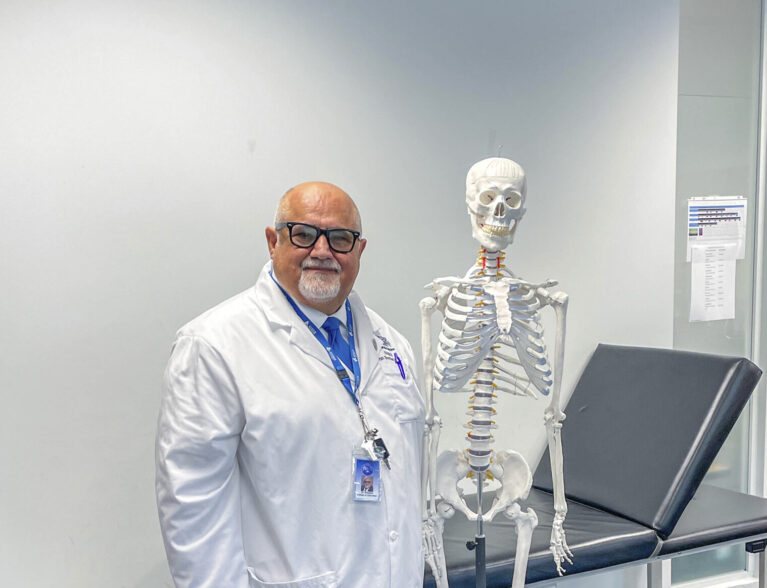
Dr. Shayan Sheybani, DC, MBA, a professor at Keiser University School of Chiropractic Medicine, says a major contributor to poor posture is today’s tech-driven lifestyle. “Look around you – ‘tech neck’ is a big problem,” he said.
“People are hunched over their phones and iPads, and when they’re seated at their computers or laptops it’s usually not in an ergonomically healthy position.”
Brown University Health notes several other causes, including:
- repetitive motions/poor biomechanics
- weak muscles
- genetic conditions
- injuries
- fatigue
- carrying heavy bags/purses (especially over one shoulder)
- carrying extra body weight
“Poor posture is the main driver of upper crossed syndrome (UCS). When the muscles of your shoulders, neck, and chest are out of balance – some too weak and some too tight – that’s UCS,” explains Dr. Sheybani.
These muscles seem to group in the shape of an X, which leads to the name of the condition. When your shoulder, neck and chest muscles do not work together as they should, the results can be quite painful for you, according to WebMD.
“Good posture and balance offer numerous health benefits” says Dr. Sheybani. “Our endocrine systems, nervous systems, inner ear, and eyesight are just a few of the things that are positively affected.
“Your personal happiness, good attitude and reduced lower back pain are three of the positive results you’ll enjoy.”
Mayo Clinic cites some of the most common problems resulting from poor posture:
- Headache. Poor posture can strain the muscles at the back of your head, neck, upper back and jaw, putting pressure on nearby nerves and triggering tension or muscle-spasm headaches.
- Back and neck pain. Pain and tightness or stiffness in the back and neck can be due to injury and other conditions, but poor posture is a common contributor.
- Knee, hip and foot pain. Muscle weakness, tightness or imbalances, lack of flexibility, and poor alignment of your hips, knees and feet may prevent your kneecap from sliding smoothly over your femur, causing a variety of afflictions and painful conditions.
- Shoulder pain and impingement. Your rotator cuff is a group of muscles and tendons that connect your upper arm to your shoulder. Muscle tightness, weakness or imbalances associated with poor posture can cause the tendons in your rotator cuff to become irritated and cause pain and weakness, and possibly tearing.
- Jaw pain. Forward head posture may strain the muscles under your chin and cause your TMJ joint to become overworked, resulting in pain, fatigue and popping in your jaw.
- Fatigue and breathing problems. Poor postural habits may restrict your rib cage and compress your diaphragm, reducing lung capacity, leading to shallow or labored breathing, fatigue and lack of energy.
You can’t blame bad posture on age. Physical therapists and geriatricians agree that a stooped posture isn’t an inevitable consequence of getting older.
“There are a lot of people who are in their 90s and 100s who have beautiful posture,” says Dr. Deborah Kado, a geriatrics researcher and professor of medicine at the Stanford University School of Medicine. “The difference is, these elders pay attention to their posture, which most people don’t.”
Dr. Sheybani agrees. “Most people have no idea how bad their posture is. Take a photo or video of yourself so that you’ll be aware of the severity of the problem.
“It’s better to start sooner rather than later to take steps towards improvement,” he continued.
“Most of us don’t realize that the head is about as heavy as a bowling ball. Even when your head is in a straight-up, neutral position it exerts 10 to 12 pounds of pressure on your cervical spine.
“At a 15-degree forward tilt, the force increases to 27 pounds. At 45 degrees, the angle at which most people bend to look at their cellphones, the force is 49 pounds.”
Dr. Sheybani says physical therapists and chiropractors can help you find ways to improve your posture.
“Trainers can help with strengthening and stretching exercises. Since everyone starts at a different place – determined by age, weight, etc. – it’s important that you learn specifically what you need to do. Eventually the routine will become part of your lifestyle.”
Dr. Shayan Sheybani, DC, MBA, FIANM, FICC, CHC, is a professor at Keiser University College of Chiropractic Medicine. He earned his Doctor of Chiropractic degree from Palmer College in 1993 and his master’s degree in business administration from St. Ambrose University in 2004. Dr. Sheybani is a Diplomate of the International Academy of Neuromusculoskeletal Medicine and a fellow of the International College of Chiropractors. Keiser University has campuses throughout Florida, including Melbourne and St. Lucie West.