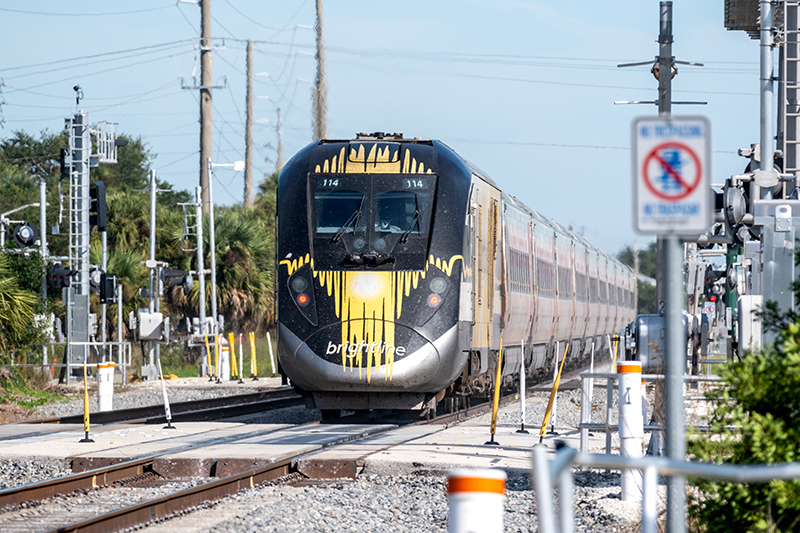
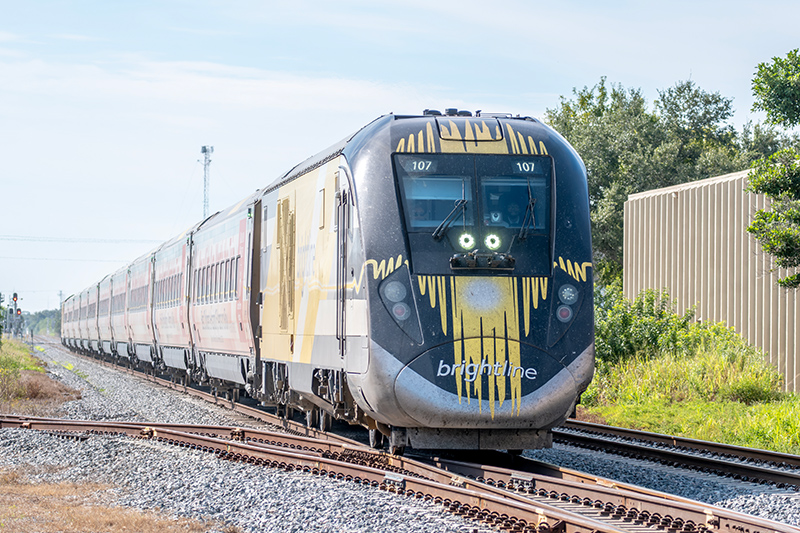
Brightline Holdings LLC and 16 of its affiliated entities filed for Chapter 11 bankruptcy protection in the U.S. Bankruptcy Court for the District of New Jersey last Thursday, Sept. 24.
Brightline itself, the company that operates the fast yellow trains that have become part of daily life in Vero Beach, did not declare bankruptcy, and the trains will run as usual according to the company. But due to provisions of federal bankruptcy law and the complexities of high finance, the bankruptcy of Brightline’s parent company will reduce the train company’s debt by approximately $3.3 billion, according to Reuters.
How that will happen exactly is somewhat opaque, but it appears that Fortress Investment Group, often identified as Brightline’s owner, will take the biggest hit, with its original multibillion-dollar private equity stake in the company severely diluted or entirely wiped out to satisfy senior creditors, according to Bloomberg.
Brightline has been attempting to chug down the tracks with $5.5 billion in debt loaded on its back, while also posting annual operating losses. The prospect of bankruptcy first came into clear view in July 2025, when the company failed to make interest payments on more than $1 billion in bonds. That triggered a stiff increase in interest rates on the debt that made the company’s financial situation even worse. Rating agencies downgraded Brightline bonds to junk status, causing one set of bonds to lose two thirds of their value in less than a year.
The company delayed interest payments on additional bonds this year, and the retail concourse in Brightline’s Miami station entered foreclosure in August, after U.S. Bank Trust sued Brightline Investment Holdings and DTS DT Retail for failing to repay or make interest payments on a $65-million loan.
Brightline said in a statement on Friday that $2.2 billion in bond debt insured by Assured Guaranty, is secure. It said another $2.2 billion in other bond debt will experience “no reduction in aggregate principal … through restructuring.”
That raises the question of what will happen to the other $1 billion-plus in bond debt and the entities that hold it. The company’s statement also does not address any possible reductions in interest rates that could be part of restructuring.
Junk bond interest rates have been dragging the company down like concrete blocks in deep water, with some of its high-yield municipal bonds structured to offer investors an effective return of 14.89 percent, according to municipalbonds.com.
The byzantine deal requires approval by a federal bankruptcy judge, but that approval seems all but certain since the details of the bankruptcy were hammered out and agreed to by the parties before the filing.
Major debtholders, Assured Guaranty and other entities with leverage to participate in bankruptcy negotiations were motivated to make some kind of deal to salvage what they could from the train company’s financial failure.
Brightline has considerable real value in its track, train and station infrastructure and its flow of paying passengers. According to the company, its ridership is up 14 percent so far this year, with revenue up 16 percent in the same period compared to last year.
If the whole financial structure surrounding the train company collapsed into rubble, much of that value would be lost and debtors, insurers and equity holders would be even worse off.
The bankruptcy is intended to give the company a fresh shot at profitability and long-term viability, with increasing revenue and much reduced debt. As part of that dynamic, Assured Guaranty and major debtors have agreed to ante up nearly $500 million in fresh cash to help Brightline transit and emerge successfully from its parent company’s bankruptcy.
“$490 million of new financing [has been] … committed by existing stakeholders to fund restructuring needs and provide ample liquidity,” the company said in its statement.
“This new capital will be used to support Brightline Florida’s ongoing operations and help position it for long-term stability and success,” Assured said in a statement.
In an upbeat public letter addressed to “Our Brightline Community,” Brightline Florida CEO Patrick Goddard painted a happy-go-lucky picture of life after ditching $3 billion in debt:
“We want to reach out to you directly and reassure you: It is business as usual at Brightline. Our full schedule of 32 daily trains continues to operate exactly as planned between Miami and Orlando, serving our stations in West Palm Beach, Boca Raton, Fort Lauderdale, and Aventura.
Your travel plans, purchased tickets, and frequent rider passes are completely unaffected.
“Thanks to riders like you, Brightline is experiencing incredible momentum, carrying 1.5 million passengers in the first five months of this year alone – a 16-percent increase over last year’s record-breaking numbers.
“We are profoundly grateful for your continued trust and support as we continue changing the way Florida moves. We look forward to seeing you on your next journey.”
Even though Vero residents can’t make much use of the train now – with the closest station in West Palm Beach – most people would probably agree it would be beneficial for Florida if Brightline survives and thrives.
Another piece of good news about the bankruptcy is that the business entities taking the biggest hits probably can afford it.
Founded in 1988, Fortress Investment Group LLC is a highly diversified global investment manager with more than $50 billion of assets under management, on behalf of approximately 2,000 institutional clients and private investors worldwide across a range of credit and real estate, private equity and permanent capital investment strategies, according to the company.
In 2007, Fortress acquired Florida East Coast Industries, which later developed the high-speed passenger rail project originally called All Aboard Florida and now named Brightline, pouring billions into the enterprise.
Mubadala Capital – a subsidiary of Abu Dhabi’s sovereign wealth fund – acquired a 70-percent equity stake in Fortress Investment Group in 2023, undeterred by the shaky state of its Florida railroad investment.
Since Brightline operates as a subsidiary of Florida East Coast Industries, controlled by Fortress, that makes the Abu Dhabi sovereign wealth fund the ultimate majority backer of the rail line – and perhaps the biggest loser in its financial derailment.
Photos by Joshua Kodis