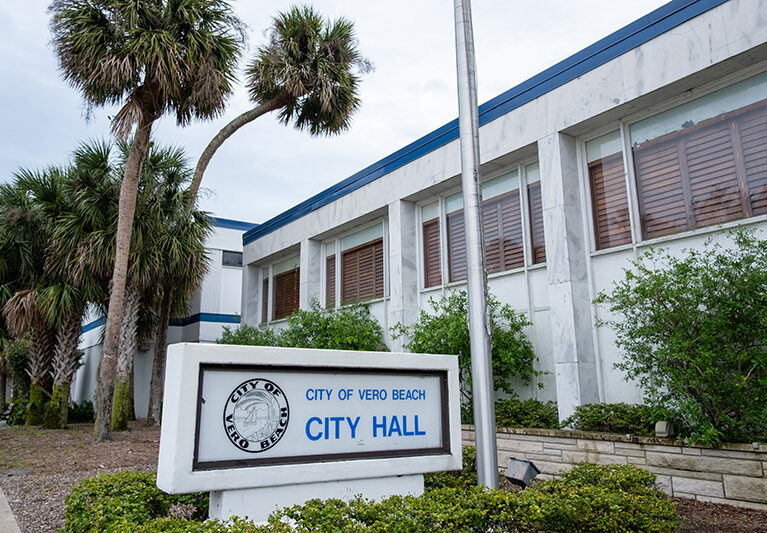
The City of Vero Beach’s long-standing practice of using millions of dollars of water-sewer utility revenue to keep the city’s property tax rate low was a contentious topic of discussion last week, both at City Hall and at Indian River Shores Town Hall.
On June 22, Vero Mayor Cotugno opened up a conversation about “improving” the city’s revenue sources.
“We are lucky as the city of Vero Beach that we have revenue sources no other municipality has in this county. None of them do. We have four enterprise funds. We have a diversified tax base. So we’re not as affected by the property tax referendum if it does pass,” Cotugno said.
“We have an industrial base, and we have residential, and we have commercial. If you look at the other municipalities, they don’t have that kind of diversified base. So we’re not as affected. And in many ways, I feel for those other municipalities because . . . they have decisions to make that we don’t have.
“But we have an opportunity here. We have an opportunity to look at . . . our enterprise funds . . . what duties they undertake, what they transfer into the general fund,” he said.
For the past few months, Cotugno has been pushing the council to increase the percentage of revenues the city skims off the water and sewer utility from 6 percent to 8 percent or even 10 percent, calling himself “a broken record” on transfers. The city could legally go as high as 10 percent, city officials said.
To ease the council into the idea of upping the water-sewer transfers, City Manager Monte Falls had them look at the other enterprise funds – marina, solid waste and the airport. The airport is trickier due to federal regulations, but the marina and solid waste were a successful opening salvo. Increasing those transfers seemed palatable to the council.
The city’s argument is that Vero owns the enterprises and takes the operational risks and therefore Vero shareholders should be compensated. Cotugno said the extra money he wants for the general fund represents “just pennies” on customers’ bills.
Councilwoman Linda Moore was not afraid to push back. “We’re already raising their water rates and their sewer rates. Like for the next 5 years. So, [now] we’re talking about raising their water and sewer rates more. I mean, let’s just be clear on it all,” Moore said.
Vero is set to increase water-sewer rates for the typical residential customer by nearly 47 percent between now and 2030 to pay for the new $164 million treatment plant under construction by the airport, plus increased costs of running the utility. The council is scheduled to vote on those rate hikes in August before the budget is finalized in September.
Moore continued to challenge Cotugno about utility rates soaring, others chimed in, and the mayor seemed to lose his patience.
“Now you sound like the people from The Shores. Oh, God forbid the water rates are going up. Well, we’re building a $164-million, state-of-the-art water treatment plant,” Cotugno said.
The morning after Vero’s budget talks, at the July 23 Indian River Shores Town Council meeting, Vice Mayor Bob Auwaerter gave a presentation showing that Indian River Shores residents already pay roughly 12 percent of their utility bills – not 6 percent – straight into Vero’s general fund.
“There are two transfers that occur out of the water and sewer fund, which is paid for by all of us in this room who get water and flush their toilets,” Auwaerter said. “The first one is a profit contribution from the water and sewer fund that goes back to the general fund. Now, they don’t use the word profit, they just say contribution from the water and sewer fund. [But] . . . this literally is a profit.
“The second one that usually flies under the radar screen is an accounting term called general fund administrative chargeback,” he said, adding that, based upon his experience serving on the city Utilities Commission, the amounts taken from each city department are not done in a systematic way. As a committee member, he asked for an analysis of the charges, calling them somewhat arbitrary, but to no avail.
On top of the nearly $1.8 million Vero transfers to its general fund from water-sewer, the city charges the utility another $1.8 million in administrative fees to defray the cost of city hall operations, according to Auwaerter.
A retired 30-plus year bond portfolio manager and credit analyst, Auwaerter had pored through several years of the city’s budget to pull out the relevant data.
He presented slides showing how transfers have risen as rates and utility revenues have increased.
Overall, money from water-sewer customers funds 10.2 percent of Vero’s operating budget, according to Auwaerter.
“That’s taxation without representation,” he said.
About 40 percent of Vero utility ratepayers live outside the city limits, in Indian River Shores or unincorporated parts of the barrier island. Those customers are forced to help fund city operations with their utility payments but can’t vote in city elections – so they don’t get a say on the makeup of the five-member Vero council that sets utility rates and transfer amounts.
The debate over cash transfers from the water-sewer utility into Vero’s general fund are likely to intensify if voters approve property tax reductions in November.