For decades, orthopedic patients looking for relief from aching joints, stubborn tendon injuries or chronic pain have typically faced a familiar progression of treatments – anti-inflammatory medications, physical therapy, cortisone injections and, if those options failed, surgery. Now some orthopedic practices are offering another option that doesn’t involve a scalpel, a needle or even a prescription.
Known as MLS Laser Therapy, the non-invasive treatment uses concentrated light energy to reduce pain, calm inflammation and stimulate the body’s own healing response. While it isn’t a cure-all or a replacement for surgery, orthopedic surgeons say it is proving to be a valuable tool for patients who have exhausted more traditional treatments, or simply aren’t candidates for surgery.
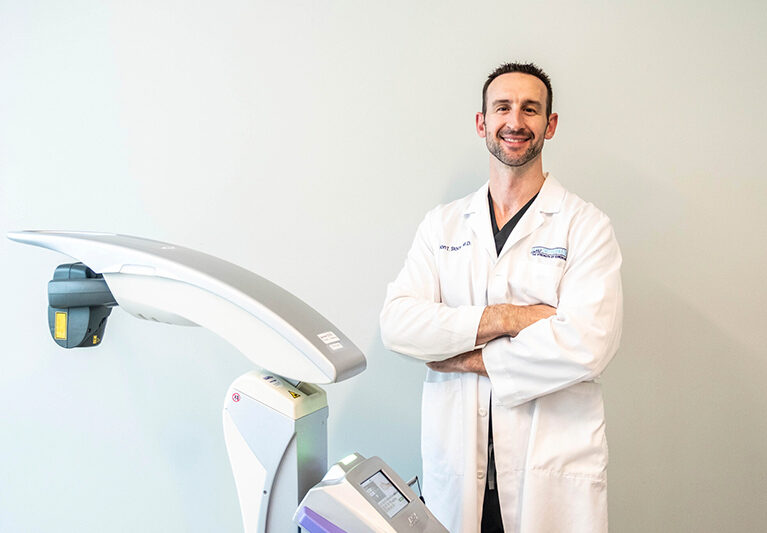
“MLS laser is an exciting, non-invasive treatment that we offer in the office,” said Dr. Jason Stack, an orthopedic surgeon with Vero Orthopaedics. “It uses targeted light energy to help relieve pain, reduce inflammation, and accelerate the body’s natural healing process.”
MLS stands for Multiwave Locked System, a technology that combines two synchronized wavelengths of therapeutic light. Unlike the red-light therapy devices now commonly marketed for home use, MLS therapy delivers light at longer wavelengths that penetrate much deeper beneath the skin, reaching muscles, tendons, ligaments and even joints.
The treatment works through a process known as photobiomodulation – the scientific term for the biological effects of therapeutic light.
When specific wavelengths of light enter damaged tissue, they are absorbed by tiny structures inside cells called mitochondria, often referred to as the cell’s “power plants.” That light energy stimulates the production of adenosine triphosphate (ATP), the fuel cells use to repair themselves. As cellular energy increases, blood flow improves, inflammation decreases, lymphatic drainage accelerates and tissue repair begins.
At the same time, MLS therapy appears to interrupt pain signals traveling along nerve fibers, providing relief that many patients notice much sooner than the healing process itself.
“The continuous beam works more on inflammation by stimulating blood flow and lymphatic drainage,” Dr. Stack explained. “The pulsed beam has a nearly immediate effect on pain because it’s able to interfere with nerve transmission of pain impulses.
The laser has received FDA clearance for the temporary relief of muscle and joint pain, arthritis, muscle spasms, joint stiffness, tendonitis, bursitis, neuropathy and lower back pain. It can also be used after orthopedic surgery to reduce swelling and improve recovery.
Among the patients he treats are individuals with tendonitis in the elbow, hip or knee, painful arthritic joints and patients recovering from surgery who cannot safely take anti-inflammatory medications because they are on blood thinners.
“Those patients tend to have more swelling after surgery,” he said. “This helps relieve that swelling by improving blood flow and lymphatic drainage.”
One advantage of MLS therapy is that it may accomplish something steroid injections cannot.
“Steroids can settle down an inflammatory process very quickly,” Dr. Stack said. “But the laser can also help with the healing process. For a tendon problem, you generally don’t want to inject a steroid near the tendon, because that can increase the risk of tendon rupture.”
The treatment has also shown promise in helping difficult wounds heal by improving circulation and delivering more oxygen and nutrients to damaged tissue.
Perhaps the most appealing aspect for many patients is its simplicity. There are no needles, no incisions and no anesthesia.
Patients simply wear protective eyewear while the laser’s computerized robotic head moves back and forth over the treatment area, delivering synchronized light energy in multiple passes. A typical session lasts about 15 minutes.
“Some patients can see benefits from the very first session, but we typically see the most significant improvements from sessions three to five,” Dr. Stack explained. “Patients typically choose to do five or ten sessions.”
Unfortunately, most insurances still rate MLS as experimental and won’t cover the procedure. Compared to other modalities like PRP, which is also not covered by insurance, it is relatively affordable at less than $100 a session.
While research into therapeutic lasers continues, Dr. Stack said his own experience has been encouraging.
“When we first looked at our practice data after several months of use, we reviewed 207 patients who had completed laser therapy,” he said. “Eighty-four percent of patients experienced improvement in the condition they were being treated for.”
Some of the most dramatic results, he says, come from patients who have run out of other options.
He recalls one patient with a painful meniscus tear in the knee located in an area unlikely to benefit from surgery. The patient had already tried anti-inflammatory medications, physical therapy, bracing, steroid injections and gel injections, yet continued to experience persistent swelling and pain that made even short walks difficult.
“I told them, ‘This is a new option. Let’s see if it helps settle down the inflammation,’” Dr. Stack recalled. “After the very first treatment, the swelling they had been dealing with for months dramatically improved. The patient sent me a photo of their visible improvement.”
Despite overnight success stories like that, surgeons view MLS laser treatment as an additional healing aid rather than a miracle cure.
“It belongs on the spectrum of non-invasive treatments we can offer,” Dr. Stack said. “I have patients who are 95 years old and simply aren’t surgical candidates. They’ve tried injections, and those have stopped working. This gives them another option and another source of hope for pain relief.”
As medicine continues to look beyond drugs and surgery alone, therapies that harness the body’s own healing mechanisms are attracting increasing attention. For carefully selected patients, therapeutic laser treatment may help bridge the gap between living with chronic pain and getting back to the activities that make life enjoyable.
Dr. Jason Stack is a board-certified orthopedic surgeon who is fellowship trained in adult orthopedic reconstruction and total joint replacement surgery. He completed his master’s degree at Boston University School of Medicine and his medical training at New York Medical College and Westchester Medical Center. He completed his orthopedic surgery residency at Orlando Regional Medical Center and his fellowship in adult reconstruction and arthritis surgery of the hip and knee at Florida Orthopedic Institute and Tampa General Hospital. His office is located at Vero Orthopaedics, 3955 Indian River Blvd., Vero Beach. You can call or text 772-569-2330 for an appointment.