Once considered rebellious and rare, tattoos are now deeply woven into popular culture – etched on arms, ankles, backs and shoulders as art, memory, identity or tribute. But as body art becomes more common, scientists have begun trying to figure out if tattoo ink has any connection to cancer.
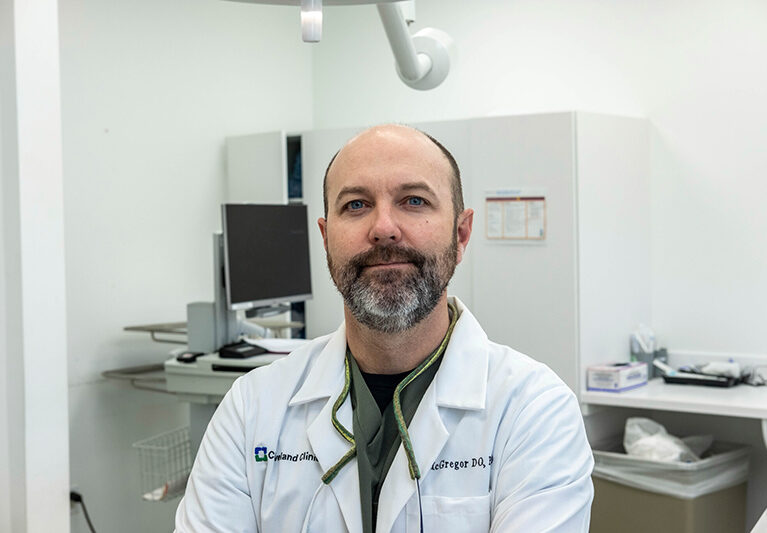
“If you look up articles relating tattoos and skin cancer, you will find a lot of mixed literature regarding the risk, but there has never really been any definitive evidence to support or deny whether tattoos cause skin cancers,” said Dr. Sean McGregor, a dermatologist with Cleveland Clinic Indian River Hospital. “There are studies that find an association between tattoos and melanoma development and others that say there is no correlation. We simply don’t have the data to confirm or dispute the hypothesis.”
That uncertainty was spotlighted by a recent Swedish study that drew international attention after researchers reported that people with tattoos had a modestly higher risk of developing malignant lymphoma, a cancer of the lymphatic system. The study, published in eClinicalMedicine, analyzed nearly 12,000 people and found tattooed participants had about a 21 percent higher relative risk of lymphoma compared with those without tattoos.
Lymphoma develops when white blood cells mutate and accumulate in lymph nodes or other organs. But experts caution that the Swedish study had limitations. It relied partly on questionnaires, which can introduce recall bias, and it could not account for every possible lifestyle difference between tattooed and non-tattooed participants. Most importantly, relative risk can sound dramatic while absolute risk remains low. A 21 percent increase in a rare disease does not mean tattoos will suddenly make that cancer common.
Harvard Health reviewed the same research and noted that headlines may have overstated the findings. Their experts stressed that no convincing evidence currently proves tattoos cause lymphoma and that much more research is needed.
“There are risks associated with tattoos, and those are going to be the same inherent risks with any procedure,” Dr. McGregor said. “Bleeding, infection, scarring and poor wound healing are things we see every day. Certain things more specific to tattoos are allergic reactions and infections – although infection risk is still fairly low, especially if you are going to reputable tattoo parlors.”
Florida regulates tattoo parlors much like other health-related businesses. A reputable shop should be willing to show its business license, the individual artist’s license, inspection history and sterile equipment practices. Regulations focus heavily on infection control and sanitation, though less on long-term ink ingredient safety or cancer surveillance.
To understand why tattoos are being studied at all, it helps to know what happens when someone gets inked. Tattooing repeatedly punctures the skin with needles that deposit pigment into the dermis, the deeper layer of skin. Some ink remains in place to form the visible design. But some particles are taken up by immune cells and can migrate to nearby lymph nodes. Research has confirmed that tattoo pigment can sometimes accumulate there.
That has led scientists to wonder whether chronic low-grade inflammation, immune stimulation, or chemical exposure from inks could play a role in disease over time. Tattoo inks are complex mixtures that may contain pigments, preservatives, metals and other compounds. Analyses of some inks have found contaminants and other substances of concern, including heavy metals and chemicals that may break down over time. Oversight has historically varied widely.
“Skin is more sensitive to some tattoo pigments than others,” Dr. McGregor said. “We sometimes see sarcoidosis, which presents as reddish-brown, purple or skin-colored bumps, and allergic reactions to red ink, for example.”
Still, dermatologists say a more immediate concern may be visibility rather than toxicity. Tattoos can make it harder to spot skin cancers such as melanoma, especially when dark pigment covers changing moles or suspicious lesions.
“There are instances of squamous cell carcinoma, basal cell carcinoma and even melanoma arising in tattoos, but those may have nothing to do with having the tattoo and may have appeared even without one,” Dr. McGregor said.
“You’ve got many other risk factors such as prior sun exposure, lighter skin, lighter eyes and history of sunburns. It is very difficult to say tattoos are the culprit, and there are no studies that show definitive evidence that tattoos increase the risk of these skin cancers.”
Dr. McGregor advises people getting tattoos to avoid placing them over scars or moles, where they can complicate diagnosis.
“It would be difficult to see a new change underneath the ink,” he said. “Melanomas are dark, and black and blue pigments are very common in tattoos. Also, don’t tattoo over skin rashes, psoriasis, and similar conditions because it could make them worse.”
With or without tattoos, he recommends regular skin checks using the ‘ABCDE’ warning signs of melanoma: Asymmetry, Border irregularity, Color variation, Diameter larger than 6 millimeters, and Evolution or change over time. Any lesion that changes, bleeds, itches or does not heal should be evaluated by a dermatologist.
For people considering a tattoo, possible cancer risk may simply be one more factor to weigh alongside cost, permanence, infection risk and personal meaning. Ask questions. Choose a reputable studio. Make sure equipment is sterile. Follow aftercare instructions carefully.
“Wound care after getting a tattoo is important. Using an ointment like Aquaphor or Vaseline and an occlusive dressing will help promote healing,” Dr. McGregor said. “We give the same advice after a biopsy or surgery.”
Tattoos often are designed to tell a story. Science is still trying to read the one they may leave inside the body. For now, the message is not one of panic, but perspective. Body art may be permanent, yet the evidence of its effects still evolving.
Sean McGregor, DO, completed his residency at Wake Forest Baptist Medical Center, and his fellowship at Mercer University/Medical Center Navicent Health in Georgia. He sees patients at 1155 35th Lane, Vero Beach, an outpatient building on the campus of Cleveland Clinic Indian River Hospital that houses the dermatology practice. Call 772-563-4741 to make an appointment.