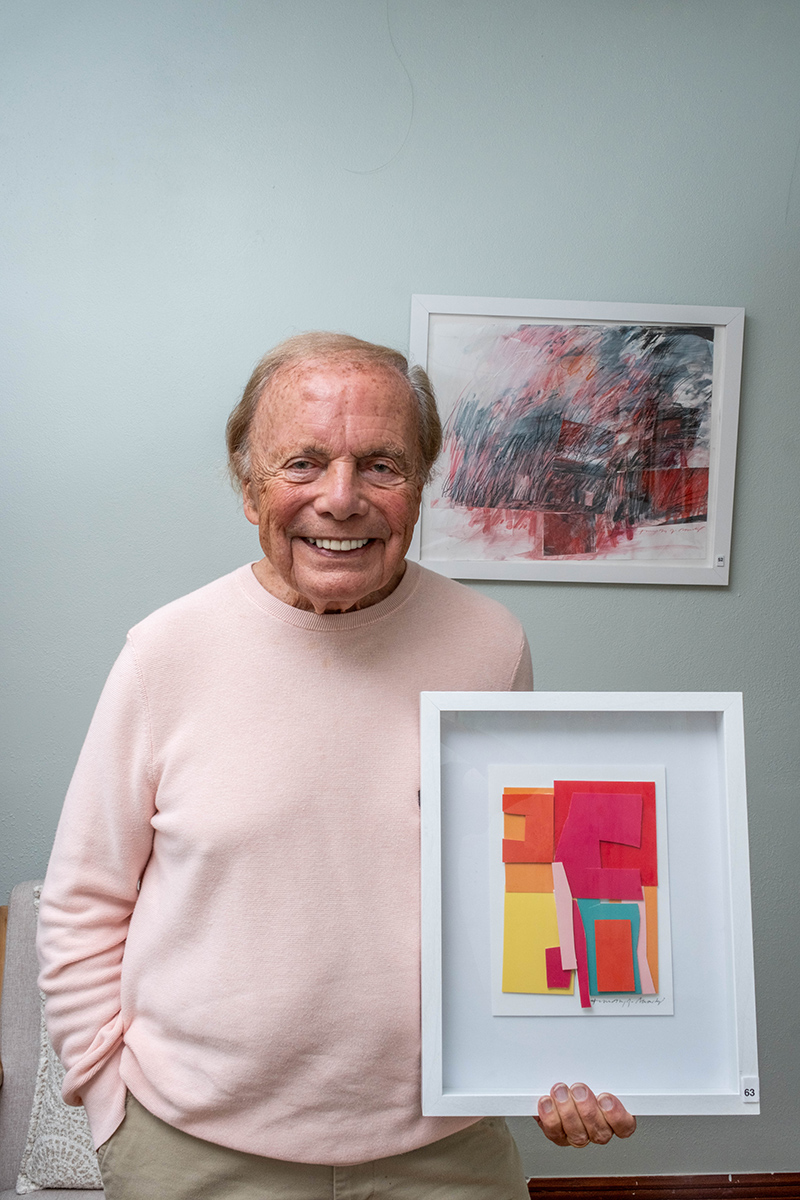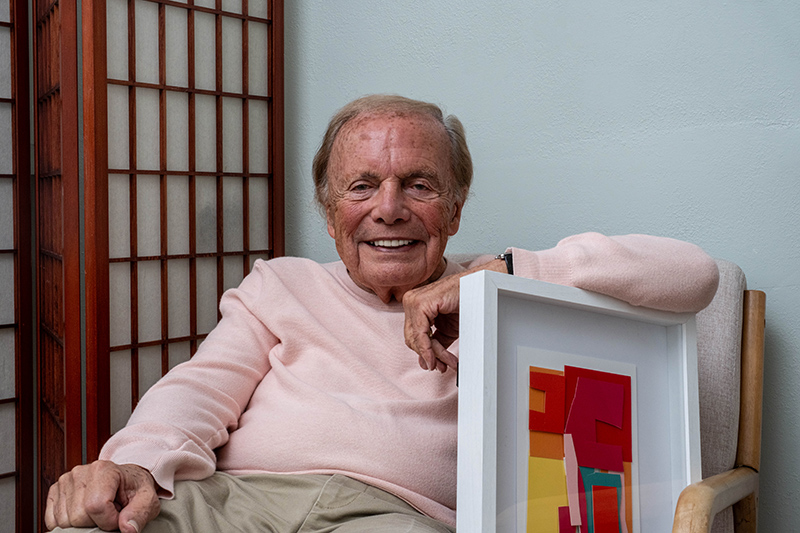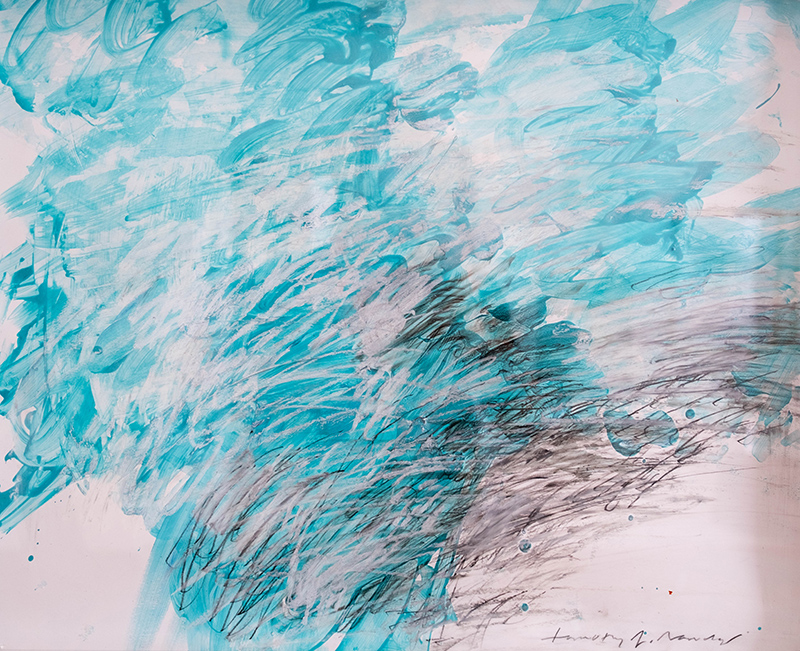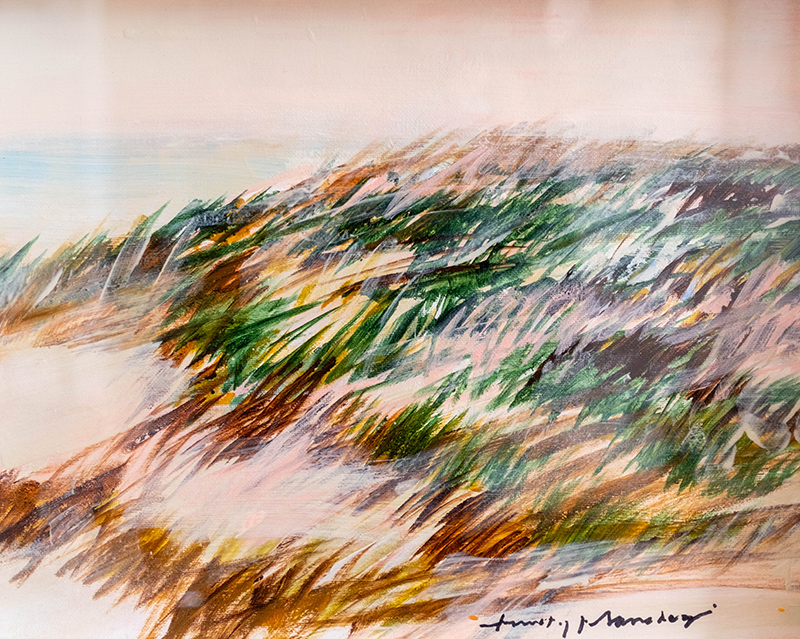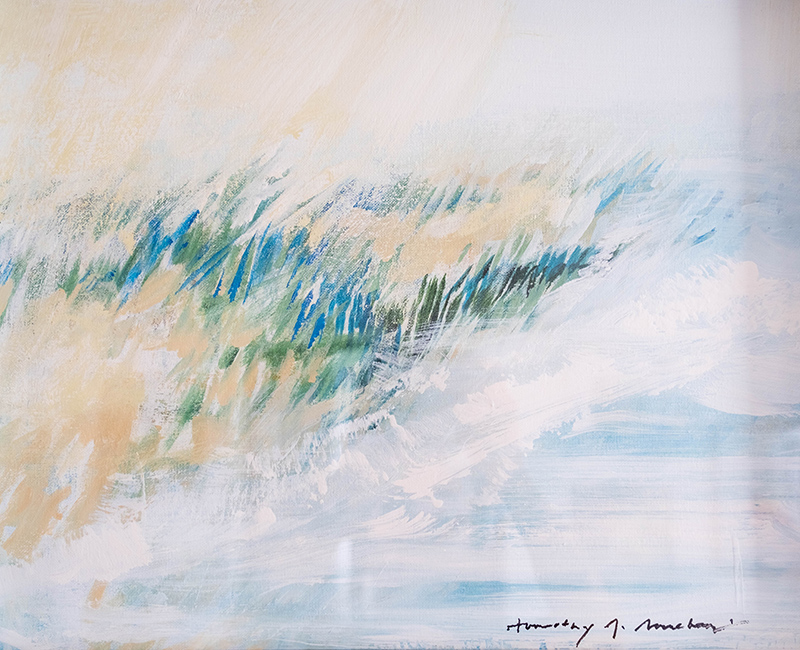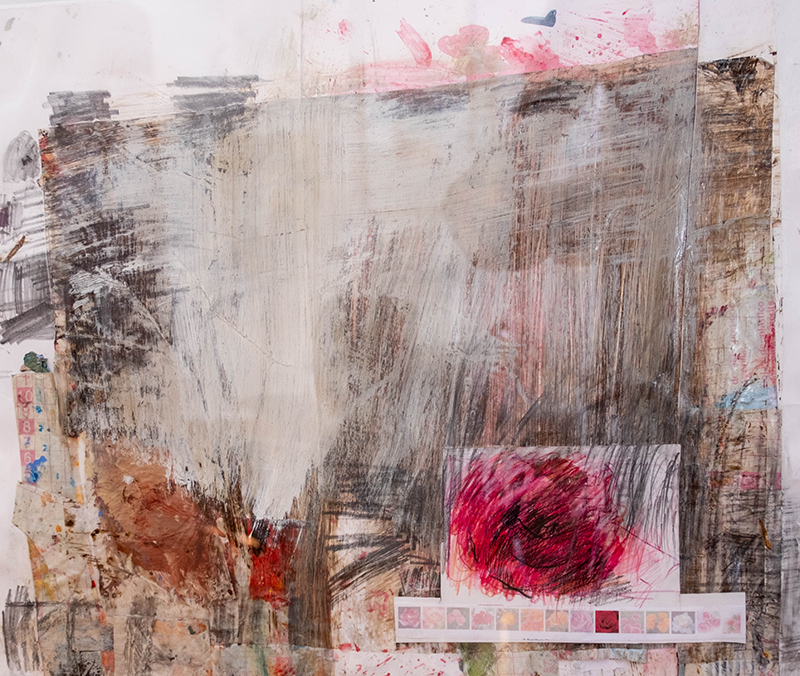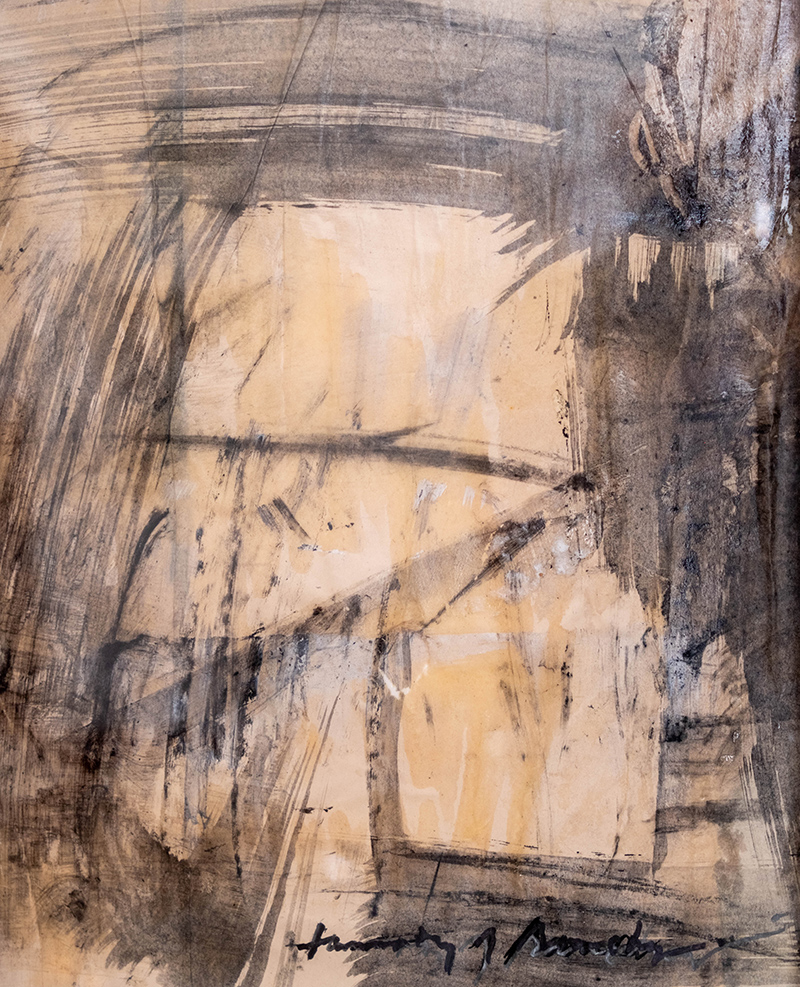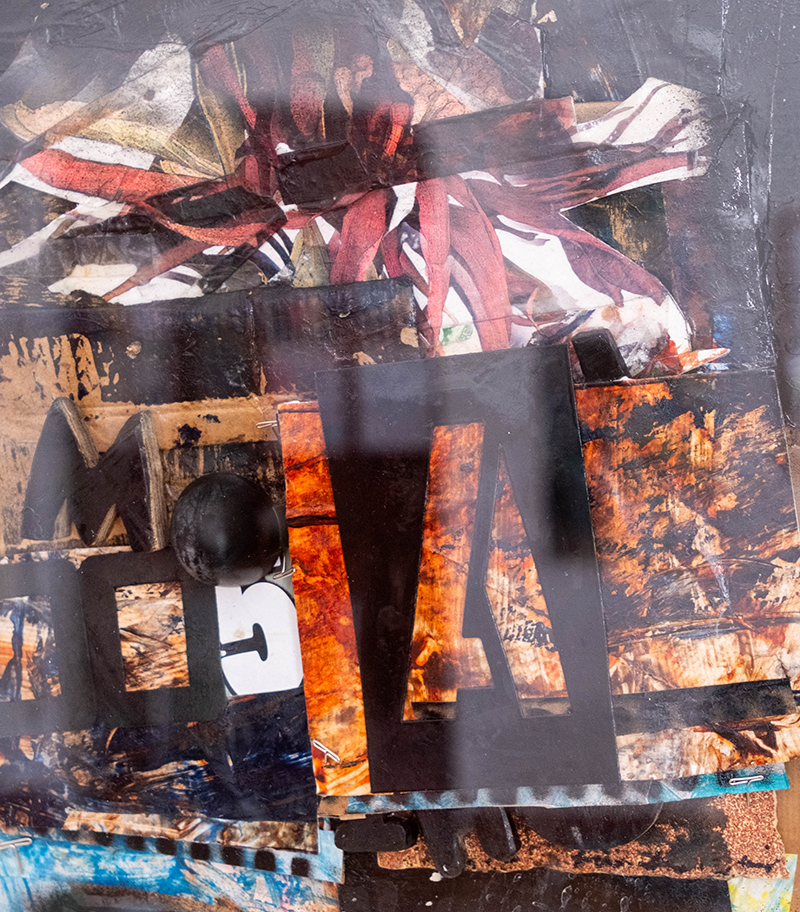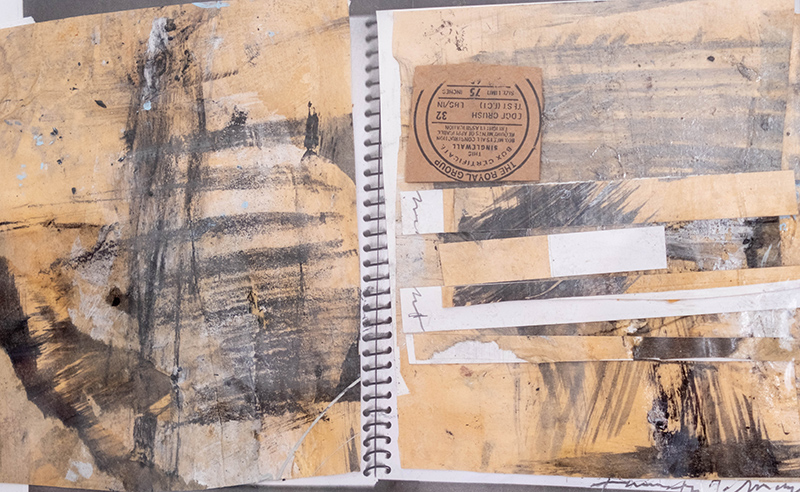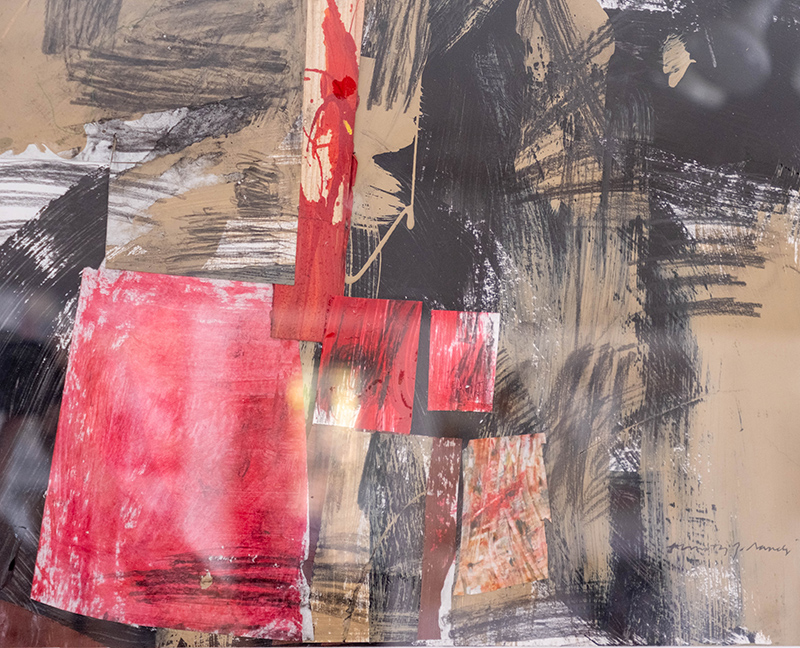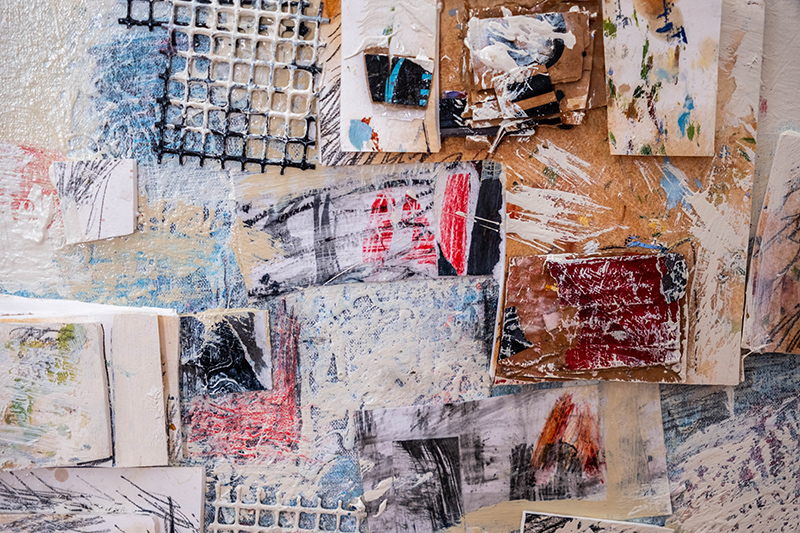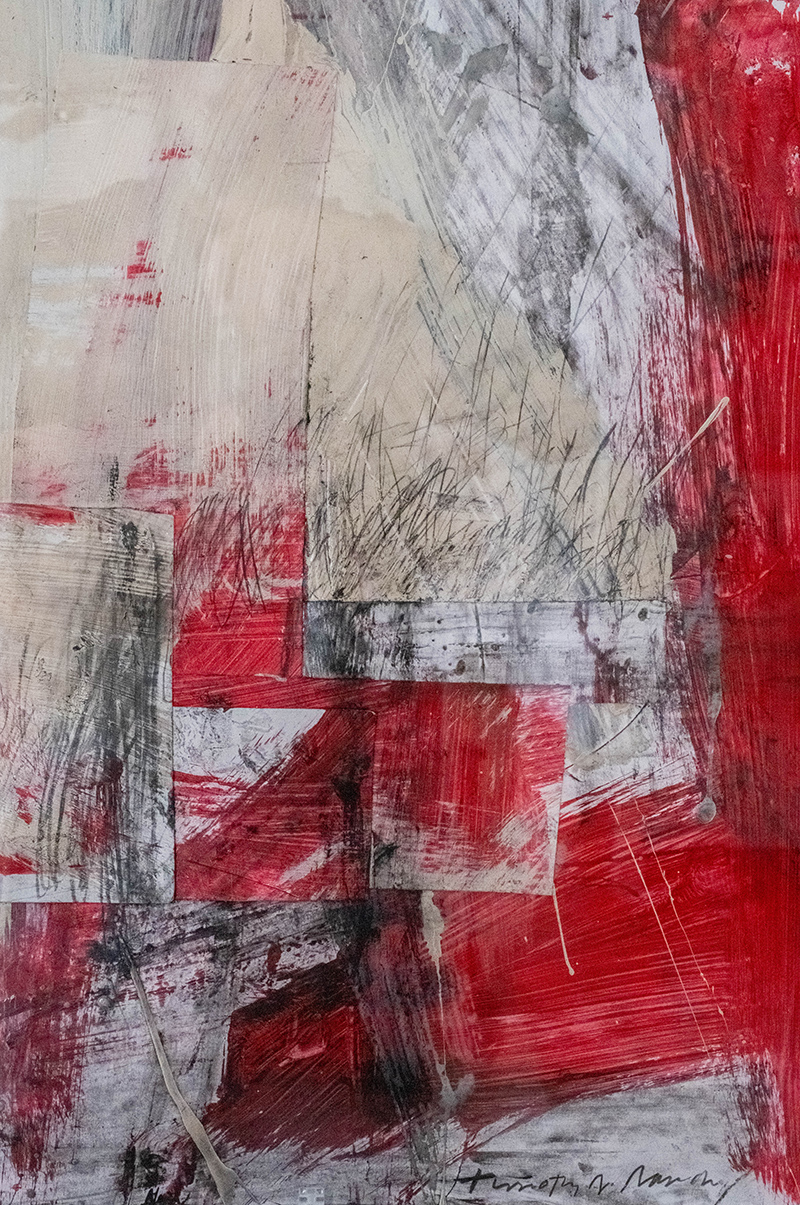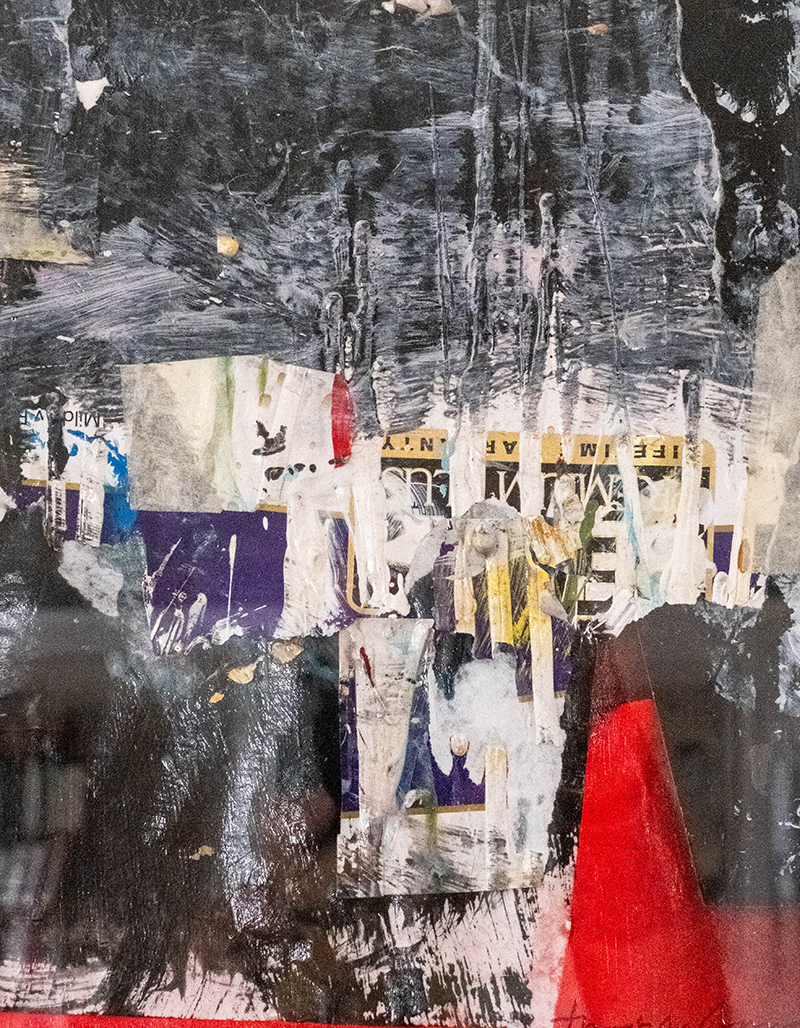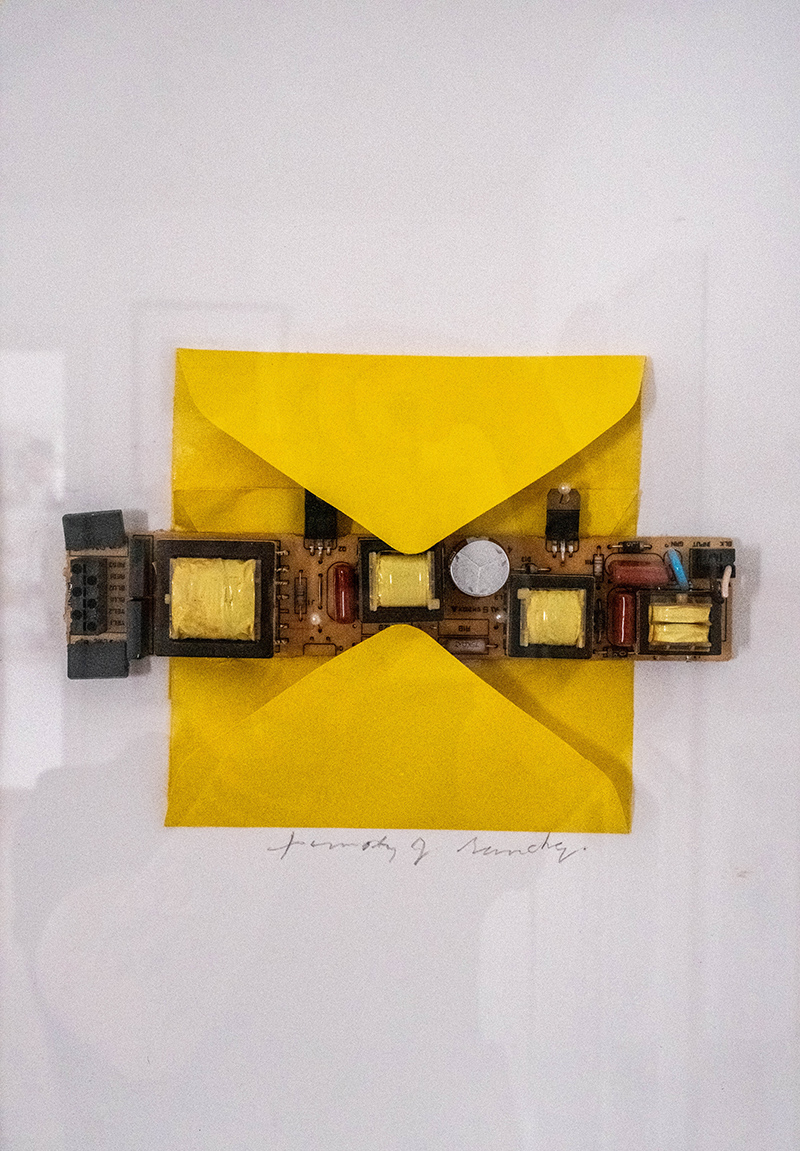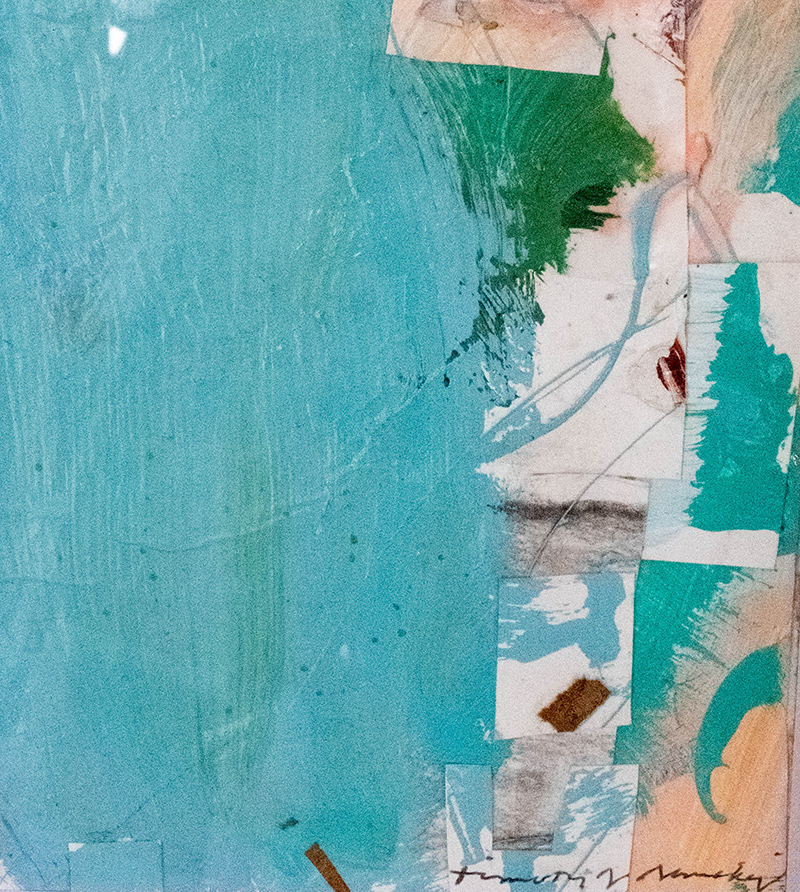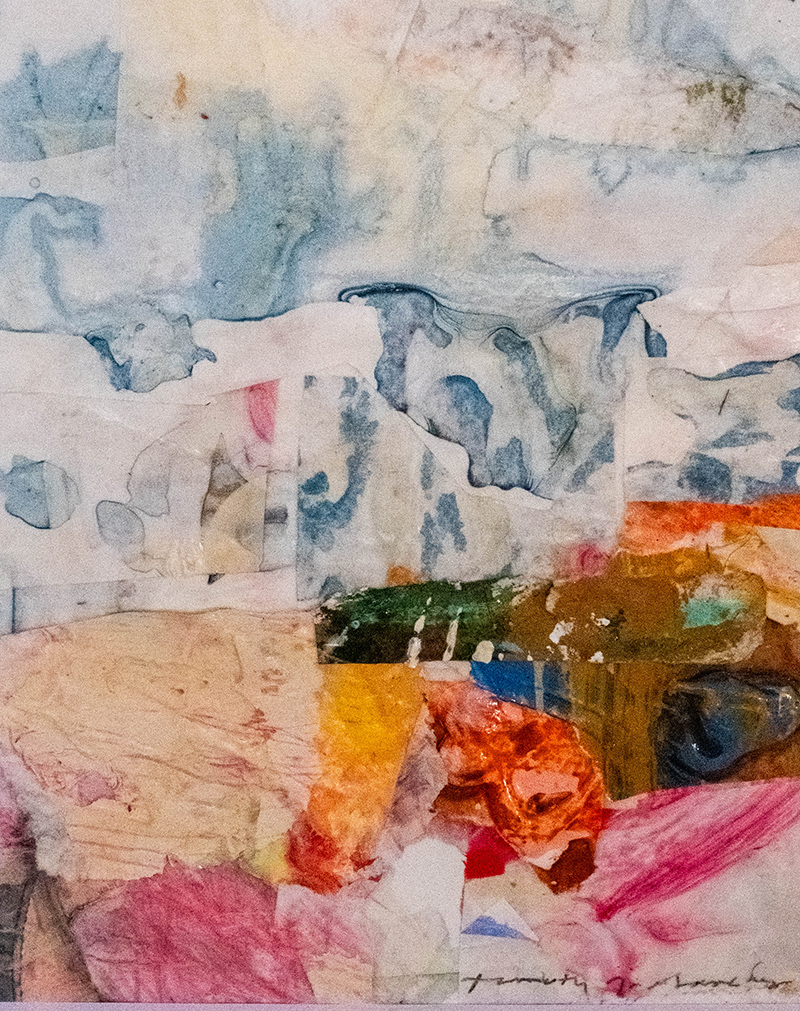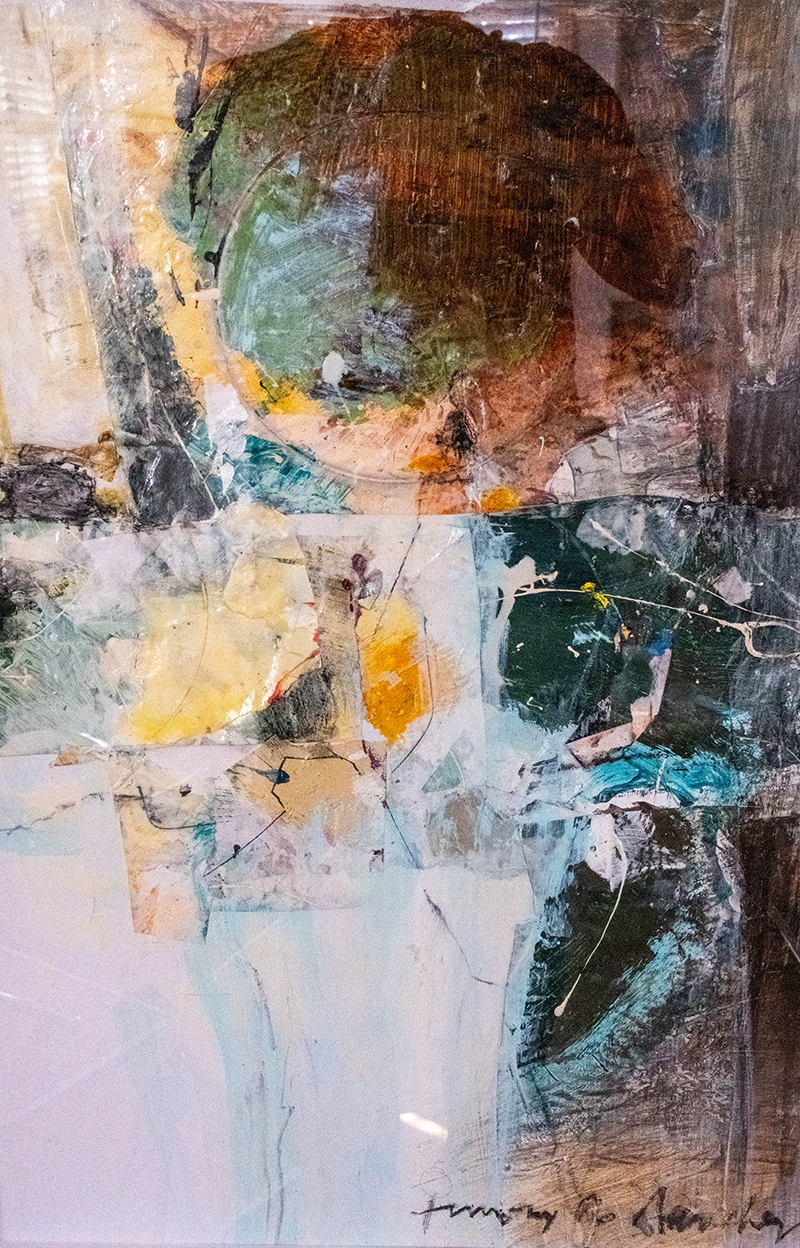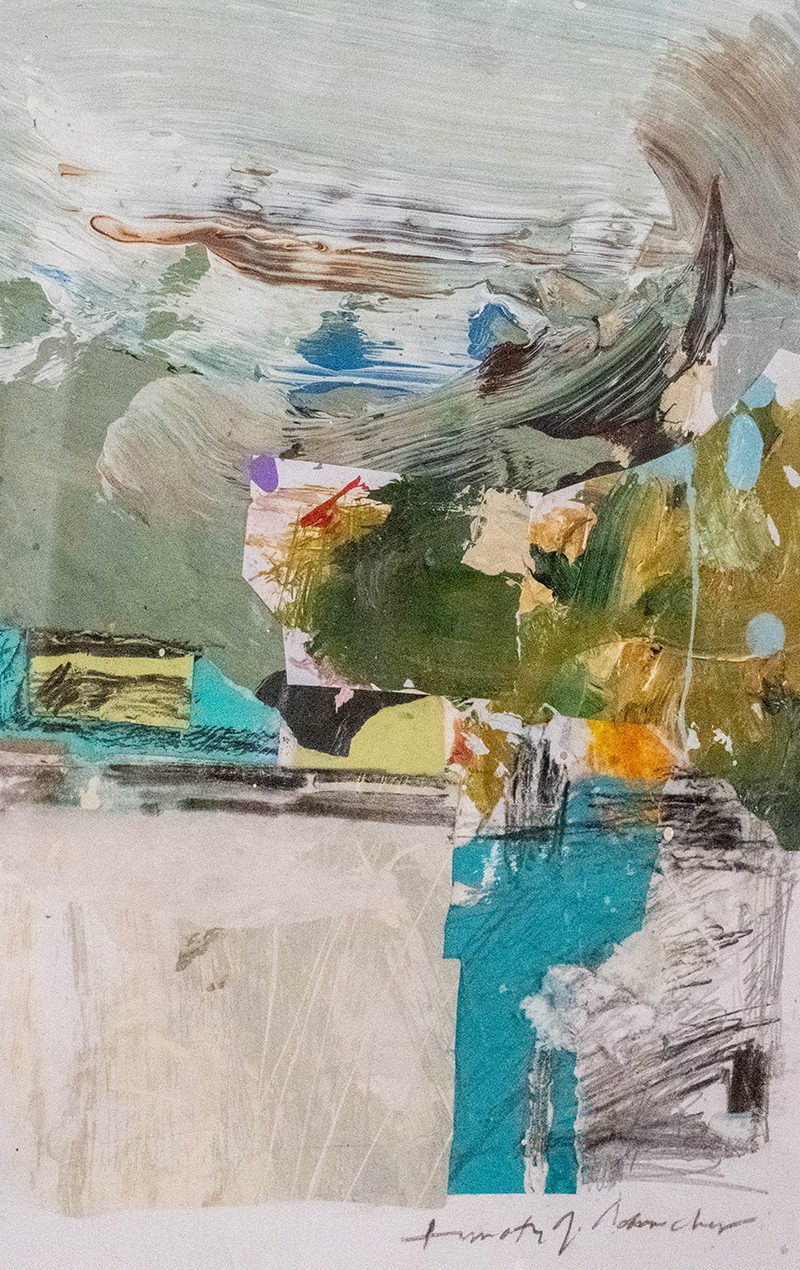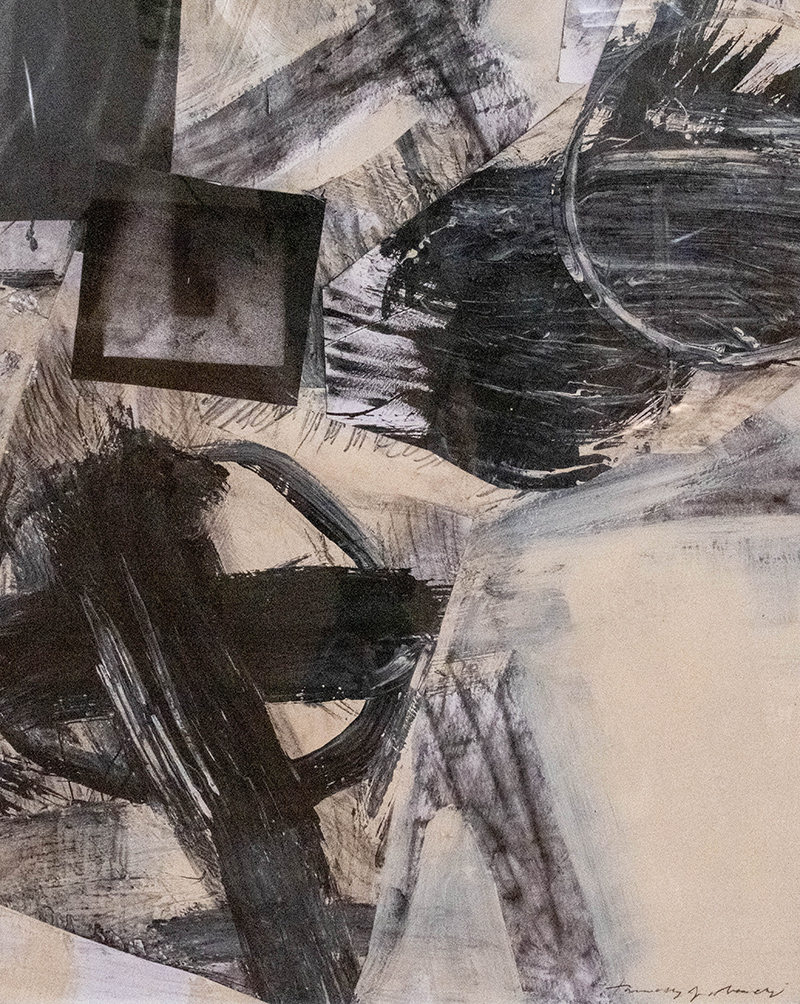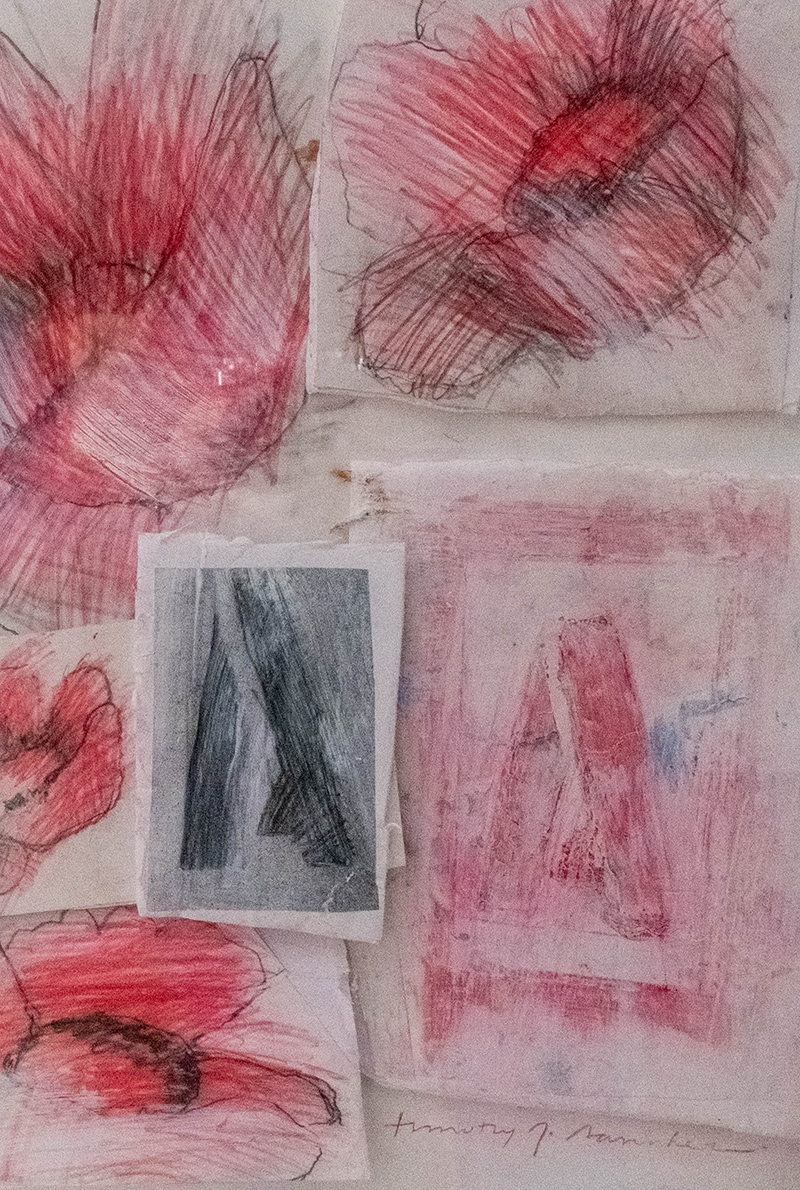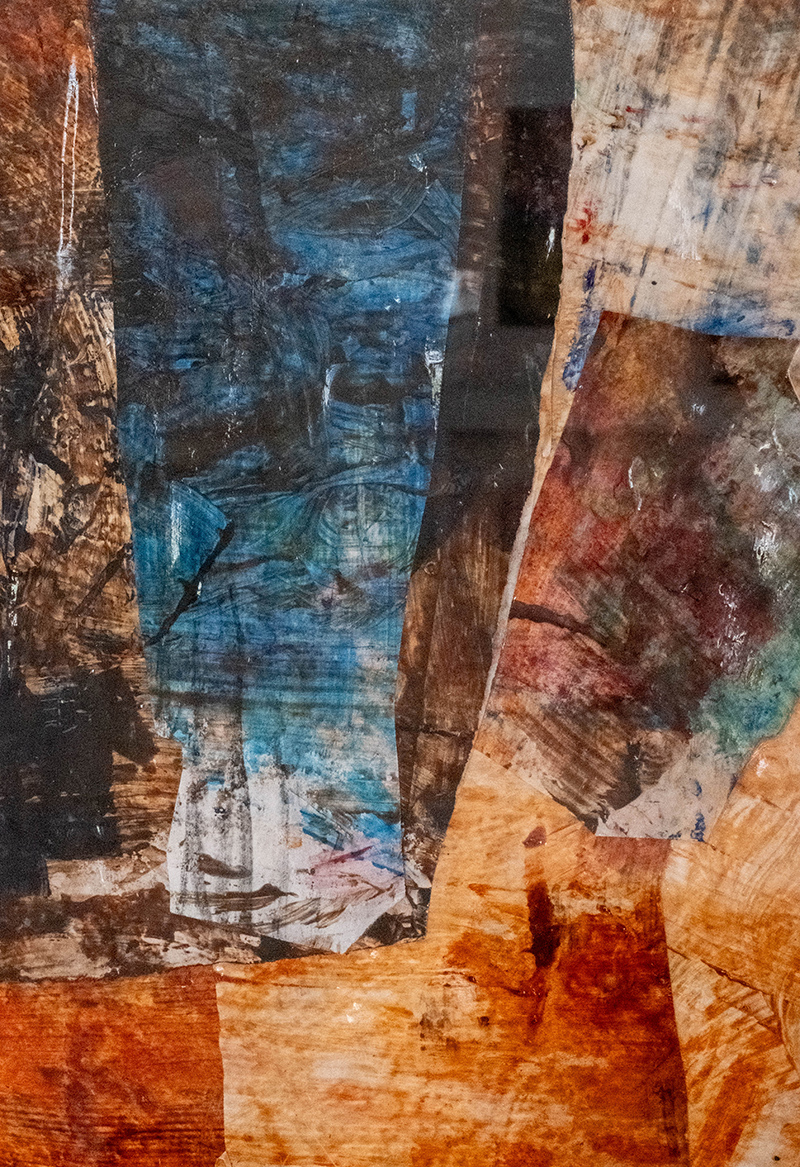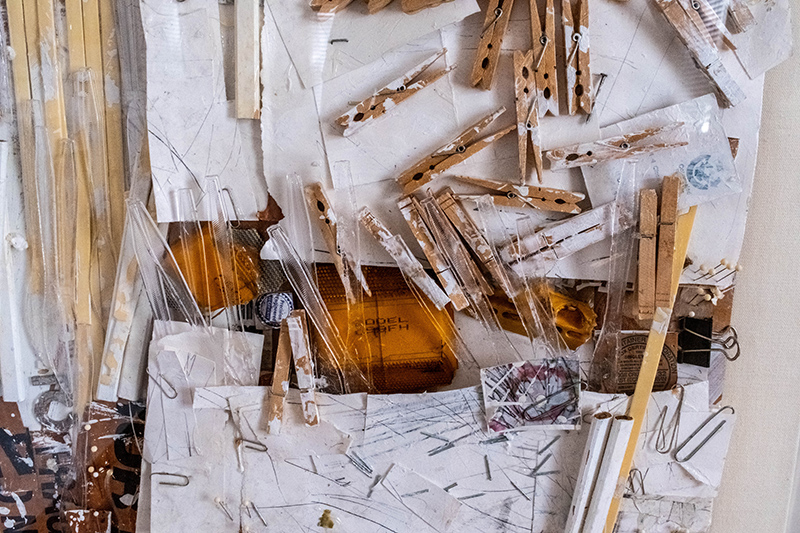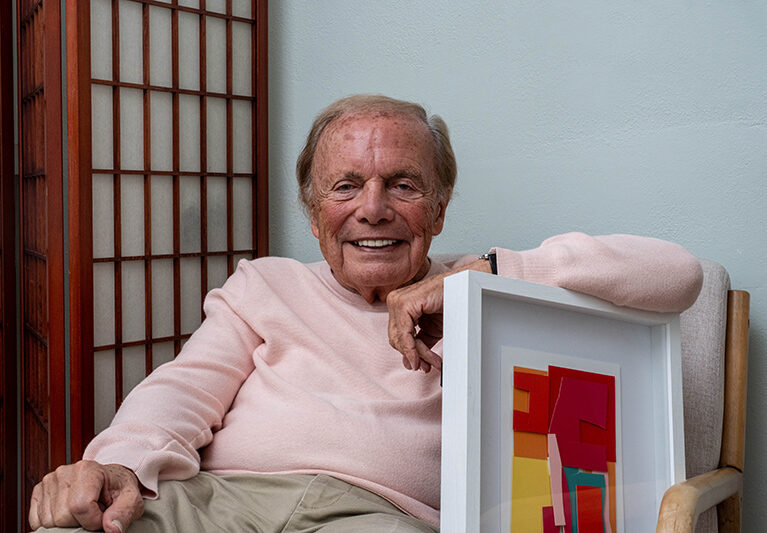
Step into the creative realm of Timothy J. Sanchez, who has merged collage and painting into a smorgasbord of colorful, inventive visuals in an exhibit he titles Reconstructed Paintings. He created the new works, on display at the Center for Spiritual Care through April 30, by integrating aspects from unfinished projects into fresh, new creations.
“Sometimes when a work of mine remains unfinished, I’ll set it aside. I never throw an unfinished piece away because almost always there are successful passages and areas I like,” says Sanchez.
“If I’m working on paper I might tear those passages out. If it’s on canvas, I’ll use my scissors and cut them out. Suddenly I have this collection of good-looking scraps, and it just makes sense to reconfigure them as a new piece. They won’t all work, of course, but when they do it’s wonderful.
The result is a reconstructed painting,” he explains.
“The exhibit is primarily collage, where many are conceptual because my thought process is as important as the structural development. I’m essentially a non-objective artist, so my process starts with thoughts rather than objects. If my work has any images at all, they’re generated from the materials I’m using.”
For this show, Sanchez assembled paintings and drawings with the intention of deconstructing and reordering them into new pieces. At face value, the process may sound simplistic, but it is as challenging as paintings by famous artists, such as John Singer Sargent.
“Sargent made it seem so effortless. But he had to build up to his surface using many academic tools. His last layers of paint, the ones we usually focus on, are the most fluid. Though the results of my work are totally different, I try, similarly, to build them on a solid structure so it will have the underpinnings to support the flourishes on the surface,” says Sanchez.
Some of his new works, with their swaths of vibrant painted layers combined with the fusion of the collage pieces, create drama and tension.
For example, his painting Floral Interference uses layers and scratches to suggest a gauze-like veil. Beneath it is the hint of flowers struggling to blossom, all surrounded by flourishing life in the perimeter. Its interpretation, of course, is in the eye of the beholder.
“I want my art to make the audience think, to be able to be contemplative. I want viewers to be able to read into these just the way they want to read into them. I don’t want to tell people what they’re seeing, I want to see what they’re seeing. I am very comfortable with that,” says Sanchez.
“Robert Rauschenberg is another American artist whose work I found admirable. But almost every artist I’ve looked at seriously has influenced or inspired me, especially in creating these dichotomies between energy and then arresting it.”
The works will certainly arrest the viewers’ sense of sight by leading them to ponder how the unrelated parts from prior compositions could have been melded together to create these new visually dazzling pieces.
His Polychrome Study achieves it with an explosion of colors and forms that blend into a cohesive abstract that demands the viewer’s attention, and only an extended viewing will reveal its secrets.
Sanchez, who has resided in Vero Beach for nearly 25 years, earned his Master of Fine Arts from Long Island University, where he studied under a number of noted colorists. His undergraduate work was done at SUNY Buffalo, where he had daily access to the Albright-Knox Museum. The museum has one of the earliest and best collections of contemporary American art, which influenced him then and now.
“Really, all my teachers have influenced me. In graduate school, Robert Yasuda was especially supportive. He was showing at the Betty Parsons Gallery, so he was coming from an echelon all his students aspired to. Stan Brodsky was a pillar of strength and encouraged me to experiment with color and light. He was represented by the June Kelly Gallery in Soho for more than 40 years.”
In Vero Beach, Sanchez says the subtropical sunlight and ocean coastline gives him enormous energy and inspiration. The beauty and elegance here also suit his sensibility, and he appreciates that objects and structures are well cared for.
“Vero seems to smack of all that. There aren’t many towns this size that have founded their own art museum and professional theater and then consistently, over decades, kept them alive and growing. The Vero Beach Museum of Art’s holdings get better as the years go on,” says Sanchez.
Likewise, he asserts that the Center for Spiritual Care has become a powerhouse in the local art community, with exhibitions that demonstrate with monthlong exhibits how an artist’s intent comes to fruition.
In his leisure time, Sanchez enjoys entertaining other artists with dinners that generate lively discussions and friendships. As with any good collage, the various artistic approaches of guests at his soirees are fertile grounds for innovative ideas and thoughts.
“The best leisure time I have is spent in conversations with other people, mostly artists. I never know what’s going to generate an artistic process through them. It may be something someone says, or an action, or just the feel of the whole thing.”
Sanchez also approves of the aesthetic graciousness of Vero Beach, which has established the town as a hub for artistic expression.
“If the Impressionists had known about Florida they would have come here instead of to the south of France,” he says seriously, albeit with a smile.
The exhibit can be viewed at the Center for Spiritual Care by appointment or on weekends from 1 p.m. to 4 p.m. Call 772-567-1233 or visit CenterSpiritualCare.org.
Photos by Joshua Kodis