They’re quiet, fast and wildly popular – and emergency rooms across Florida say e-bikes and electric scooters are sending a growing number of riders to the hospital with life-altering injuries.
What began as a convenient, affordable transportation trend has evolved into a major public safety concern, with doctors warning that high speeds, minimal protection and a lack of regulation are creating a perfect storm for trauma on Florida’s roads and sidewalks.
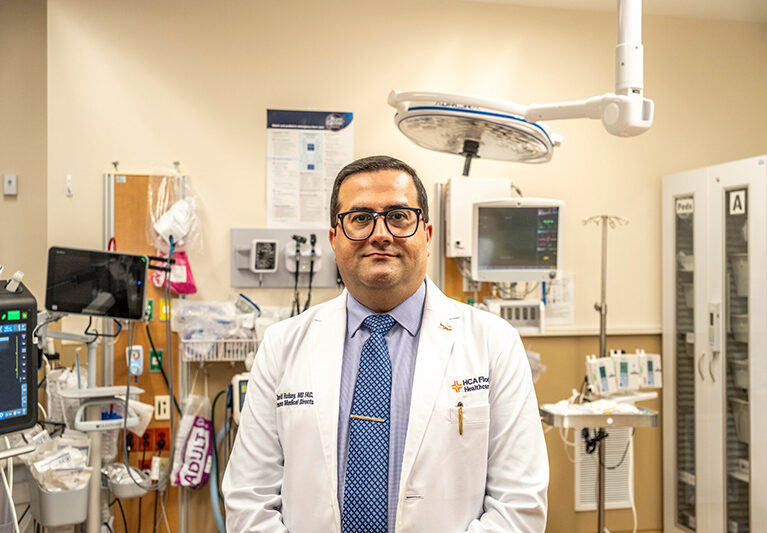
“We’ve seen a significant increase in accidents related to what we call micro-mobility,” said Dr. David Rubay, chief of trauma and emergency surgery at HCA Florida Lawnwood Hospital. “The term micro-mobility refers to e-bikes, scooters and mopeds that can reach speeds of up to 32 miles per hour. We consider many of these injuries preventable if the operator follows the proper methods for using this equipment.”
But many people don’t follow the guidelines and hospitals across the state report treating serious e-bike and e-scooter injuries daily, many involving traumatic brain injuries, internal bleeding and broken bones that require hospitalization. Emergency room physicians say teens and adults riding high-speed models without proper protective gear make up a growing share of those patients.
According to Dr. Rubay, the primary danger lies in the lack of protection.
“The biggest problem is that these bikes provide no protection for the body, so the impact of a crash goes directly to the rider,” he said. “While we travel much faster in cars, we’re protected by airbags, seatbelts and the structure of the vehicle. With an e-bike, it’s just you and the pavement.”
Florida consistently ranks among the states with the highest number of bicycle crashes and fatalities. In 2024 alone, the state recorded more than 9,300 bicycle crashes and 207 cyclist deaths. However, e-bikes are not tracked separately in official statistics, despite traveling significantly faster than traditional bicycles. Those higher speeds increase the risk of collisions with vehicles, pedestrians and slower riders and often result in more severe injuries such as head trauma, fractures and internal injuries.
“E-bikes are much faster than bicycles, and they’re silent,” Dr. Rubay explained. “That creates a problem for drivers because they can check their mirrors, see and hear nothing, and within seconds an e-bike is right next to them. Many accidents happen simply because drivers don’t see or hear the e-bike. The same is true for pedestrians, they don’t hear it coming, get startled, and can stumble or fall.”
Under current Florida law, e-bikes are treated like traditional bicycles rather than motor vehicles, as long as they meet specific criteria. Riders do not need a driver’s license, registration, title, or insurance for Class 1, 2 or 3 e-bikes.
To qualify under the law, an e-bike must have operable pedals, a seat or saddle, and an electric motor of less than 750 watts. Speed limits vary by class:
- Class 1: Pedal assist only, stops assisting at 20 mph (motor only works while driver is peddling).
- Class 2: Throttle-assisted, stops at 20 mph (motor works when not peddling but only provides power up to 20 mph).
- Class 3: Pedal assist, stops at 28 mph.
E-bikes that exceed these specifications may be classified as mopeds or motorcycles, and subject to stricter regulations.
Because Florida does not require licensing or formal training for e-bike or e-scooter riders, doctors say many users are unfamiliar with basic traffic laws, such as stopping at intersections.
Helmets are required only for riders under 16, leaving adults free to ride without one, despite the increased risk of head injuries.
One of the most troubling scenarios Dr. Rubay encounters involves young riders.
“One of the most disheartening things I see is a child under the age of 16 coming in with severe head trauma from an e-bike accident,” he said. “Why a parent would let a 10- or 12-year-old operate a motorized vehicle unsupervised is beyond my comprehension. These children don’t know the rules of the road and don’t have the maturity to operate a moving vehicle.”
Some local governments are beginning to respond. Last month, Indian River County passed new regulations aimed at improving e-bike safety. Riders under 16 are now prohibited from using e-bikes on public roads, bike lanes and shared-use paths.
Under the new regulations, e-bikes are banned from sidewalks when a bike lane is available, and devices exceeding 750 watts are prohibited from sidewalks, bike paths and shared roadways.
Riders must follow traffic laws, use lights and reflectors at night, and wear helmets if they are under 16. Helmets are strongly recommended for all riders.
Even with protective gear, Dr. Rubay says high-speed crashes carry serious risks.
“Even a helmet won’t eliminate the force of impact,” he said. “It’s the weight and speed that cause head injuries, and the cervical spine can be injured as well. Long bones like the femur and tibia are often affected. Falling off a bike at low speed is one thing, but falling at 30 miles per hour is very different.”
He also urges riders to wear reflective clothing to improve visibility.
“E-bikes are hard to see from a car,” he said. “You may see the car, but that doesn’t mean the driver sees you.”
Beyond crash injuries, e-bikes present another danger – fire risk from rechargeable batteries.
“Some of these batteries are cheaply made and poorly manufactured,” Dr. Rubay warned. “We’ve seen severe burns from batteries catching fire while charging. These devices should be charged outside, just in case.”
As Florida’s streets grow more crowded and micro-mobility devices become more powerful, trauma surgeons like Dr. Rubay fear the consequences will only worsen without meaningful change.
While e-bikes offer an efficient and eco-friendly way to get around, he stresses that they must be operated with the same care and caution as any motorized vehicle. Without better education, consistent statewide rules, and a cultural shift toward safety, the injuries filling emergency rooms today may only be a preview of what’s ahead.
Dr. David Rubay graduated from Florida Atlantic University for general surgery and from the University of Florida for trauma and critical care. He can be reached at 772-462-3939.