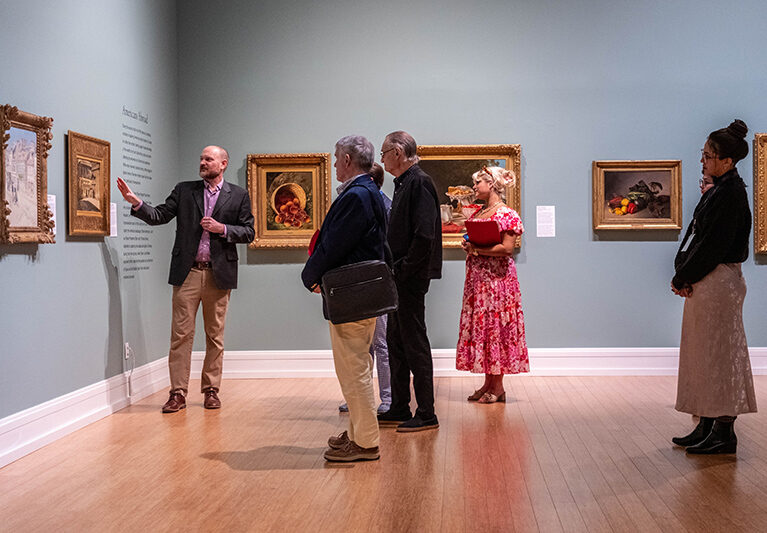
You’re going to want to make multiple visits to view the “American Made: Paintings and Sculpture from the DeMell Jacobsen Collection” exhibition at the Vero Beach Museum of Art. On display through June 7, the exhibit contains artworks spanning 250 years, from the late 1700s onward.
Organized into eight thematic sections, it includes 75 paintings and nine sculptures chosen from more than 300 artworks collected by Diane DeMell Jacobsen, Ph.D., and her late husband, Thomas Jacobsen.
Diane Jacobsen formed the DeMell Jacobsen Foundation after his death, continuing his wish to collect great American artworks and share them with the public, says Jonathan Stuhlman, Ph.D., senior curator of American art at the Mint Museum and the exhibition’s co-curator.
Among the works by women artists is “Portrait of Sarah Anne Walter Deming” c. 1829, by Sarah Miriam Peale, who is considered the first female to succeed as an American artist. The show has four works by the prolific Peale family, including iconic portraits of George and Martha Washington, c. 1846, by Sarah’s cousin, Rembrandt Peale.
The scene of Daniel Huntington’s fascinating “The Counterfeit Note” 1858, is a merchant shop around the time of the Civil War, when rampant counterfeiting made it challenging for shop keepers and advantageous for con artists, often working in pairs.
“So you’ve got a shopkeeper and his wife, and he’s carefully inspecting this bill. She’s looking back and her thumb is up, pointing over her shoulder towards this guy,” says Stuhlman, of the shady character in the background.
Centered is an elegantly dressed woman inspecting fabrics, begging the question, he says, “Is she part of the scam or is she innocent? Just a great picture.”
Within the landscape section, William Bradford’s “Ship Trapped in Pack Ice” c. 1871, illustrates Americans’ growing fascination with exploration. Having himself been stranded on the ice during a three-month Arctic expedition, Bradford depicted its vastness by painting small figures on the boat and ice.
“It’s interesting, all of the landscape paintings in the show have people in them except for the one on the title wall by Asher Durand,” says Stuhlman.
Small figures are plentiful in Ferdinand Richardt’s “A View of Niagara Falls” 1873, reflecting its appeal as a tourist site even then.
“It’s interesting for its vertical composition, but it also looks like he’s trying to capture all the major parts of the falls; the power of the water and the foam and steam that rises up as it’s crashing down.”
Among the still lifes is “Sunflowers” c. 1880s, by the acclaimed Charles Ethan Porter, one of the first Black artists at New York’s National Academy of Design.
“This is kind of a unique still life in that it’s vertical, it’s not a tabletop piece, and the composition shows the sunflower at various stages of life. So I see this as kind of an allegory of the phases of life.”
“Still Life of Vegetables” c. 1822 by James Peale (Sarah Peale’s father) is one of the earliest American still lifes, says Stuhlman. He adds that the Peale family had an experimental working farm where they grew seasonal vegetables, a ready crop for paintings.
Stuhlman explains that “A Basket of Peaches, Upset” 1865, by William Mason Brown, was the basis for one of the more popular chromolithographs, paintings commissioned and reproduced by 19th century printmakers.
Another type of still life, trompe l’oeil (fool the eye), became popular here in the 19th century by artists such as John Haberle, who employed the technique in his humorous self-portrait, “That’s Me! (Self-Portrait)” 1882, presenting as a grinning mustachioed man. An image of Oscar Wilde is centered in a sunflower brooch on his lapel.
“This is meant to be a tintype photograph of him that’s been tacked up to a boarded wall. To push the illusion, one corner is pulled away and he’s put his calling card there. That’s where he signed it,” says Stuhlman.
As Americans began to flock to Paris, then the center of the art world, they also started exploring further afield.
Edwin Lord Weeks, known as an Orientalist for depicting exotic locales, is represented by “Sacristy and Doorway of the Cathedral Granada” c. 1880. Stuhlman says it took Jacobsen 14 years to find the painting’s fascinating frame.
“It’s an original period American frame, but it has Arabic inscriptions all around the edges that relate to the elements of the architecture.”
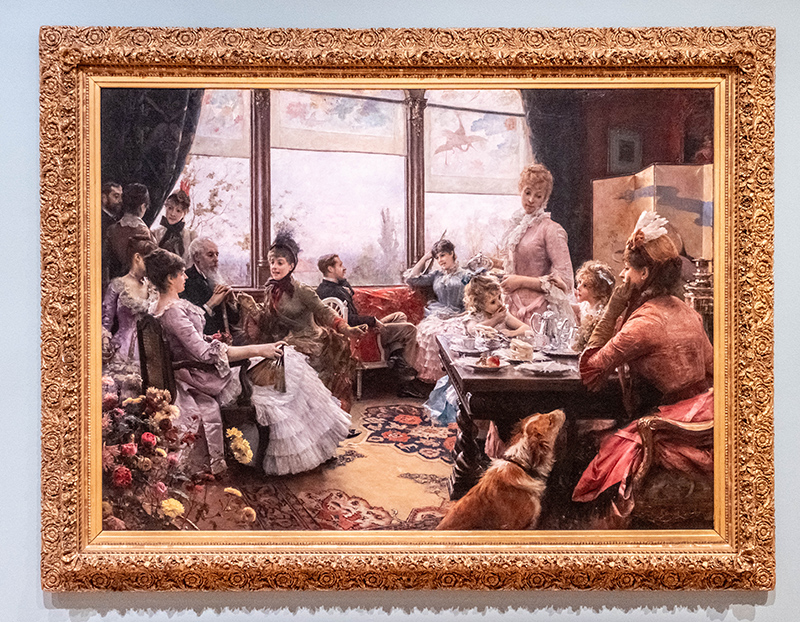
The large-scale “Five O’Clock Tea” 1884, by Julius LeBlanc Stewart, is characteristic of his penchant for depicting elements of upper-class life.
“He had this great ability not only to paint the people and the interactions, but all of the different elements and textures, the silver, the rugs, the fabrics, the hair on the dog,” says Stuhlman. The artist’s self-portrait peeks out at the top left corner.
The sweet “Baby Charles Looking Over His Mother’s Shoulder (No. 3)” 1900 is by the renowned Mary Cassatt, the only American to exhibit with French Impressionists.
“It’s unique in that it is her well-known mother and child subject, but she’s doing something different by turning the mother’s back to you. It shows her skill using a mirror; you see the mother’s face, but only in reflection.”
Colonies and Destinations contains works produced in the various artists’ colonies that popped up at the time, such as Marsden Hartley’s “Movement, Sails” 1916. It was painted in Provincetown, Mass., after he returned home from Europe, where he had experimented with cubism.
“This is a sailboat that he’s abstracted, flattening it out into just a beautiful abstract pattern. It’s modern in that it’s not a realistic representation; it’s broken down into those cubist planes. But it’s also very traditional in a way because it’s very balanced.”
The Titelman Gallery houses works from 1930 and beyond, such as “Play at Dark” 1935, a congenial summer scene by African American artist Allan Rohan Crite.
“The whole community’s out playing together in the park. You’ve got the great swing set here, and you can almost hear the people talking, the hum of activity of people coming out and getting together before going in for a meal.”
Circus performers were a favored subject of Walt Kuhn, who recognized that their public persona often belied their grueling, underpaid work. In “Lady in Vest” 1939, her wearied expression counters the colorfully embroidered vest, necklace, hat and earrings.
In contrast, “Singer” c. 1976, by Ernie Barnes, depicts a performer singing purely for the joy of it, despite the dismal setting.
“He’s giving it his all; that emotion, that intensity of his closed eyes; just giving it his all.”
In “Peinture/Nature Morte” c. 1924, Patrick Henry Bruce presents a geometric tabletop still life inspired by cubism and abstraction.
“It’s tilted up toward you, with various geometric objects on it. But he’s really worked to simplify it, make it as abstract as possible,” says Stuhlman.
Lois Mailou Jones, another acclaimed Black artist, frequently traveled to Europe on fellowships – often to the creative haven of Paris where she could escape some of the prejudices she encountered in America.
“Paris le Soir” c. 1948/1950, a visual collage of all its major landmarks, portrays her love of the city.
Charles Alston’s “Black and White #8” 1961 is the most abstract painting in the show.
“I think this is a really important painting. It’s a moment in early 1960s, the middle of the Civil Rights Movement. An African American artist, Alston did a whole series of black and white paintings that I think were his way of commenting on racial struggles at the time,” says Stuhlman.
For more information, visit VBMuseum.org.
Photos by Joshua Kodis