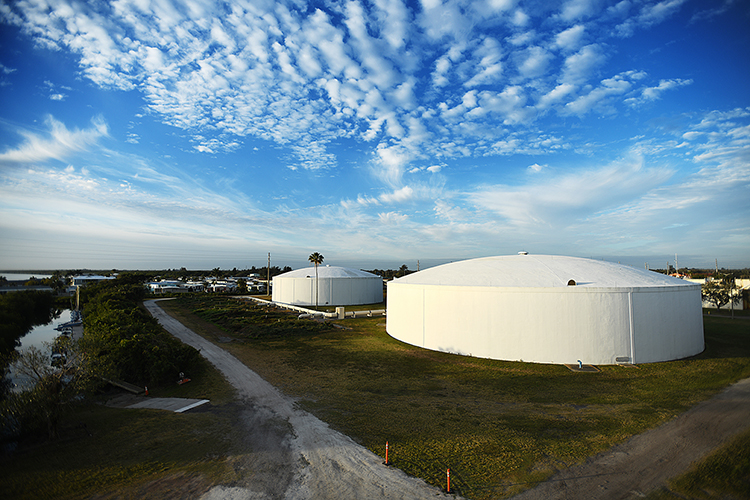
The City of Vero Beach’s water-sewer customers are now officially on the hook for $55 million borrowed to pay for roughly one-third of the wastewater treatment plant now under construction at the city’s airport complex.
Municipal bonds to refinance the entire $150-plus million project will come later, Utilities Director Rob Bolton said, likely in 2027.
The city used state environmental and infrastructure grants to design and begin laying the pipelines and foundation for the plant, with the $55 million bridge loan approved by the Vero Beach City Council on Dec. 9 providing cash needed to continue the work until all the documentation needed to issue bonds can be completed.
“The Raymond James proposal consists of a fully funded term loan (in the form of a Bond Anticipation Note) with a fixed, tax-exempt interest rate of 3.53 percent, which can be locked up to 30 days prior to closing. Additionally, the loan allows prepayment without penalty beginning June 30, 2026,” Bolton said in a background memo on the council action.
Jay Glover, the city’s bond consultant of PFM Financial Advisors explained, “Based on discussions with City staff and Bond Counsel, it was determined that the proposal submitted by Raymond James provided the best combination of interest rate and terms most favorable to the city.”
“The city will be able to invest the proceeds at an interest rate comparable to the borrowing rate, thus offsetting part of the interest cost,” Glover said.
Bolton still does not know the full water-sewer rate implications, as the plant was initially sketched-out before the Covid pandemic when it was expected to cost around $80 million. As supply chain issues dragged on – and fuel and labor costs, interest rates and overall inflation soared over the past few years – the tally for what the city bills as a state-of-the-art “One Water” facility has nearly doubled.
Payments of all debt service on the new plant are not funded by Vero property taxes, but through customers’ water-sewer bills paid to the utility enterprise fund. Vero Beach residents make up roughly 60 percent of utility customers, with the balance residing in the Town of Indian River Shores and the unincorporated South Beach.
The ratio of outside-the-city ratepayers is growing as Vero pushes the boundaries of its Septic Tank Effluent Pump (or STEP) system hookups northward and southward on the island to move older island homes off septic tanks in accordance with state environmental mandates.
As the customer base continues to increase, the cost of building the One Water plant is spread among more utility ratepayers. The city is also planning to initiate a monthly fee on water customers who have sewer lines available but are lagging in signing up for a STEP conversion.
Bolton is hoping growth factor in the sewer customer base, plus declining long-term interest rates, will keep utility bill increases under control.
Staff, aided by its financial consultants, will undertake a rate study in 2026 that will demonstrate the city’s ability to repay the bonds.
By then, hopefully, Vero will get caught up on crucial, timely financial reporting because no monthly or quarterly financial reports have been publicly available since Summer 2023.
In May, then-Councilman Taylor Dingle, selected as vice mayor last month by his peers after finishing as top vote getter in the November municipal election, requested monthly and quarterly financial reporting resume post-haste. Dingle at the time was overridden by Mayor John Cotugno, who said Finance Director Lisa Burnham and her staff had way too much on their plates to resume the financial reports.
Cotugno suggested this past August as a doable start date for producing the reports, but work on the city’s audit dragged on months longer than anticipated into the fall – overtaking the council’s need to receive timely reports of the city’s financial position.
Vero’s finance staff filed the city’s 2022-23 audit and certified financial statements that were due in June 2024 in spring 2025, causing the Florida Legislature to impose financial sanctions on the city. One month of state sales tax sharing was lost – but then covered by an errors and omissions insurance policy.
Police and fire pension funds collected by the state from certain fees and taxes also were withheld until Vero complied with state law. Failure to properly fund the pensions for two years cost the city a six-figure sum in interest and necessitated a re-statement of the Police Pension Fund.
Vero then filed the city’s 2023-24 audit and certified financial statements due this past June later than expected in October. Though the city appeared on an initial non-compliant list published by the Florida Joint Legislative Auditing Committee, Vero did achieve compliance by November when the JLAC began taking enforcement action against cities, counties, school districts, colleges and special taxing districts.
Then in early November, Vero got a notice that it was again in violation of state law, this time for submitting incorrect numbers to the State of Florida for the publication of Truth in Millage or TRIM notices. City officials said this was due to a data entry error related to a downtown improvement fund being left off state forms. The City Council held a cure meeting on Nov. 25 to approve the corrected numbers.
The finance staff is now working on the 2024-25 budget year’s financials with auditors Cherry Bekaert. But despite the addition of two experienced accountants to assist Burnham, the city staff is apparently still too overwhelmed to produce a basic profit-and-loss statement or budget-to-actual report.
According to the city clerk’s office, “The financial reports are anticipated to resume at the early part of 2026.”
Councilman John Carroll on Dec. 9 took issue with the position the lack of financial reporting has put the city’s decision makers in – operating and voting on this year’s budget somewhat blind.
Carroll said the city had a budget surplus of hundreds of thousands of dollars this summer during budget workshops – but did not know it due to the lack of reporting. He complained that staff could have moved forward with important projects sooner had the finance staff brought forth timely data.
Cotugno and City Manager Monte Falls defended Burnham and her staff for their hard work, saying they walked into an unworkable situation with outdated accounting systems and deserve much gratitude.
Vero’s volunteer Finance Commission, an advisory group tasked with studying city finances in more detail than council has time to do during business meetings, seemed to shirk its primary responsibility in 2025. No meetings were held between Jan. 22 and Oct. 9 as the city navigated getting in compliance with state reporting requirements. No November meeting was held and no December meeting is scheduled.
The more publicly available financial data Vero Beach can have at the ready for financial institutions to evaluate the city’s stability and accountability, the better deal ratepayers could get in 2027 when the city seeks one or more bond issues for the entire project.
When contacted in early 2025, bond rating agency Fitch reported to Vero Beach 32963 that it had insufficient recent financial data on file to issue a bond rating at that time. It’s been many years since Vero floated a large bond for utility infrastructure, so any bond rating work is nearly a decade old. The city could opt to circumvent requesting a full-blown public bond rating process through a firm like Fitch or Moody’s and instead seek funding through the private bond market.