A sharp decline in middle school enrollment over the past decade has spawned a bold plan to reconfigure the county’s public education infrastructure by expanding and combining several elementary and middle schools, while relocating others.
The goal is to refill half-empty classrooms and save on operating expenses while creating better learning environments for students.
The move comes amid growing competition for students and the state funding they bring with them. Florida’s school voucher system – the so-called Family Empowerment Scholarship Program – pays $8,000 to $10,000 or more per student per year for private school tuition or homeschooling.
School Superintendent David Moore and other administrators have been previewing their reconfiguration plan – which will roll out over the next three years – at town hall-style meetings with educators, parents and community groups, and Moore said the vast majority of comments have been positive.
“Based on the feedback from the community, we’re very excited to get started on this work and improve the quality of education in the district,” Moore said.
The reconfigured district will give parents more pathways to choose from, said Trina Van Os, president of the Parent Teacher Association at Beachland Elementary School, which is not undergoing any changes under the plan. Van Os has a child in fourth grade at Beachland and another in sixth grade in the gifted program at Gifford Middle School.
“The move to middle school is a concern to some parents,” Van Os said. “This plan provides more options. Students can stay in a more familiar setting until eighth grade if they prefer. The district is doing a really good job of laying out all the logistics and thinking through the details.”
Up until now, district students have attended a K-5 elementary school and then moved to a larger middle school for grades 6 through 8, but the district’s four middle schools are at just 54 percent capacity, Moore said at a Nov. 17 Superintendent’s Workshop meeting.
Local public school enrollment shrank during the pandemic, and not all of it returned afterward, but the decline in middle school enrollment is also due in part to a problem researchers call “transition regression.” This academic/social setback can occur when graduating fifth graders leave an elementary school with 400-500 students and are thrust into a middle school environment with 1,000 or more students where they must change classrooms, classmates and teachers every 50 minutes.
The change can be daunting for 11- and 12-year-old kids who are used to a small, familiar school where they spend most of the day in the same classroom with the same teacher and friends. As a result, some parents choose to send their sixth graders to smaller private schools or teach them at home, Moore said.
To sidestep transition trauma and maximize classroom space, “the district began exploring ways to keep those kids in our schools, and the K-8 model provided that opportunity for us,” Moore said. “K-8 schools are not innovative and have been around for a long time, but they’re new to us.”
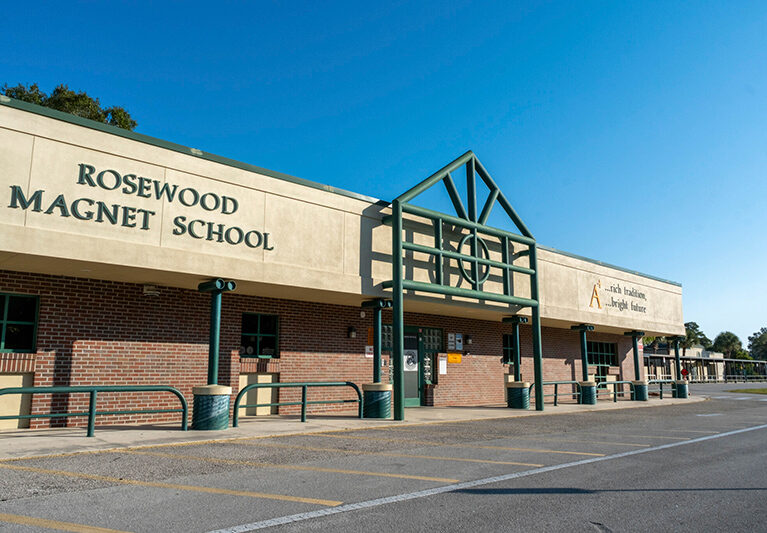
Four K-5 schools were expanded to the K-8 model this year – Fellsmere Elementary, Osceola Magnet, Rosewood Magnet and Pelican Island Elementary. Each school added sixth grade this school year and will add seventh and eighth grades over the next two years.
About two-thirds of graduating fifth graders chose to remain at their expanded K-8 schools, Moore said. That was a win for the district but also reduced the number of sixth graders enrolling in the district’s four “traditional” middle schools. As the new K-8 schools add seventh grade next school year, middle school enrollment will drop below 45 percent of capacity, according to Moore.
“That’s just unacceptable,” he said. “Having underenrolled schools hurts all schools.”
To combat that deficit, the district’s reconfiguration plan includes combining several K-8 and middle schools in the 2026-27 school year:
- Rosewood Magnet K-8 students and faculty will join students and staff at Storm Grove Middle School.
- Osceola Magnet K-8 moves to the Oslo Middle School building, while Oslo Middle School students and faculty move to the Vero Beach High School Freshman Learning Center, which will be renamed Vero Beach Middle School.
- Ninth grade students will be moved from the Freshman Learning Center into Vero Beach High School.
- Sebastian Elementary School of the Arts will move in with Sebastian Middle School.
- Indian River Preparatory Academy will move in with Treasure Coast Technical College.
Schools that students move out of will be repurposed for other district needs.
The current Osceola Magnet School campus will be modified to provide support for home-schooled and micro-schooled children, Moore said. A micro-school is a group of home-schooled students taught by a group of parents. “They could rent space to offer courses or programs they can’t provide at home” and get credit for learning that qualifies for the voucher system, he added.
The media center, administration building and cafeteria at the Rosewood Magnet School campus will be used for professional learning and before- and after-school programming. And the current Glendale Elementary School campus will be retrofitted as the new home for the Wabasso School for special needs students.
Attendance boundaries will be redrawn in accordance with the changes, and class times will be revised so that elementary schools and K-8 schools are on the same schedule.
“These changes allow us to expand resources and teacher compensation,” Moore said.
The teachers’ union, which tends to oppose closing public schools, is onboard with the changes.
“In this case, it will save our district from going bankrupt because students are leaving the system,” said Jennifer Freeland, president of the Indian River County Education Association.
“We see and understand the need to do this.
“By taking the older buildings out of school use, and renting space to homeschool parents, we save money on the overhead” and recoup some of the tax dollars lost to the voucher system, Freeland added. “Do we agree with everything in the plan? We need to learn more of the specifics before we can say.”
State programs like the voucher system and Schools of Hope – which provides funding for private charter school operators to locate in areas with low-performing public schools – may be appropriate in other districts, but not in Indian River County, said Adam Faust, a 30-year educator who is principal at Rosewood Magnet School.
The Indian River school district ranked 5th among the state’s 67 school districts for the 2024-25 school year, up from 38th in 2018-19, and public schools teach students more than just academics, according to Faust.
“We are teaching kids more than just reading, writing and math – we are teaching them teamwork and collaboration,” he said. “Public schools have a better product. We’ve proved that.”
“At the end of the day, what we’re doing is responding to what parents want,” Moore said. “We learned something at each of these sessions based on listening and learning about the problems that need to be solved.”
Combining Rosewood and Storm Grove “gives us the best of both worlds,” said Adam Crawford, the parent of a fifth grader at Rosewood and an eighth grader at Storm Grove. “We add the culture and high level of academics that Rosewood has built over the years with the special programs that Storm Grove Middle has offered.”
“It’s an ambitious idea, but the district is working overtime to anticipate the challenges,” said Gregory Harris, chorus and drama teacher at Storm Grove, who is part of a team working to make sure the merger goes smoothly. “They have been good about listening and responding to the ideas that parents have brought up.”
Parents, teachers and community members will have one more opportunity to voice their opinions at a second public hearing scheduled for 6 p.m. Dec. 17 at the school district office, 6500 57th St. in Vero Beach.