Pablo Picasso, the Spanish-born artist regarded as one of the most significant figures of the 20th century art world, produced more than 2,400 graphic prints throughout his career, the majority of which were made using etching and lithography techniques.
An interesting exhibit at the Vero Beach Museum of Art, Picasso and the Progressive Proof: Linocut Prints from a Private Collection, focuses on the linocut process, a technique he began to experiment with at age 77. It is on display through Jan. 4.
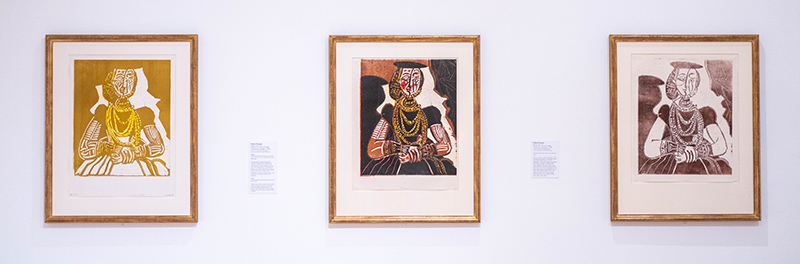
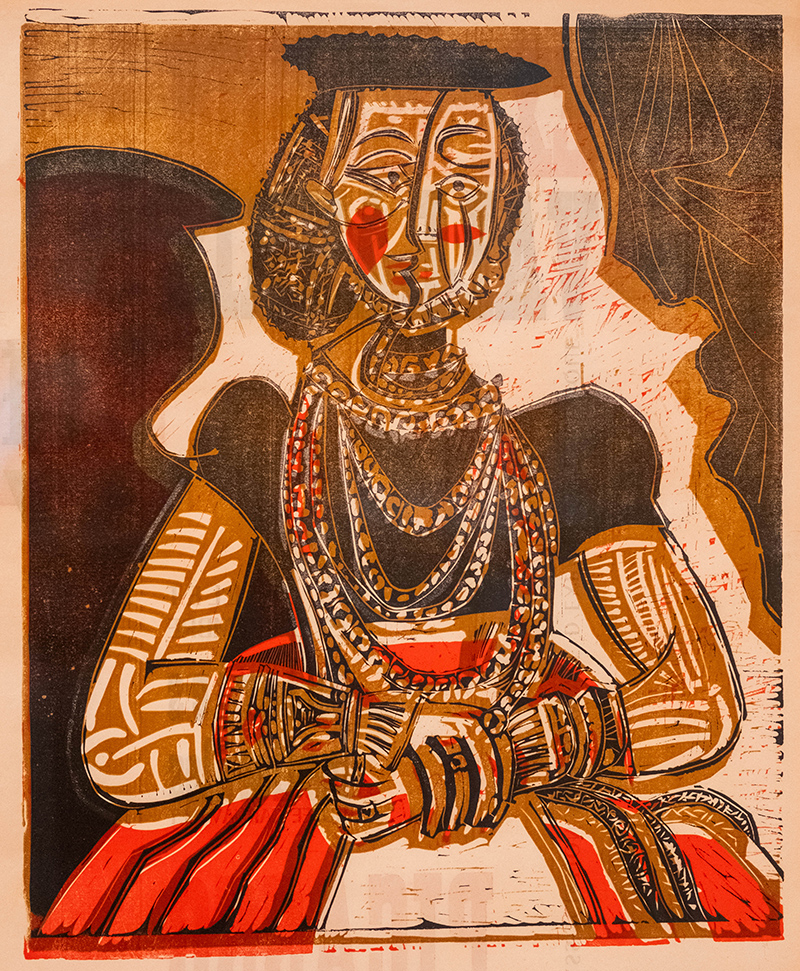
Curated by Richard P. Townsend, president of the Townsend Art Advisory LLC, the exhibition showcases the progression of three works: “Portrait of a Young Woman, after Cranach the Younger II” 1958, “Pique II” 1959, and “Bacchanal with Kid Goat and Onlooker” 1959. He would eventually produce roughly 200 linocuts.
Townsend spoke of the nationally touring exhibition at a lecture on “Picasso and the Masters … and Dora Maar Too,” in which he described how Picasso was influenced by such “grands maîtres” as Titian, Cranach and Goya when conceptualizing the exhibited prints.
He also touched on research recently discovered regarding unpublished drawings of Surrealist artist Dora Maar, one of Picasso’s many lovers.
In the late 1940s, Picasso, who of course was also highly prolific in painting, sculpture, ceramics and collage, moved to Vallauris, a town near the Spanish boarder known for its ceramics.
It was there that he met the printmaker Hidalgo Arnéra, from whom he learned how to carve linoleum.
“He said of Hidalgo, ‘Without Hidalgo, I am nothing, and without me, he is nothing.’ In other words, he was acknowledging the mutual relationship that they had,” says Townsend.
As an aside, it was around that time that Picasso also met Françoise Gilot, a French artist known for her ceramics and watercolors. Although they never married, they had two children together.
She left him 10 years later (and would later marry Jonas Salk) when Picasso met (and would later marry) Jacqueline Roque.
Although Picasso trained under his father in the academic system and understood the rules, he chose all throughout his life to challenge them, including his approach to making linoleum block prints.
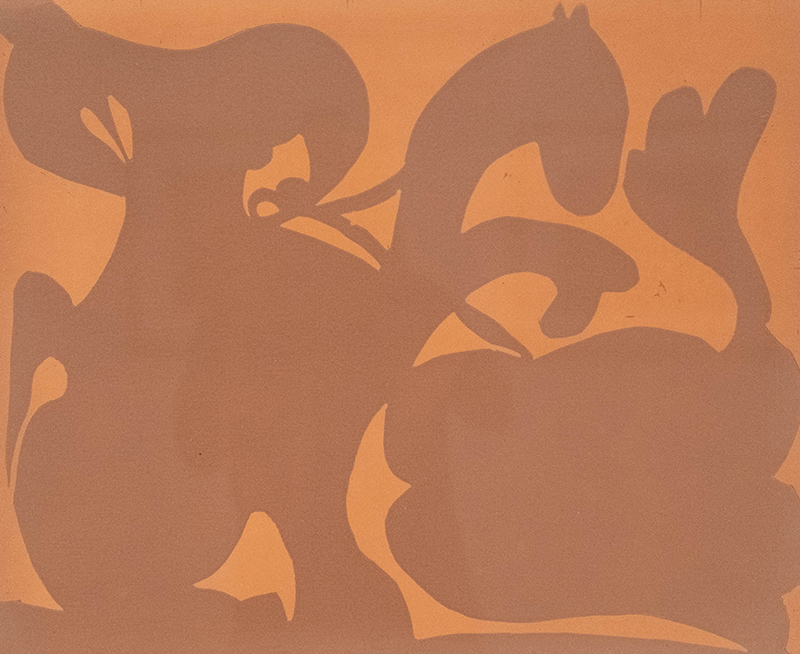
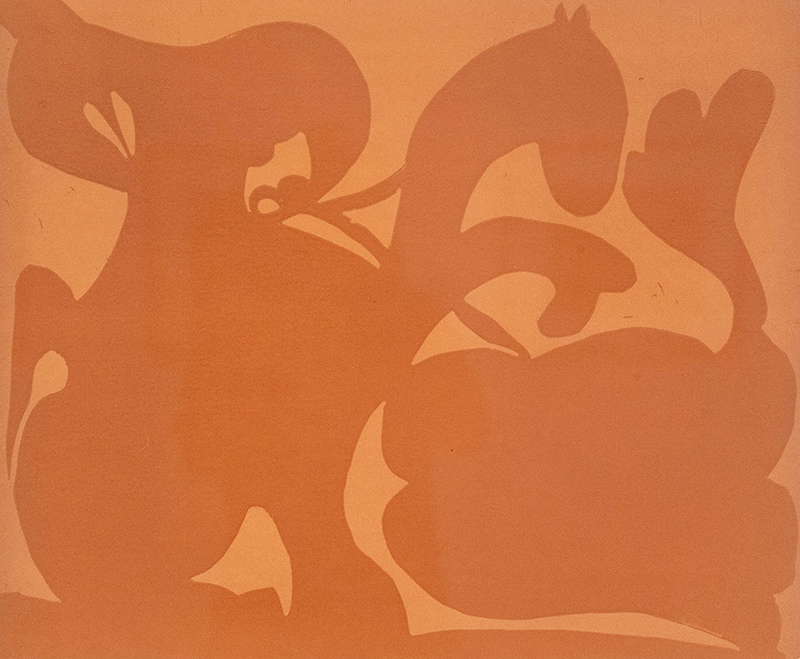
“Pablo Picasso is renowned for being a rule-breaker,” says Townsend. Ever the innovator, the exhibit illustrates how Picasso created a new, more efficient “lost block” process to make multi-color prints by re-carving a single linoleum block, rather than one each per color.
“He took what was thought a simple artistic process, and elevated it into a higher form of artistic expression. He whittled the block, or carved the block down, printing it in progressive stages as they went.”
Beyond that technical prowess, Townsend explains, Picasso played with timeless themes, infusing his simple line cuts with a sophisticated vision of historical images.
A photograph in the exhibition is of Picasso’s studio in the Villa La Californie in Cannes, circa early 1959, taken by André Villers. Townsend says Picasso made a very conscious decision to arrange the pieces in the shot, including a trial proof of his “Portrait of a Young Woman after Cranach the Younger II.”
“This is his very first print. It’s the most loved of all the linoleum block prints.”
The inspiration, Townsend says, was the 1564 painting “Portrait of a Woman,” by Lucas Cranach the Younger, son of the great German Renaissance painter Lucas Cranach the Elder.
“Picasso had a prodigious appetite for earlier art. He’s clearly fascinated by this remarkable moment in this German Renaissance painting. This is another key to how Picasso works,” says Townsend, commenting that Picasso frequently reinterpreted earlier artworks.
In this case, Picasso’s art dealer had sent him a postcard of the Cranach painting which Townsends says, “obviously triggered something. Picasso is omnivorous.”
Another print, Pique II or Pike II, is a stylized depiction of a bullfighting picador on horseback tormenting a bull with his pike, sourced from a plate in a series called La Tauromaquia (Bullfighting), by the Spanish painter and printmaker Francisco Goya.
Picasso used Plate 28, “The Forceful Rendón,” 1816, as the source for his own print.
After pointing out that carvings are printed in reverse, Townsend refers to the clear similarities between the two, despite Picasso’s more abstract style.
“Look at the relationship of these two figures, the picador on rearing horseback, with the lance stabbing the bull. I mean, this is the amazing thing about Picasso. Notice the tail of the bull. Isn’t that the most beautiful flourish you’ve ever seen? With the tail in Goya, it’s the same idea,” says Townsend.
“It’s not a copy, but Picasso is thinking, he’s looking. He’s looked at this many times. He has this in his memory. We call this received artistic tradition. It’s the great visual encyclopedia that artists keep in their mind, the great artists. But at any rate, he has everything here. It’s just been Picasso-fied.”
The third print in the exhibit is “Bacchanal with Kid Goat and Onlooker” 1959, an idyllic landscape by a lake that uses as its source “Le Concert Champêtre” (The Pastoral Concert) c. 1509, attributed to the Italian Renaissance master Titian.
“This is a great tradition in Venetian Renaissance painting, of a happy group, music making, picnicking, and of course this is all symbolic of lovemaking, the idylls, the idyllic pastoral pursuits,” says Townsend. “So, this is the imagery Picasso absolutely has in mind.”
While stylized, Picasso was, again, clearly influenced by the voluptuous figures and utopian setting of the painting when he designed the landscape and frolicking characters of his print.
“Now, did he have a picture of the Titian in a beautiful art book next to him while he was making this? Probably not.
“But it’s in his subconscious and it comes out and he expresses it,” says Townsend.
“I think this is the most beautiful and wondrous thing about art making and about great artists who just have this wellspring of creativity. That creativity means summoning up these images.”
Photos by Joshua Kodis