Save the Chimps, recognized as the world’s largest chimpanzee sanctuary, has experienced substantial growth and development since welcoming its initial group of 21 chimpanzees in 2001.
Five of that original group still reside at STC.
The nonprofit, which currently houses some 220 chimps, is currently embarking on an $18 million Capital Campaign to update, fortify and improve the campus, from the numerous chimp structures to the medical, kitchen and staff facilities. A donor will match contributions one-to-one or, for someone who has never given to the sanctuary, will match at two-to-one.
“The sanctuary is on 150 acres and it was built to last 20 to 25 years, and it’s now 25 years later,” says CEO Ana Paula Tavares, a Vero Beach resident.
Located fewer than 30 miles from Vero Beach in a rural part of Fort Pierce, the serene 12-island moated refuge was the dream of the late Carole Noon, Ph.D. Although Noon passed away in 2009, before seeing her dream fully realized, her legacy lives on.
Noon founded STC in 1997, assisted by funding from Jon Stryker of the Arcus Foundation, to rescue chimpanzees discarded by the U.S. Air Force space program as “surplus equipment,” and awarded to the Coulston Foundation, a horrific biomedical research lab in New Mexico.
One year later, it lost all its funding due to egregious animal welfare violations, and another 226 chimps needed to be rescued.
As STC wasn’t ready for that big an influx, they purchased and overhauled the lab, enabling the chimps to experience the outdoors for the first time. A nine-year Great Chimpanzee Migration ensued, with chimps transported to STC via a custom-built trailer; the last arriving in December 2011.
Chimps rescued from laboratories, the entertainment industry and the pet trade are now living their best lives in familial groups of 12 to 24, tended to by caregivers committed to their welfare.
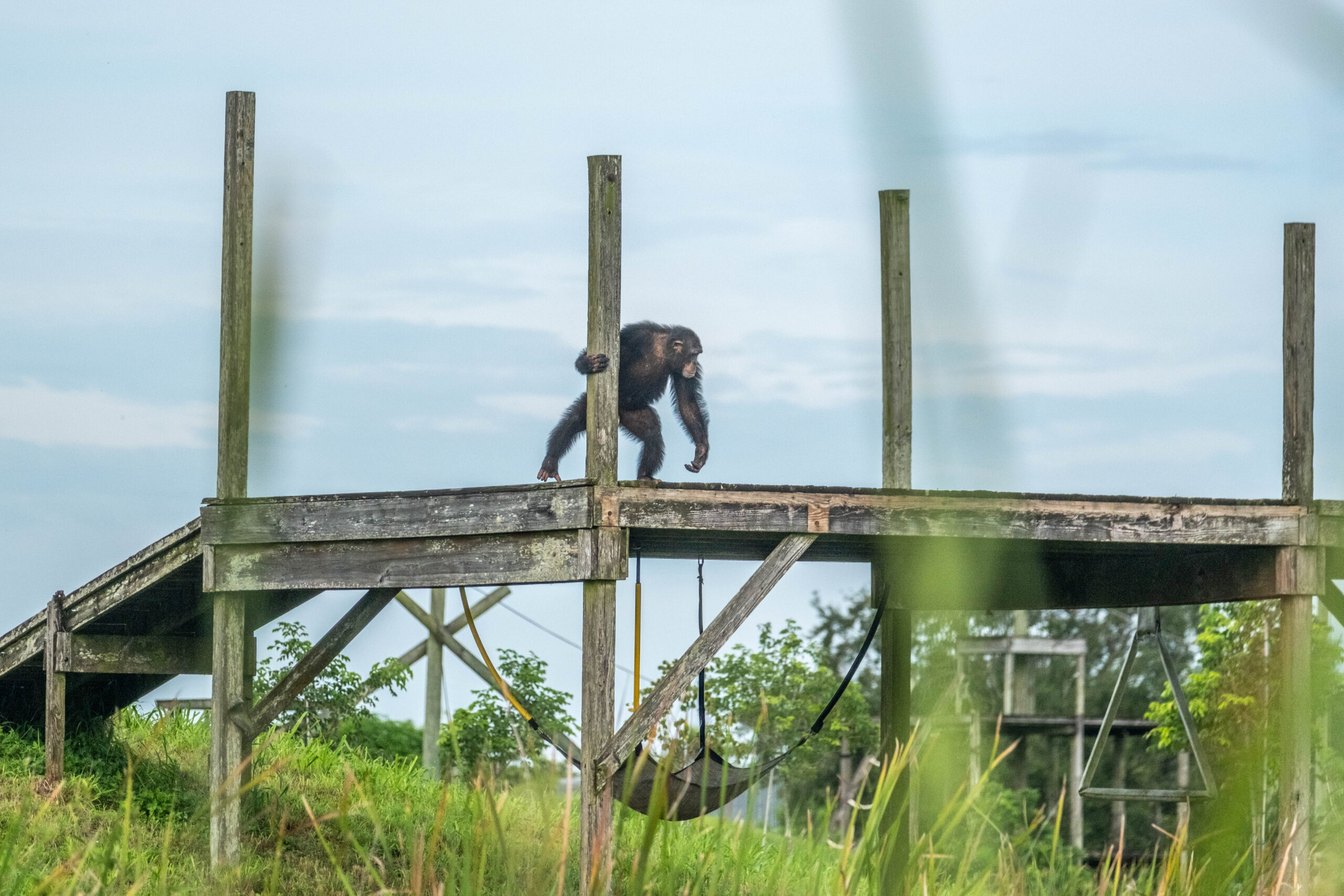
The 3- and 4-acre islands each contain indoor housing and outdoor moated hills for free roaming, enhanced by climbing structures and trees.
“These structures need to be rebuilt. The containment walls that keep the chimps and the humans safe are aging and the portion that’s in the water has started to sink, so we’re rebuilding these walls,” says Tavares.
“This is a huge operation. We need to keep the chimps away from the island, but to keep them cooped up inside for three weeks is quite dangerous.”
The solution was to construct an enormous three-story, outdoor mobile annex that can be relocated from island to island as needed.
Caring for the chimps is an all-day, everyday complex task.
“We have a vet team of eight, which includes veterinarians, vet techs, pharmacy and operating conditioning trainers. They are some of the best in the country, if not the best in the world, when taking care of chimpanzees,” says Tavares.
“It’s a really amazing team. But we don’t have the facilities to match them.”
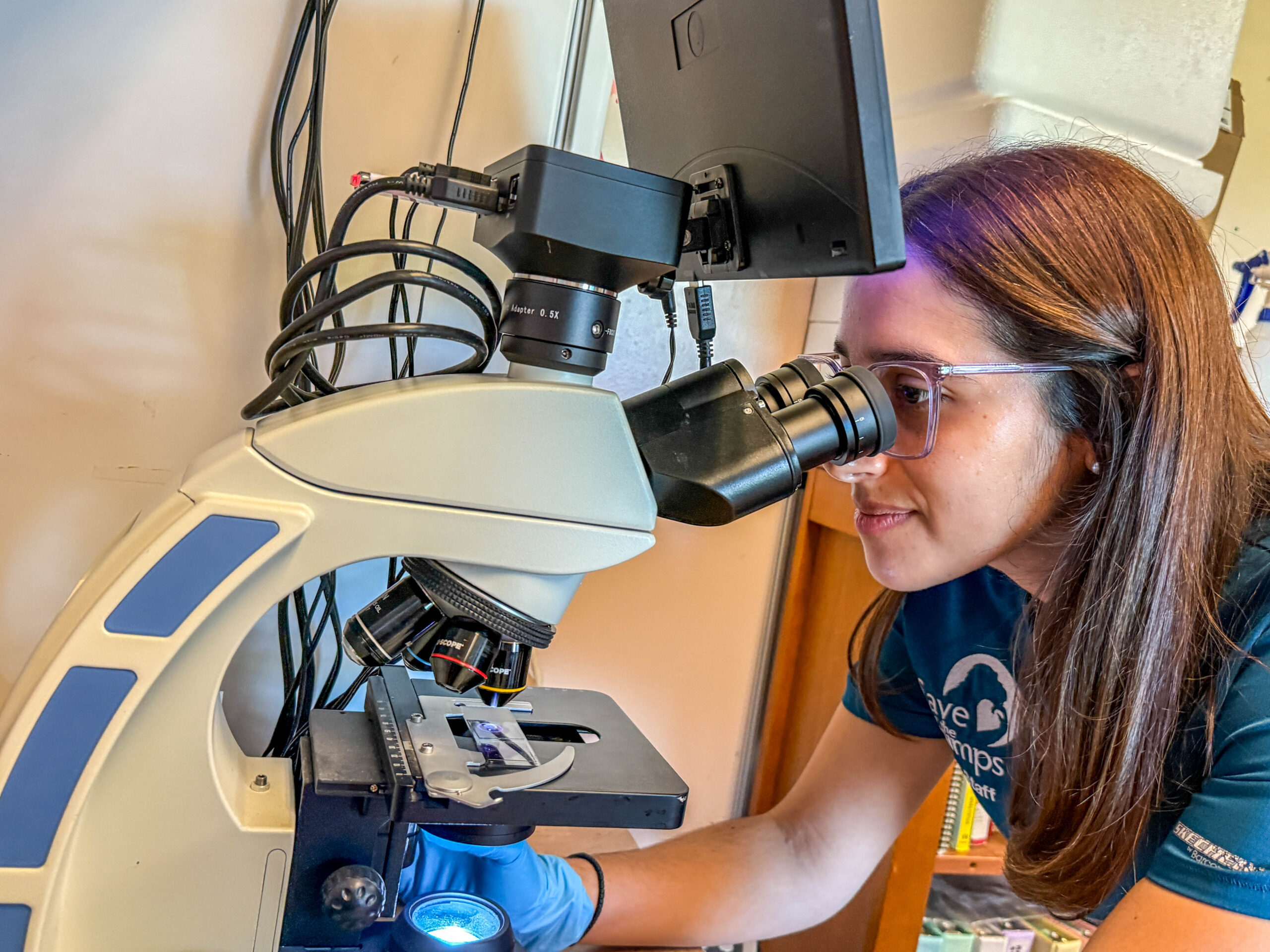
A larger, more advanced medical facility is greatly needed. Currently one very small room serves for treatment, surgery and necropsy, and across the hall techs sort and record each chimp’s medication in an equally small pharmacy.
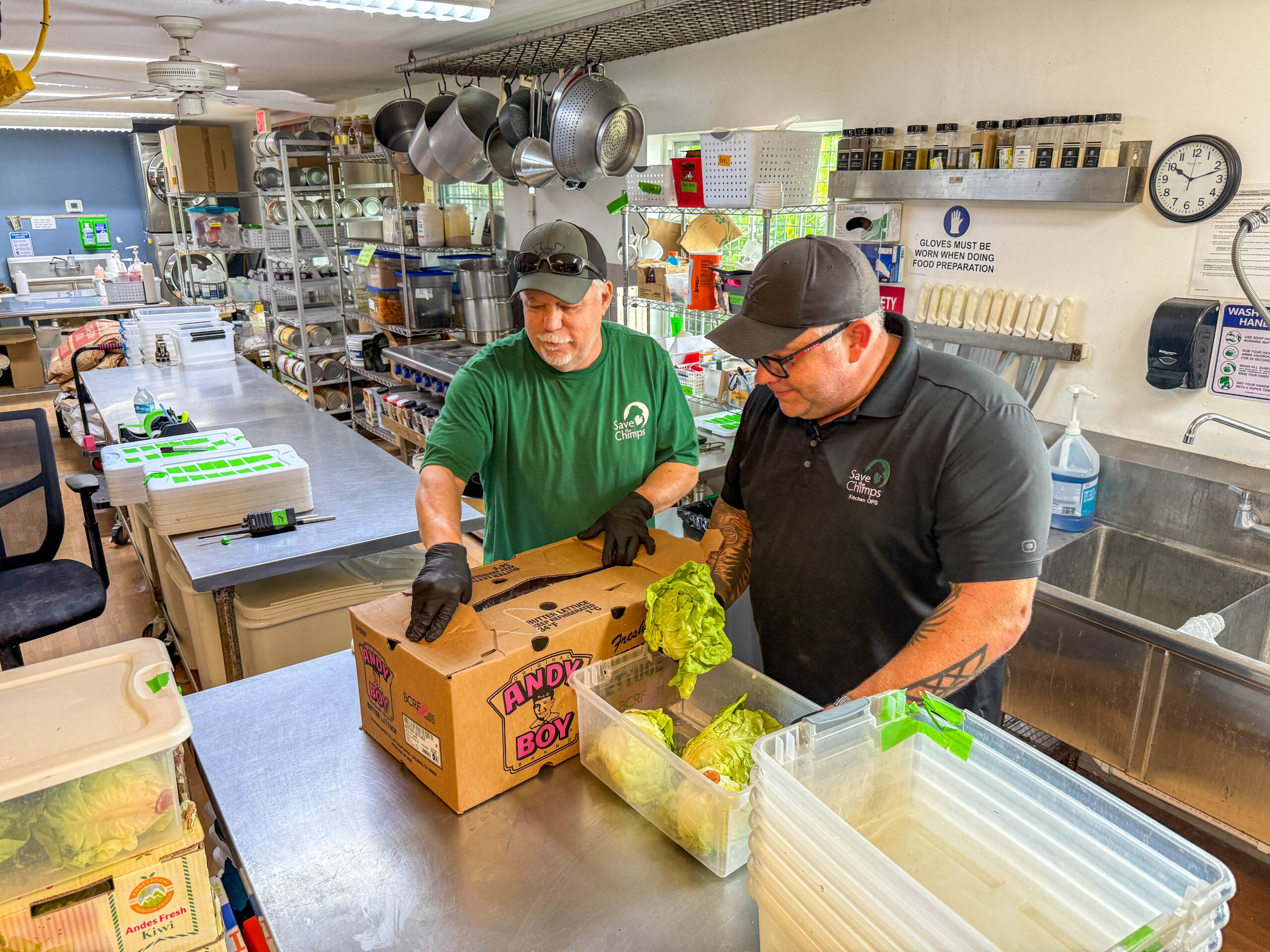
A more spacious kitchen is required for the daily preparation of 2,500 pounds of fresh fruit and vegetables, plus enrichment activities, usually food, to stimulate the chimps physically, cognitively and psychologically.
“Chimps in the wild will walk 6 miles a day and encounter challenges so they have to problem-solve. We try to create that same foraging environment where they are challenged,” Tavares explains.
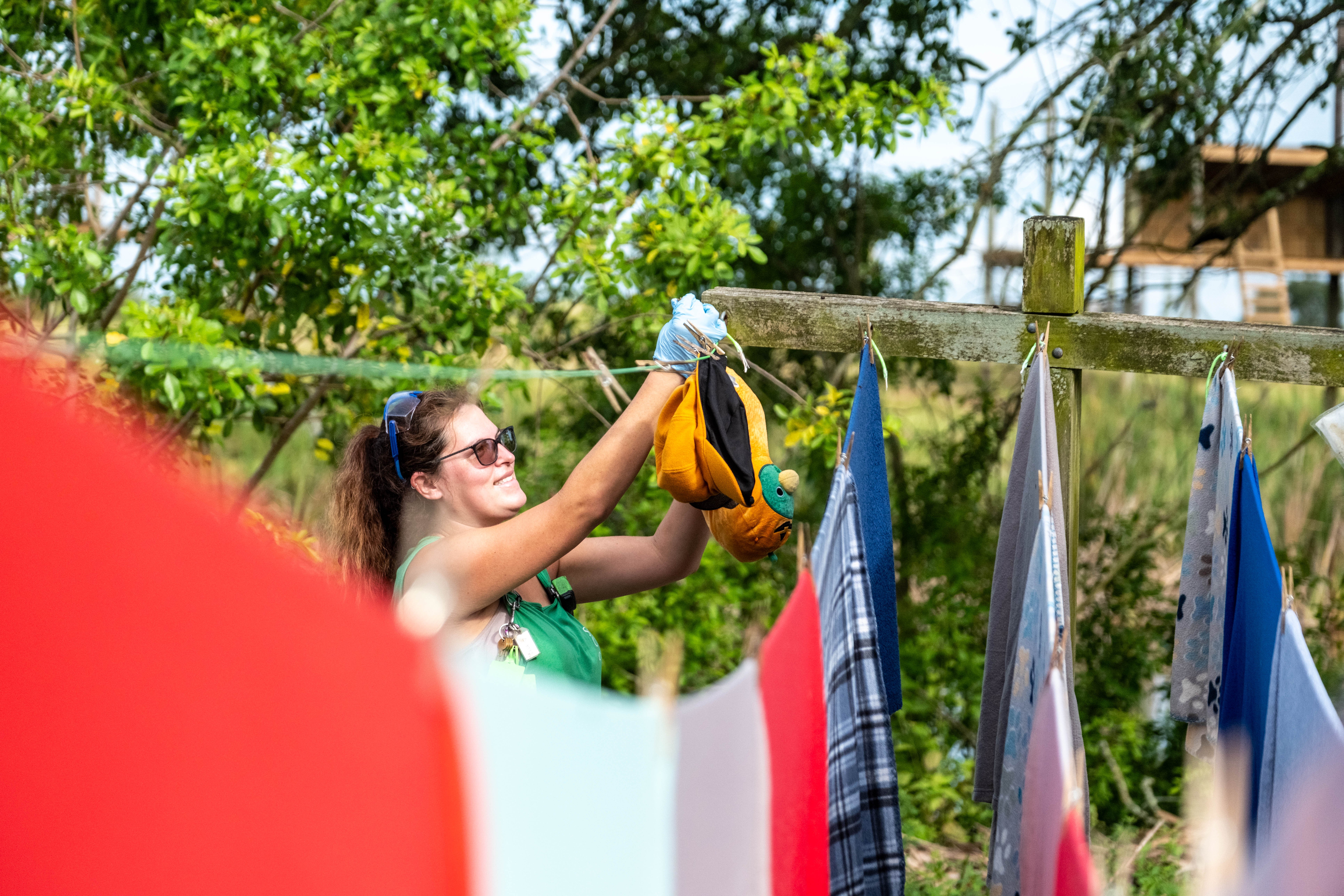
As chimps like to build nightly nests, STC caregivers have the herculean task of cleaning and providing clean hay and blankets every day.
A primatologist and conditioning team teaches them to come indoors when needed and to assist with their own medical treatments, such as presenting an arm for an injection or placing their fingers on a Kardia EKG monitor.
“Something very unique to the sanctuary is the type of care that we provide, which is individualized care for each chimp based on its own history. We’re very proud of this integrated, individualized model of care,” says Tavares, adding that it is recognized as the highest standards.
Like humans, chimpanzees are social and learn from one another. However, as most were abducted at birth it can take time for them to learn how to behave before they’re accepted.
Despite their past psychological and physical trauma, most eventually build bonds with other chimps and even their caregivers.
“And as our founder Carole Noon used to say, ‘All you need to do is give them the space and each other and they’ll do the rest, which is to just learn how to be chimps,’” says Tavares.
Incoming chimps go into a quarantine area to heal and acclimatize to their new life. Some never get over their years of isolation and deprivation and remain in a smaller special needs group.
Their chimps range in age from about 9 to 55. Limbani, the youngest, is a “charming, good-looking and funny” chimp rescued last December from a zoo. He walked on a leash and was treated as a pet until he reached puberty, when chimps become strong and potentially aggressive.
“They’re wild beings; should never be kept as pets,” says Tavares.
Although humans and chimps have a 98.6 percent DNA similarity, she says that 1.4 percent makes them truly unique. “They’re not little humans. It’s the similarities that we have that has led to their exploitation.”
Limbani had never been with other chimps and was slowly introduced to a family that included Tuffy, another former pet, who was rescued some 10 years ago. The two are now best friends.
“It’s the magic that happens every day; it’s that growth and those breakthroughs,” says Tavares.
Tonka made Hollywood movies until being discarded at puberty. He eventually became the subject of TV’s “Chimp Crazy” and was rescued from an irresponsible woman’s basement.
“It’s one story after the other of their resilience and how they overcome all that they’ve been through. It’s fascinating just learning about their personalities,” says Tavares.
“We really think that it’s our moral responsibility to care for these vulnerable individuals who could not live freely as chimpanzees. At the sanctuary our goal is to give them a life as close to the life that they would have had in the wild as possible.”
Although it’s now illegal to use chimpanzees for medical research, there are still some 150 living in biomedical labs, and the sanctuary community continues to advocate on their behalf.
STC is hosting its very first fundraising gala at the sanctuary on April 9 to support operational costs; a tented affair overlooking the islands with dinner catered by Elizabeth Kennedy.
“It’s going to be a very special opportunity to be at the sanctuary in an evening. We are around for 25 years and we’ve never had an evening event at the sanctuary, so it will be super, super special,” says Tavares.
“We invite the Vero Beach philanthropic community to come check us out because. We promise, it’s hard not to fall in love with the chimps and the place. It’s just absolutely peaceful and beautiful. It’s like being in Africa but right here.”
STC is not open to the public except for scheduled events: Dec. 13 Holidays with the Chimps; Feb. 21 Chimpathon 5K & 10K Run/Walk; April 9 Gala; and April 18 Members Day.
For more information, visit SaveTheChimps.org.
-

- PHOTO BY JOSHUA KODIS

-

- PHOTO BY JOSHUA KODIS

-

- PHOTO BY JOSHUA KODIS

-

- PHOTO BY JOSHUA KODIS

-

- PHOTO BY JOSHUA KODIS

-

- PHOTO BY JOSHUA KODIS
-

- PHOTO BY JOSHUA KODIS
-

- PHOTO BY JOSHUA KODIS
-

- PHOTO BY JOSHUA KODIS

-
- PHOTO BY JOSHUA KODIS

-
- PHOTO BY JOSHUA KODIS
-

- PHOTO PROVIDED

-

- PHOTO PROVIDED

-

- PHOTO PROVIDED

-

- PHOTO PROVIDED

-

- PHOTO PROVIDED

-

- PHOTO PROVIDED

-

- PHOTO PROVIDED

-

- PHOTO PROVIDED

-

- PHOTO PROVIDED

-

- PHOTO PROVIDED

-

- PHOTO PROVIDED

-

- PHOTO PROVIDED

-

- PHOTO PROVIDED