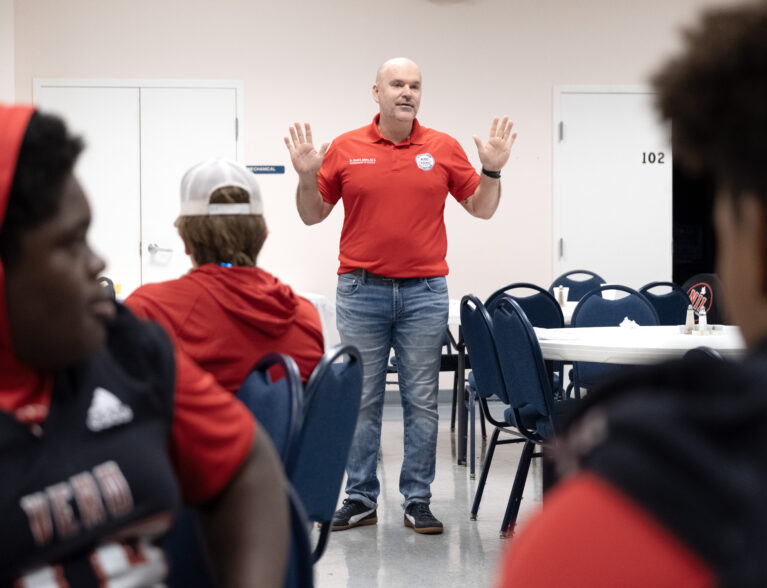
David Moore is not quite ready to step down as the county’s superintendent of schools. He’s got a few more t’s to cross and i’s to dot before he feels his legacy is cemented. That’s one reason why he’s announcing his departure now, even though he’s sticking around through the current school year.
Moore has racked up a long list of remarkable achievements since he was hired to helm the district just under seven years ago. Under his guidance, third grade literacy climbed from 38th in Florida to 3rd in the state. Before his arrival, fewer than half of the county’s schools received an A or B grade from the Florida Department of Education. For the 2025-2026 school year, 23 of the district’s schools earned an A rating, one school earned a B, and one school finished with a C.
Moore’s goal for this next school year? He wants every school to get an A. He wants the district to earn its fifth consecutive A overall. But that’s not all – he wants the district to become the Number 1 school district in Florida.
Tall order? Not really. With Moore’s help, the district has already climbed from 38th in the state to 5th last year.
“My role here was to deliver on a promise that I made in my interview, which was to make sure every school can be an A school,” Moore tells Vero Beach 32963. “It’s now one of the highest performing districts in the state of Florida, but we’re still striving to be Number 1. Our work is not finished. I want us to demonstrate just how far a mature, coherent, high-performing system can go.”
The job for him was always supposed to be transitional, Moore said. Those who are surprised that he is leaving didn’t fully understand that, he said, but internally, that was always the goal.
In fact, his previous job as assistant superintendent for Miami-Dade Public Schools was transitional, as well. Of the district’s 102 schools, 65 had scored below a grade of C; 16 of those were F’s and 49 were D’s, he said. Under his leadership, the district eliminated all the F grades and all but one of the D’s.
School officials and board members in Indian River County took notice and hired him to work the same magic here. But Moore says the key is anything but magic.
“When you look at public education as a whole, some of what has made this district so successful is the innovative way of work,” Moore said. “It is a willingness not to just refine the previous year’s practice, but to reinvent the experience. We are innovating and recreating what public education looks like.”
That all starts with empowering leaders at every level to make decisions informed by timely data, Moore said. Professional learning is embedded in every educator’s role. Feedback is encouraged and employees across the system are directed to take ownership of both identifying and solving challenges, he said.
“When I step back and I see the folks who are doing the work, I see they own this way of work and they’re fully committed to this way of work, to the community,” Moore said. “I see how engaged and connected they are and that they have what they need to continue this work.”
Dr. Christina Jacobs, Moore’s Chief of Staff, agrees.
“If you look across our district team and his leadership over the years, we’ve really built some incredible capacity in various areas, whether that be curriculum and instruction, operations – it’s an overarching strategy,” Jacobs said. “That way of work has been clearly defined, not just at the top, it has permeated throughout the organization.
“When you go into our schools, you’ll see there’s a very clear way in which we hold ourselves accountable to the learning experiences of our students. Many of our leaders have deeply invested in it and it continues to drive us to carry the mission forward.”
Jacobs said she was especially impressed with Moore’s leadership during the Covid pandemic when the district was forced to shift to virtual schooling. “None of us had experienced anything like that before,” Jacobs said. “That was certainly a challenge.”
More recently, Moore has heralded a major transition as many middle school students this year were shifted to new facilities, some facilities were repurposed, and Vero Beach freshmen have moved from the Freshman Learning Center to Vero Beach High School.
“That was a significant amount of change in a very short period of time,” Jacobs said. “It really took us being in the community, talking with our families, talking with community members, talking with our teachers, to ensure that we were listening and making the change as smooth as possible. I think that speaks to how the team has collectively come together to ensure that we’re doing what’s the very best for students.”
Moore said the accomplishment he’s most proud of is helping to lift reading proficiency of the district’s 3rd graders from 38% in 2022 to 71% last year. The national average is just 32-35%. Four schools in the county have reached 90% proficiency.
Moore said he was only able to achieve by partnering with The Learning Alliance, a nonprofit organization founded by two local moms whose children struggled to read at grade level. Inspired by President John F. Kennedy’s 10-year goal to land a man on the moon, they created the Moonshot School, a program designed to bring 90% of third graders up to grade-level reading proficiency.
The Alliance realized that reaching that goal begins long before children even enter the school system.
“People talk about childhood illiteracy as the canary in the coal mine,” said Barbara Hammond, one of the two moms who founded The Learning Alliance. “The health of a community and a school district in a nation depends upon your 3rd grade scores. If a child can’t read, they can’t read to learn. They can’t do science, they can’t do math word problems, they can’t do social studies, or STEAM. So it stops that child’s life. We fail three-quarters of the kids after 3rd grade because we can’t get them reading.”
The success of the district partnership with The Learning Alliance is now nationally recognized. This past February, educators from districts in 31 states converged on Indian River County for the Wired to Learn Fast Education Leadership Summit, a professional development conference hosted by the Alliance. The success of their program also spawned a video series that is shared with school districts all over the country.
“Dr. Moore came here because we needed to figure out what it takes to get 90% of our kids reading. Hammond said. “He came here because he needed a community who could come behind him and allow him to be a transformational leader.
“As much as we all might want him to stay forever, the whole point of transformational leaders is for them to be the catalyst for change and create a change culture. He’s done his job and now it’s the community’s job, right? The community has to navigate these changes. It’s our responsibility to hold the way of work, which is just such a gift.”
Another of Moore’s legacies will be the introduction of high school level courses to middle school students.
“If you give the child the chance, you can provide them with upfront remediation or acceleration in some of the skills they may not have been exposed to,” Moore explains. “Now we are leading the state in this and kind of setting the example.”
With Moore’s guidance middle school acceleration moved from 56th place to 4th place out of Florida’s 67 public school districts.
Looking ahead to his final school year here, Moore plans to continue to innovate and to navigate school choice, which has led to scores of students to leave the public school classroom for a private education funded, at least in part, by tax dollars. One way the district is meeting that challenge is by offering more flexibility in programming, including changing programming at the former Pelican Island Elementary School to a classical school format, which emphasizes traditional liberal arts and languages and teaches critical thinking rather than focusing on job training or passing standardized testing.
Other schools in the district focus on the music and the arts, or math and science, as well as other areas. The idea is to offer more choices and keep students in the public school system, Moore said.
Other than that, Moore says he has no concrete plans. He does know, however, that whatever he does, this will be his last superintendent job.
A role as a consultant may be in his future, he said, an opportunity to share what he has done in Miami-Dade and Indian River County with other districts in Florida and beyond.
“That’s not fully baked,” Moore said. “That sounds great, but what does that mean? How do you develop that? I don’t even want to engage in those conversations yet because my focus is on this year and delivering on an outcome.”
Moore said he plans on staying in Vero Beach with his wife, Jennifer, who is Director of Development with Youth Guidance. Their two daughters, ages 26 and 28, live outside the area. He’s put much of his sizable superintendent’s salary aside and does not need to rush into anything, he said.
Having come from the hustle and bustle of Miami, the couple now have grown addicted to laid-back Vero Beach, he said. “It’s the people. It’s the pace. We’ve connected and engaged. It’s just the overall vibe that is here,” Moore said.