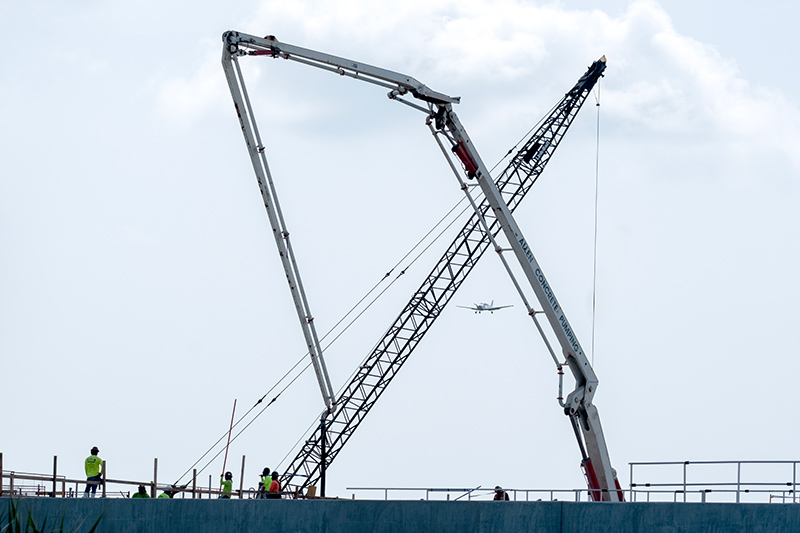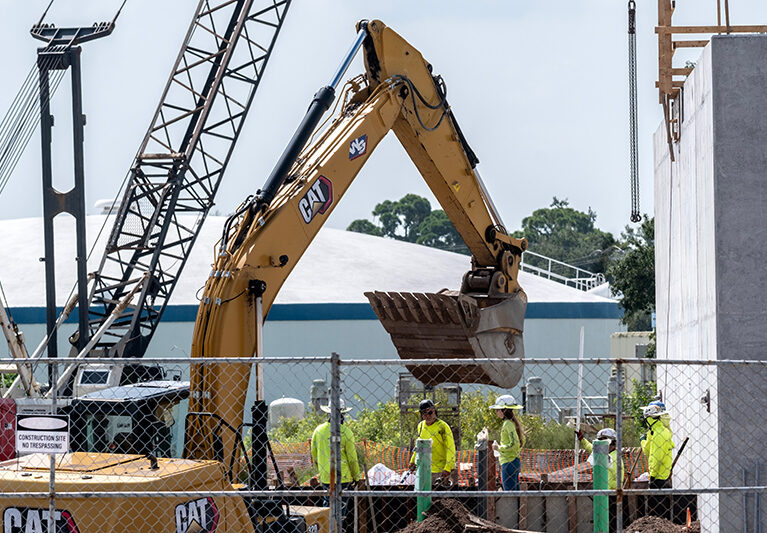
There is good news about Vero Beach’s massive and sometimes controversial new water treatment plant by the airport. Construction is ahead of schedule, according to Water and Sewer Director Rob Bolton, and the city just received another $25 million grant to help offset the $164 million cost of the futuristic project.
The project reached a milestone this month with the completion of the first new building on the site, a 100-foot-long steel structure that will house offices for staff electricians and mechanics, a workshop, and 2,500 square feet of warehouse space.
The city expects to move staff and equipment into the 3,750-square-foot building in the next week or two, as soon as the county issues a certificate of occupancy, said Bolton.
The so-called “One Water Campus” will eventually handle all types of water treatment and distribution – wastewater treatment, stormwater reclamation and drinking water purification – for the city of Vero Beach and surrounding communities that rely on the city for water and sewer service.
Sitework for the project began last year, including installation of drainage and lime beds. The water reclamation facility is currently under construction and construction of the two-story, 11,115-square-foot administration building is set to begin in August, Bolton said. A 4-million-gallon storage tank for reclaimed water will get underway this fall.
The maintenance building had to be built first to provide protection from the weather for welders, lathes, drill presses and other equipment, materials and supplies that will be arriving in August, Bolton said.
Discussions about moving the old 1977-vintage water treatment plant from its current location at the western end of the 17th Street Bridge began as early as 2006. But it wasn’t until 2019 that the city council approved the new location on city-owned land near the intersection of U.S. 1 and Aviation Boulevard, east of the airport.
The old plant’s location makes it vulnerable to storm damage and increases the risk of pollution in the Indian River Lagoon.
Building the One Water Campus by the airport has multiple benefits. Besides reducing the risk of storm damage and related pollution, the new facility will filter more chemicals from water that flows back into the environment, further protecting the lagoon and public health. It will also free up land for riverfront redevelopment at the city’s Three Corners mixed-use development site when the old plant is torn down.
Vero’s One Water Campus and the thinking behind it represent the cutting edge of water technology worldwide, seeing all water as a single resource and integrating conservation, purification and reuse.
In addition to a new reverse-osmosis purification system, the One Water Campus will use advanced treatment technologies to remove harmful nitrogen and phosphorus from wastewater and stormwater. Excess amounts of those two chemicals entering the lagoon have caused devastating algae blooms in recent years that clouded the water, smothering seagrass and resulting in massive fish kills, sick bottlenose dolphins and starving manatees.
The Florida Department of Environmental protection likes the project well enough that it just awarded the city a $25 million grant, informing Bolton on July 1 that “your Water Reclamation Facility Relocation Project has been awarded in the amount of $25,000,000 from the Resilient Florida Program Fiscal Year 2026-2027 Statewide Flooding and Sea Level Rise Resilience Plan.”
This grant comes on top of $41 million in earlier grants from the FDEP and state programs intended to protect the Indian River Lagoon and other ecologically sensitive waterways. The federal government has provided a small amount of funding as well.
When the project concept took shape in 2022, the price tag was estimated at $82 million, but the cost doubled over the next couple of years and once was estimated as high as $180 million. Such cost increases were common for infrastructure projects planned during the pandemic and inflationary period that followed it.
The current $164 million budget includes $142 million for the water reclamation facility, $11.8 million in contingency funding, with the remaining $10.2 million earmarked for construction of the administration building, maintenance bay and other infrastructure, Bolton said.
The $25 million grant received this month raises the city’s total grant funding to $66 million, which reduces the city’s cost to less than $100 million for design, construction, equipment and supplies need to bring the new facility online.
But interest payments on construction bonds will add $100 million or more to the long-term cost of the project.
In February, the city will seek $125 million in bond financing for construction, which includes $25 million for upgrades to the city’s existing drinking water plants to improve filtration and better remove harmful per- and polyfluoroalkyl substances, otherwise known as “forever chemicals.”
Last December, the city council approved taking out a $55 million bond anticipation loan to continue funding construction until the municipal bond is finalized. Vero Beach will raise utility rates to service the bond debt.
On June 23, the City Council reviewed a utility rate study prepared by Los Angeles-based consultants Raftelis. The study recommends a 27-percent increase in drinking water rates, a 45-percent increase in the charge for wastewater, and a 60-percent jump in the price of reclaimed water, all to be rolled out over four years beginning this October.
A typical bill for the average utility customer in Vero Beach, Indian River Shores and the incorporated south island area will increase from around $84 per month now to about $122 per month by 2030, based on 4,000 gallons of consumption, according to the study.
The Vero Beach Utilities Commission unanimously approved the proposed increases. Two more public hearings on the increases will take place in August, before the City Council votes on the proposed ordinance.
Bolton expects the One Water Campus to be completed by early 2028.
Photos by Joshua Kodis