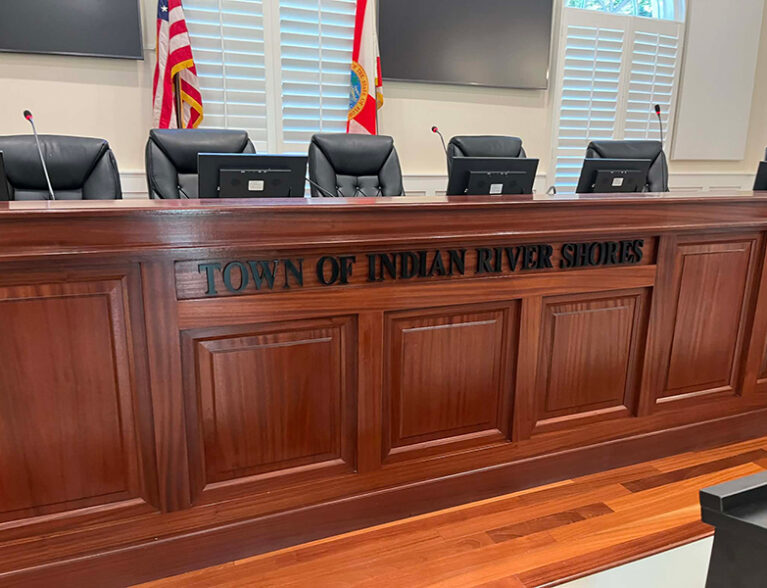
Indian River Shores town officials see Florida House Bill 1451 signed by the governor on June 11 as a huge step forward in protecting ratepayers who live outside the city limits of their utility providers and cannot vote for the city council members who set rates, fees and other charges.
Most of the Town of Indian River Shores and the unincorporated South Barrier Island get water and sewer service from Vero Beach Utilities as outside-the-city customers under separate franchise agreements.
Town Attorney Pete Sweeney, in an analysis of the bill prepared for the Shores Town Council in March, called HB 1451 “a new regulatory scheme for municipal utilities.”
“We’re not talking about privately owned, investor-owned utilities, but this certainly would apply to the utility provider for the town of Indian River Shores,” he said. “It requires several things … [including] more transparency.”
The rates of investor-owned utilities like Florida Power & Light are regulated by the Florida Public Service Commission, which is supposed to look out for consumer interests, but municipal-owned utilities like Vero’s water-sewer service are not. Instead, they are self-regulating through an elected city council that votes to set rates and determine how much utility revenue goes to support the city’s general fund.
Indian River Shores, which sued Vero Beach in state court for breach of contract over rates the town believed were too high, and in federal court over antitrust concerns, is preparing to renegotiate the terms of its franchise agreement.
Mayor Brian Foley said he thinks the new measure provides outside customers like The Shores with stronger legal footing to negotiate and will serve as a basis for other measures beneficial to the Town in upcoming legislative sessions.
“We’ve referred to this on the dais at a couple of meetings as a giant leap in the right direction for utilities regulation, although we did not get exactly everything we wanted,” he said. “HB 1451 now mandates that our rates have to be set using the same criteria as the providing utility, which is the city of Vero Beach. Surcharges are eliminated, and there’s a cap on a differential that can be charged.”
In the past, Vero tacked on a 10 percent surcharge to utility bills on service addresses outside the city limits but ended that practice after years of customer complaints. The city still transfers 6 percent of utility revenues from all customers into its general fund to cover non-utility city functions like City Hall operations, which is still allowed under Florida law.
No new surcharges on outside customers can be imposed, thanks to HB 1451, and existing surcharges must be phased out.
“The bill provides that in addition to the rates, fees, and charges authorized by law, a municipality may continue to impose a surcharge on consumers outside the municipal boundaries if the surcharge was in effect before March 1, 2026, but only to the extent necessary to comply with the terms of bond covenants in effect as of July 1, 2024,” the Florida House staff analysis states. “The bill requires that such surcharges must be phased out by July 1, 2029, or upon the retirement, expiration, or refinancing of the applicable debt obligation, whichever occurs earlier.”
At a recent Finance Committee meeting, committee chair and former Shores vice mayor Michael Ochsner expressed his opposition to Vero’s rates and to the general funds transfers.
“This is a little bit of a sore subject with me simply because, you know, we spent a lot of money trying to get divorced from the City of Vero Beach utilities, and we’re still stuck,” Ochsner said.
“And now we’re going to be stuck paying for their new plant, which makes no sense.”
Vero water-sewer customers, including Shores residents, are facing an estimated 47 percent increase in utility bills between now and 2030 to pay for the city’s under-construction of One Water Campus treatment plant near the airport.
This is especially frustrating to Shores residents because Vero, in the town’s 2012 franchise agreement, promised to charge Shores residents Indian River County Utilities rates. When the city failed to match county rates and the Shores sued, Judge Janet Croom ruled in favor of Vero that the city had not breached its contract. After that, Vero continued to increase rates on Shores residents well above the promised county rates.
Indian River County Utilities charges $67.70 for water and sewer service for a residential customer using 4,000 gallons of water. Vero’s proposed rate next year, if adopted, will be $94.92 for that same service and usage. By 2030 that monthly bill for Vero customers will be $122.45, if rate recommendations are adopted in August.
Town Manager Jim Harpring addressed Ochsner’s comments, offering hope that state officials are beginning to understand the need to regulate municipal utilities’ rates – especially the rates of those utilities which transfer utility revenue into their general funds, as cities prepare to scramble for revenue if property tax reform prevails in November.
“We didn’t get everything that we wanted, which would have either capped or in some way required some accurate measure or appropriate cost allocation as to transfers from funds such as a utility fund,” Harpring said. “I think the legislative step that was made this year was demonstrable.”
One provision of the new law is aimed at keeping the ratepayers who live outside the provider city better informed.
“The bill requires that an appointed representative of each municipality providing utility service in another municipality or unincorporated area outside of the municipality’s boundaries must conduct an annual customer meeting in conjunction with the governing body of each municipality and unincorporated area in which it provides service,” according to the Florida House staff analysis. “The purpose of this meeting is to receive public input on utility-related matters, including rates and service.”
Like Foley, Harpring said HB 1451 is merely a first-step reform.
“There could potentially be an appetite for more because now we have some cornerstone, some foundational piece, and it’s easier to add a step onto that than to have started with four or five steps,” he said.
At a June city council meeting, Vero Beach Mayor John Cotugno pointed out that Vero is abiding by all the current laws governing municipal utilities. The city’s position is that it deserves the 6 percent “rate of return” it skims off the water-sewer utility as the owner of the utility.
For now, at least, the state statute backs that up.
Last week, Cotugno convinced his fellow council members that the city needs to formalize and document its general fund transfers, and the council directed staff to draft a policy memorializing the city’s longtime practice of transferring millions of dollars in utility revenues to the general fund. This action could be an attempt to grandfather in Vero’s transfers and protect the revenue stream from future actions by the Florida Legislature.
Indian River Shores’ franchise agreement with Vero expires in 2042. By then, town officials may be able to broker a deal to have the town hooked up to the Indian River County Utilities system, ending the long battle with Vero over rates. The town would need to give Vero notice by October 2037 that it will be leaving the city’s utility system. In 2042, Vero will only be halfway finished paying off the 30-year bonds on its new water treatment plant.