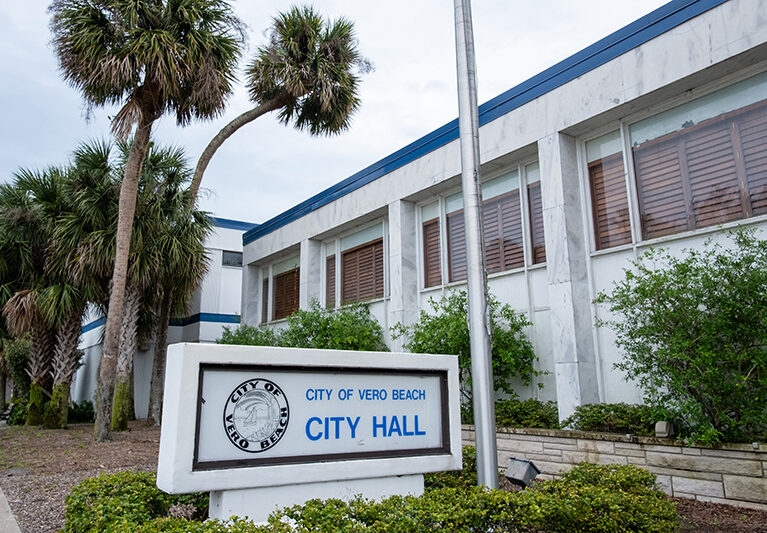
For the first time since it was incorporated more than a century ago, Vero Beach is seeking direct federal help for five high-dollar projects through the congressional appropriations “earmark” process. Four of the projects are on the barrier island.
“We broke new ground at the city this year,” City Manager Monte Falls said at a city council meeting last month, noting that Vero has applied for a total of $23.5 million in federal funds. “I believe this is the first time we have ever made a federal appropriation request.”
The city has used federal disaster relief funding from FEMA and received federal and state funds through grants many times, but earmarks are different.
Also called Community Project Funding, earmarks allow members of Congress to attach funding for specific projects in their districts to congressional appropriations bills. These chunks of money bypass typical competitive grant processes “to fund community infrastructure, education initiatives, health facilities, and local development projects to boost local economies,” according to the Peter G. Peterson Foundation, a fiscal policy nonprofit.
Florida 8th District Congressman Mike Haridopolos gave the city the idea to seek earmark funding. Elected in 2024 and sworn in last January, he has shown more interest in Vero Beach affairs than prior members of Congress representing the city.
“A lot of these things are about relationships,” Falls said. “Congressman Haridopolos has been really proactive in reaching out.”
“I’ve had a good ongoing relationship with the congressman since before he ran for election,” Mayor John Cotugno said. “We had been talking about things specifically in our city. He mentioned earmarks and asked whether we had participated in them.”
After Haridopolos won the election, his local office reached out to get the city engaged in the process. “They wanted to know what requests we had for funding,” Cotugno said. “I had Monte and his team put together a list of requests, including the five projects [we submitted].”
City staff drew up documents describing the details of the projects, indicating their importance to the community and how they align with federal priorities.
The Community Project Funding Requests were submitted by a March 9 deadline to Haridopolos’ office. His office reviews the applications and submits them to appropriate subcommittees of the U.S. House Appropriations Committee. If they survive House and Senate appropriations scrutiny, they become part of the federal budget for fiscal 2027, which begins October 1, 2026.
Via email, Congressman Haridopolos told Vero Beach 32963, “We will keep working with local leaders as the process moves forward.”
The city submitted the projects in order of priority.
The top ask was for $5 million to help fund Vero’s $164-million wastewater treatment plant under construction by the airport, which has already received $42 million in state and federal grants.
The facility will replace the aging sewer plant on the shore of the Indian River Lagoon, which is being removed for environmental reasons and to clear space for the Three Corners riverfront redevelopment.
The new location near the intersection of U.S. 1 and Aviation Boulevard is 18 feet above sea level, securing the facility from storm surges and coastal flooding and ensuring that pollutants don’t enter the Lagoon, a federally designated Estuary of National Significance.
The application for the earmark includes a letter to the chairman and ranking member of the House Appropriations Subcommittee on Interior, Environment and Related Agencies. It notes that, “The City of Vero Beach is taking a proactive approach to achieving measurable water quality improvements beyond its jurisdictional boundaries while safeguarding natural resources for future generations.”
The second request is for $3 million to assist with rebuilding the Humiston Park Boardwalk.
The third request seeks $3 million for flood protection improvements in Oakmont Park neighborhood located southeast of SR 60 and 6th Avenue.
The Oakmont neighborhood was built in the 1960s before flood insurance rate maps existed. “The funding request is to construct stormwater culvert improvements and a mechanical pumping station to alleviate repetitive flood claims,” says the application. The project has the added benefit of diverting stormwater.
The fourth project is the Jaycee Park Dune Exfiltration System. The city is requesting $4 million to help pay for technology that will divert polluted stormwater from the lagoon to a filtration system under the dune at Jaycee Park.
If approved, the system will treat runoff from 130 acres of urbanized barrier island, removing nitrogen, phosphorus and other pollutants currently flowing directly into the lagoon.
“Once filtered, the water will go back into the channel aquifer,” Falls said. “At Humiston, [where an exfiltration system] … was built 10 years ago, we have been able to reduce discharge into the Atlantic Ocean by 99 percent.”
The final request is for a $10 million seawall titled “Conn Beach Coastal Armoring.” The seawall would protect Conn Beach infrastructure, including the boardwalk and a stretch of Ocean Drive that has been washed out repeatedly by storms in recent years, resulting in road closures and expensive repairs.
Mayor Cotugno remains “cautiously optimistic” that the $23.5 million will be approved. Either way, the city has learned how to apply for earmark funding to bolster its notoriously tight budget, even with a small staff.
“We know the process, now,” said Cotugno. “Everybody has gotten their feet wet from filling all the mounds of paperwork out and we are in queue.”