Whether you see Tallahassee politicians who are proposing property tax reductions as barbarians at the gate of home rule and Vero’s prized quality of life, or as prudent fiscal hawks protecting homeowners and senior citizens, there’s no doubt they have become obsessed with the issue in the last year or two.
In response, Vero Beach officials, who believe cutting or eliminating property taxes will harm the city and its residents, are mounting an information campaign to alert residents about the danger they see ahead if one of the unfunded tax mandates being proposed becomes law.
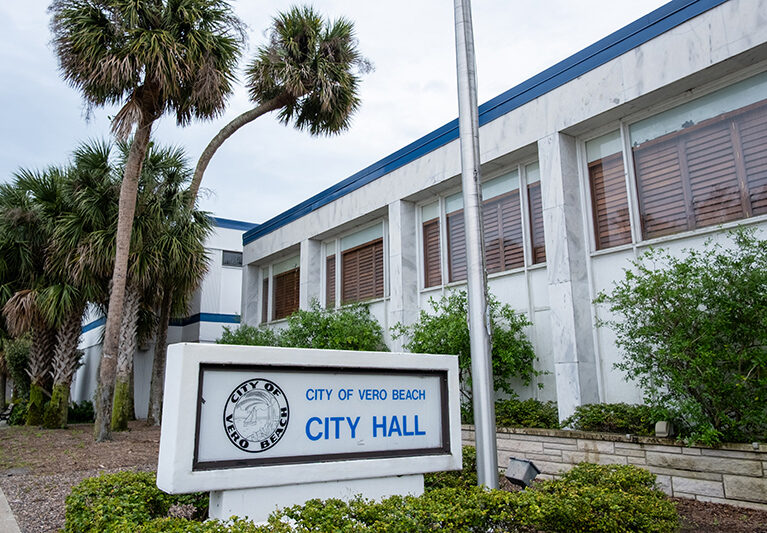
The council met in a special call session last Tuesday to highlight what’s at stake if voters approve a property tax reduction or elimination referendum this November. Councilmembers plan to continue the discussion at the next regular city council meeting, hoping to inform voters about the plan’s hidden costs.
At first glance, the idea of reducing or even eliminating property taxes might sound like a dream come true to homeowners, but city council members say the measure could cost more money in the long run while threatening the safety and quality of life city residents have come to rely upon.
The situation in Tallahassee has been confused, with multiple property tax reduction proposals floating around, but the situation clarified somewhat last week, when the Florida House voted 80-30 along party lines to pass House Joint Resolution 203, which would eliminate all non-school taxes for properties with homestead exemptions.
But murk remains, since the state Senate has not passed a similar bill.
“The property tax issue as a whole is not simple math,” Senate President Ben Albritton told a CBS reporter after the House vote. “It is trigonometry at a minimum. So, it is a very, very challenging topic to try to find what is fair across the board.”
Any alteration to the Florida property tax system – which has been in effect in some form for almost 200 years to fund government services – would have to be approved by voters in November. If a referendum passes, it will take effect Jan. 1, 2027.
Time is of the essence in the city’s pushback effort. The Legislature’s regular session ends on March 13. Once a bill is passed, municipalities are no longer allowed to lobby for or against the referendum, said Vero Beach Mayor John Cotugno.
“Some people may think we’re employing a scare tactic,” Cotugno said explaining the urgency of the matter during the special call meeting. “But from my standpoint, if we don’t get people’s attention and [legislation passes], then it’s too late.”
House Joint Resolution 203 is one of eight proposals making their way through various committees in the Legislature. Most will require the approval of at least 60 percent of Florida voters, but one proposal could be accomplished by changing a state statute without the need for voter approval.
All the proposals freeze funding for law enforcement at the levels set by municipalities in their 2026/2027 budgets.
Potentially making matters worse from the city’s point of view, Senate Bill 1420, which has not come up for a vote so far, would prohibit municipalities from transferring utility service revenues to any area of the general fund budget that is not related to utility services.
Vero Beach routinely transfers 6 percent of utilities revenues into the general fund each year. The amount budgeted for transfer this year is $1,671,218, Cotugno said.
The entire budget for 2025-2026 is $35,946,860. About 80 percent of that goes to pay for labor and labor-associated costs for city employees, according to City Manager Monte Falls.
The city collected $13,754,099 in property tax last year, about 39 percent of the entire budget, well below the statewide average of 43 percent, Falls said. The budget for the police department is about the same amount, he added.
“This will not be a tax cut, it will be a tax shift,” Falls told council members. “A tax shift to higher sales taxes, new fees, and/or reduced local services.” The measure will also shift local decision-making power to the state government, he said. “Our community is so unique and so are its needs. Public safety, infrastructure, parks and recreation, roads, trails – it is far better to make those decisions locally instead of up in Tallahassee.”
If approved by the Senate, the house bill will not sweep away all the city’s property tax revenue, since more than half of the tax collected comes from commercial and non-homesteaded properties.
Nevertheless, making up for lost property tax revenues would mean no more free parking, Cotugno said. “And we may have to stop guarding the beaches.” The state does not mandate lifeguards at beaches, he added.
“We’d have to increase fees at the marina and fees for business licenses would go up. And that would still not make up for the lost revenue,” said Cotugno, noting that with a substantially reduced budget, there would be less money for road construction and repair.
“The money’s got to come from somewhere,” said councilmember Linda Moore. “If the money’s not coming from property taxes, I guarantee you, sales taxes will be raised. And that means we all pay more for all the things we use every day, and more of the burden will go to people who rent.
The lower income portion of our population will be more affected.”
Many of the 1,100 nonprofit organizations in the community use city parks and other facilities, said councilmember Aaron Vos. “Will they be able to afford it if we have to increase the fees?” he said.
“It’s a very bleak picture,” said council member John Carroll, who has served on the development committee for the Florida League of Cities, which has been reaching out to Florida municipalities to encourage special sessions like the one on Feb. 17.
The League of Cities commissioned a property tax study, conducted by researchers at Wichita State University and released in December 2025, using Florida property tax data from 2019 to 2023.
The study found “that property tax remains the fiscal backbone of municipal finance” and “because the state lacks an income tax, the property tax functions as the stabilizing base that offsets volatility in consumption-based revenues. Any reform that significantly weakens this base directly compromises municipal fiscal resilience.”
“Vero Beach . . . has kept the millage rate flat or lower since 2020,” Carroll said. “Property values in the city increased from $1 billion in 2008 to more than $7 billion in 2024, but the taxable value is just $4.5 billion,” because of the Save Our Homes cap on property tax increases and the $50,000 homestead tax exemption.
State-mandated property tax cuts would be a double whammy to the city because they are unrestricted funds, which means they go into the general budget to fund any part of city government, Carroll said. If the city instead has to raise fees on things like building permits, parks and facilities usage, or impact fees, “those funds are restricted and can’t go into the general fund,” Carroll added.
Cotugno said he would place the property tax issue on the agenda for the next city council meeting on Feb. 24 so council members can decide how best to alert residents and protect the city.
“At the risk of being considered an alarmist … I think you need to get people’s attention, so they really understand and realize the impact of the kinds of proposals they are floating up in Tallahassee,” Cotugno said.