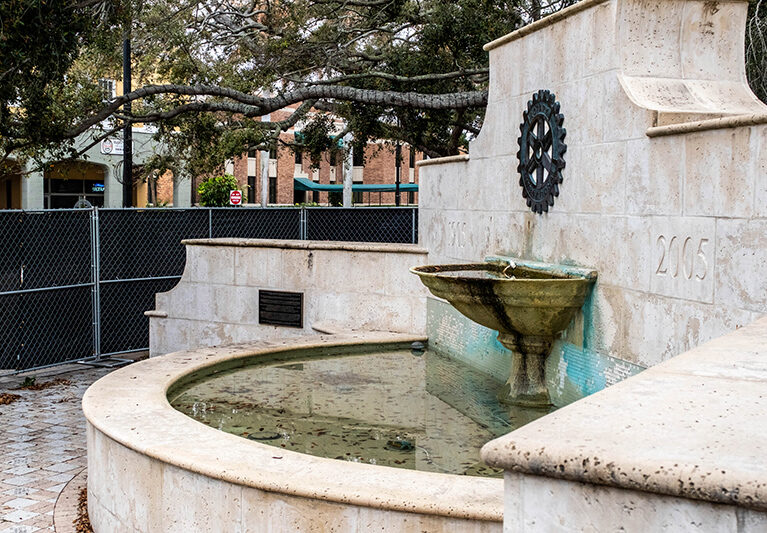
Say goodbye to Centennial Fountain, the crumbling, controversial structure at the southwest corner of Pocahontas Park in downtown Vero Beach. Then, toward the end of May, prepare to say hello to a newly landscaped “Rotary Corner.”
The fountain – and the park itself – have for years been a favorite gathering place for homeless residents, who slept on the concrete benches along 14th Avenue and sometimes used the fountain to bathe.
Hoping to discourage gathering at the park, the city removed the concrete benches in 2023. That same year, in a kind of philanthropic Jujitsu, The Source, a homelessness outreach ministry, launched Community Works in collaboration with the city – a program that pays homeless residents to clean up the park, as well as other public spaces in the community.
Meanwhile, City Council member John Carroll, a longtime member of Vero Beach Rotary, invited fellow Rotarian Marty Lewis to come up with a proposal to refurbish the deteriorating fountain – originally funded by local Rotarians – instead of tearing it down.
“There were several ideas, but converting the fountain into a planter seemed to be the most popular,” Carroll said. “It will be easier to maintain.”
Last July, the six Rotary Clubs in Indian River County entered an agreement with the city to rent the space in perpetuity. The city will provide irrigation and electricity to power a new LED lighting scheme donated by Southern Nights Landscape Lighting. Rotary members will maintain the monument, now called Rotary Corner, Carroll said.
Contractors with Larry Franklin Construction of Vero Beach began refurbishing the structure in early February, and it’s now surrounded by a green fabric construction barrier. Holes are being drilled in the fountain’s basin, so it no longer holds water. Flowering plants will be added in front of the structure, and hibiscus trees will be planted on either side.
One of Vero’s nicknames is “Hibiscus City,” and there is an annual Hibiscus Festival downtown that celebrates the popularity of the colorful flowering plant.
The Rotarian’s agreement with the city allows the clubs to sell sponsorship brick pavers to raise the roughly $25,000 needed to complete the project, Lewis said. A 4-inch by 8-inch brick sells for $100 and an 8-inch by 8-inch brick sells for $200, he said. Sponsors’ names will be engraved on the bricks.
More than half the money was raised before construction began, Carroll said. Rotarians have been selling the sponsorships since last August at community events.
“We wanted to send a message to the city and to the community that we still care about the future of that monument,” Lewis said. “Rotary has been strong in this community for a long time, and we want it to remain strong long into the future.”
The first public structure located at the southeast corner of the intersection of 21st Street and 14th Avenue was a public drinking fountain erected in 1931 to honor Charles Pettibone, the first minister of the Community Church. Pettibone had helped found the Vero Beach Rotary Club and served as its first president. The drinking fountain was demolished in 1962 after the coquina rock deteriorated. A new plaque honoring Pettibone was erected in its place on a small stone marker.
By 2005 there were six Rotary Clubs in Indian River County. To commemorate Rotary International’s 100th anniversary, the clubs raised $75,000 and built the impressive stone and tile fountain/monument, which soon became a downtown landmark.
The renovated monument will fit in nicely with the city’s plans to refurbish the rest of Pocahontas Park, Carroll said; $1.4 million has been budgeted to replace the playground equipment, improve the Community Center and Heritage Center, construct new archways and gazebos, and possibly build an outdoor stage in the field south of the Heritage Center.
Sponsorship bricks for Rotary Corner can be purchased online at sunriserotaryverobeach.org/engraved-pavers