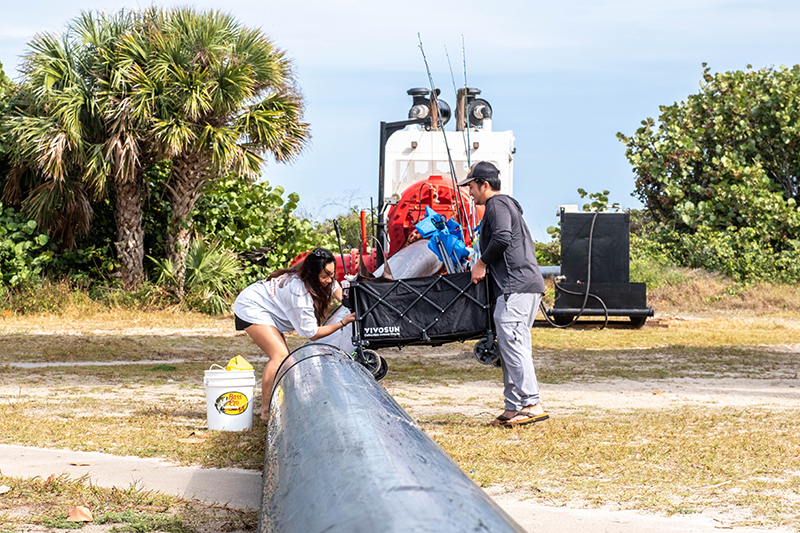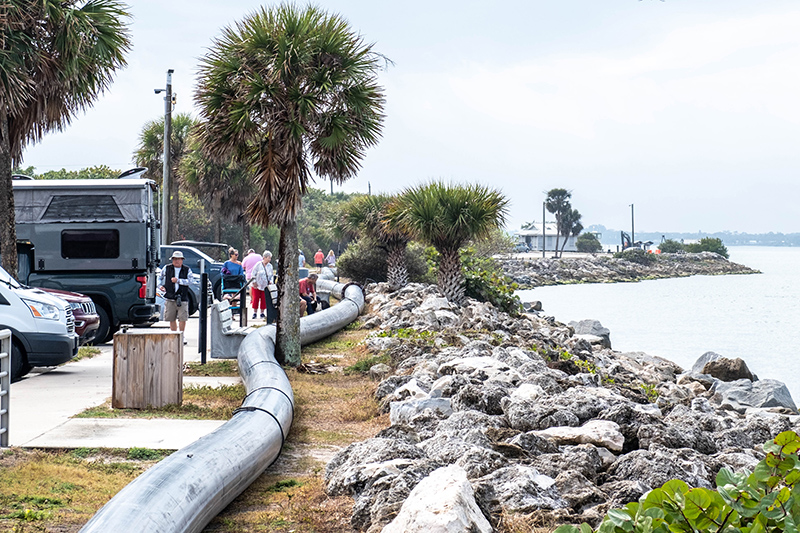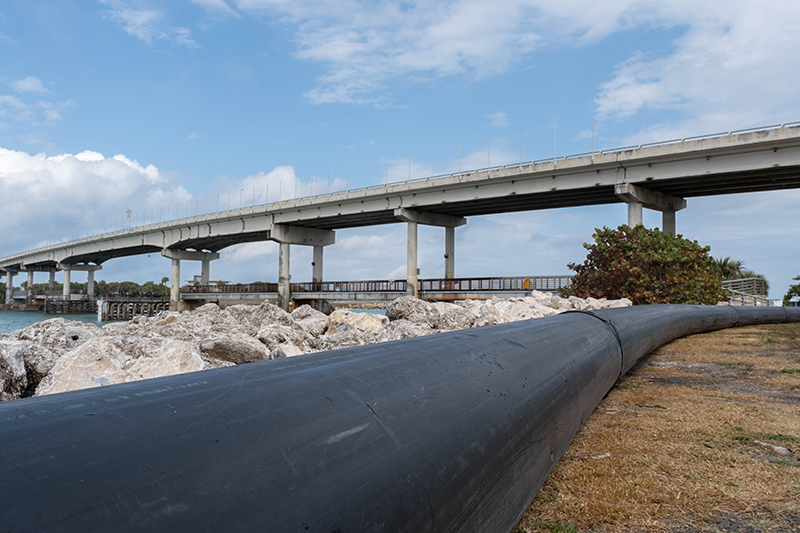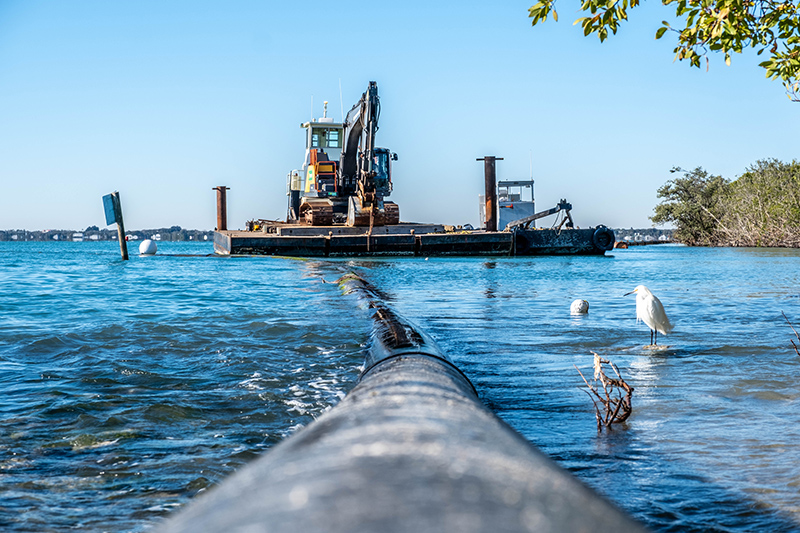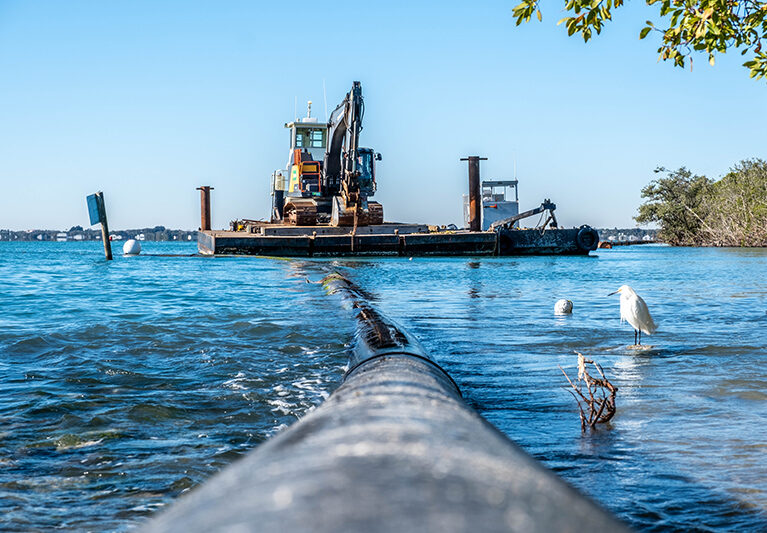
After a Murphy’s Law-muddled attempt faltered last year, a major channel dredging and beach renourishment project is back in full swing at the Sebastian Inlet.
The Sebastian Inlet District, which exists to keep the inlet open and in good repair, launched the project in January 2025. It planned to dredge more than 300,000 cubic yards of sand from the navigation channel and a sand trap, wrapping up in April, just before the start of Florida’s sea turtle nesting season.
But a series of problems and accidents stymied the plan. Some of the pipe delivered to the work site turned out to be the wrong size, said Ed Garland, a public information associate for the Inlet District. Also, a brand-new sand dredge caught fire, and mechanics had to be flown in from California to repair it.
Due to the snafus, only about 130,000 cubic yards of sand – less than half the planned amount – was removed from the busy channel last winter and deposited in a 6-acre Dredged Material Management Area (DMMA) north of the inlet, where dross is separated from usable beach sand.
The compatible sand is then trucked across the aging inlet bridge to beaches on the northern stretch of the 32963 barrier island.
“We’ve learned a lot from that,” Garland said. “So far, it’s been much better this time around. Everything seems to be on schedule.” The new project completion deadline is March 30, he said.
Hydraulic dredging is a method for removing underwater sediment by using a suction system to create slurry, a mixture of sediment and water, which is then pumped through a pipeline to eroded beaches or processing sites.
The Inlet District surveyed the channel in 2024 to determine where dredging was needed, and which sections of sand were beach compatible.
All the sand dredged last year was non-compatible, so it was pumped to the DMMA for processing. This year, sand that is suitable for Florida beaches is being pumped directly onto the beach.
Dredging at the inlet resumed in December, and, by mid-January, contractors with ATL Diversified Inc., headquartered in Boynton Beach, had rerouted the pipes that slurry is pumped through to the south side of the inlet, snaking under the A1A bridge and onto the beach.
There, the slurry is deposited and, after the water drains off, the sand is spread by bulldozers along the Atlantic shoreline from the Inlet south to the McLarty Treasure Museum at 13180 N. A1A.
As part of the beach repair project, 85,000 cubic yards of upland sand was trucked in and deposited on the beaches last year, Garland said. The district gets its mined sand from Stewart Materials in Fort Pierce.
The goal of the dredging is to keep clear the 150-foot-wide navigation channel in the inlet to around 10.5 feet deep, said James Gray, executive director for the Inlet District.
The sand trap – an underwater pit that was blasted in the marl in 1962 and enlarged in 1972 to capture drift sand that would otherwise cause shoaling in the channel – has to be dredged along with the channel to a depth of 17 feet, Gray said. Contractors began dredging the sand trap on Feb. 5 and will remove approximately 130,000 cubic yards of material.
Boaters are strongly cautioned to be aware of dredge pipes and pumping equipment and to slow down and steer clear. Beachgoers should mind the warning signs and stay away from bulldozers and other equipment on the beach.
Dredging the sand trap and the inlet is necessary every four to five years, depending on how much material collects in the navigation channel, Garland said. Keeping the inlet clear is vitally important to the environmental and economic health of the region, he said.
Environmentally, dredging the sand from the inlet and depositing it on beaches south of the inlet – called “bypassing” – helps to mitigate and repair erosion on those beaches, Gray said.
“The Sebastian Inlet jetties provide the opportunity to safely navigate the inlet from and to the Atlantic Ocean,” he said. “Direct bypassing projects replicate the natural drift of sand that is interrupted by the jetties.”
The north jetty extends hundreds of feet into the ocean. As sand drifts south with prevailing currents, it is blocked by the stone jetty, keeping the mouth the channel open but starving beaches to the south of natural renourishment.
State law requires the Inlet District to make up for that lost sand by placing large amounts of beach-compatible material on the southward beaches, either by dredging and pumping or trucking it in.
Beach-compatible sand is sediment that conforms to specific measurements of silt and shell content, to ensure that it provides adequate drainage, Gray said. The sediment must also be the right color, he said, measured by something called the Munsell Soil Guide.
A study performed in 2023 estimated that the inlet contributes $1.1 billion annually to the region’s economy. About $953 million is generated by tourism activities such as fishing, surfing, kayaking, camping and swimming. Boaters contribute another $150 million in local spending.
And property sales generate a $108-million premium, above what they would otherwise fetch, because of proximity to the inlet, the study found.
The Sebastian Inlet District is an independent special taxing district established in 1919 to maintain the inlet. Funding comes from property taxes paid by property owners in northern Indian River County and southern Brevard County who reside in the district.
The Inlet District extends from Route 60 in Indian River County to Viera in Brevard County. Tax revenues collected for the 2025-2026 fiscal year budget were $6,222,068 from Brevard County and $1,342,516 from Indian River County.
Sebastian Inlet State Park was created in 1970 and is managed by the Florida Department of Environmental Protection through the Florida Park Service. The Inlet District and State Park are separate entities that cooperate to serve the public by providing ocean access and recreation.
Photos by Joshua Kodis