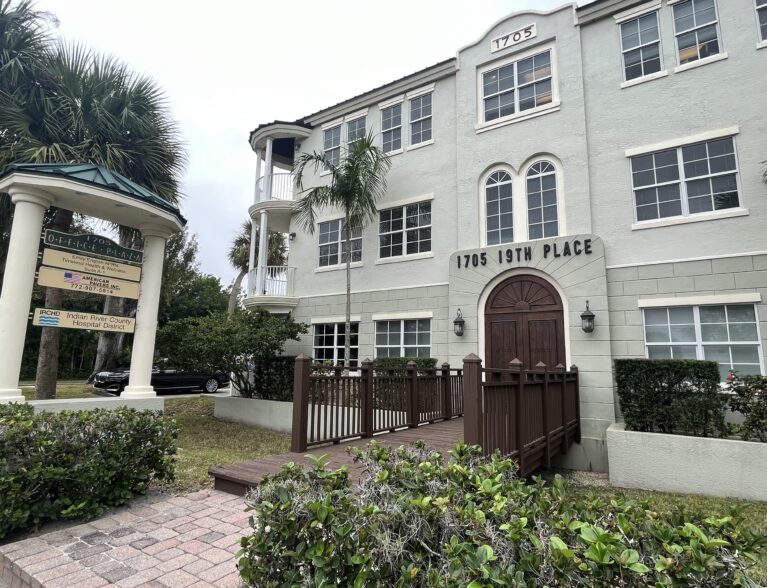
Indian River County Hospital District trustees are seeking more details from one of the groups that want to open a substance abuse treatment facility in two buildings on 10th Street owned by the district – but selling the buildings and land instead of leasing them to a treatment facility is still on the table.
Trustees could flip the real estate, which was purchased for $4 million in 2024, for at least $4.7 million, based on market estimates. Considering money already spent on repairs, maintenance and improvements, such a sale would net taxpayers approximately $500,000, which would be an impressive return on investment.
But the Hospital District purchased the property for a treatment center and most of the board still wants to make sure it is used to address what they see as an unmet need for drug and alcohol recovery services in the county.
The district reviewed letters of intent from four substance abuse treatment operators in October. Afterward, in November, New Horizons of the Treasure Coast, Rite Life Services, Thrive (formerly Substance Awareness Center), and PUR Health and Wellness pitched their plans to trustees.
Thrive and PUR Health and Wellness emerged as the top prospects, with Thrive inching ahead because it would provide a unique service to the community and the Hospital District already has a long-standing relationship with the organization, funding and auditing its programs.
Thrive now has to convince district trustees that its operation will be financially sustainable without burdening taxpayers. Thrive was also asked to explain how and when it plans to purchase the property.
Moving forward with Thrive by digging into the details of its plan and proposal was not a unanimous decision. It squeaked by with a 4-to-3 vote at the Hospital District’s Jan. 15 meeting, and there’s still strong support on the board for a quick sale of the property.
Trustee Paul Westcott said at the meeting that he would rather sell the property than lease it to a treatment center – sooner rather than later.
“I am looking more toward having us place greater emphasis on the options that would result in a sale of the property, as opposed to the options that are going to have us funding certain activities and being a landlord,” Westcott said.
Ideally, an operator-tenant with a lease or lease-to-own agreement would pay the district market rent for the property at 620 and 650 10th St., handle any costly legal and engineering work needed to secure zoning approval, and then offer local indigent patients services at a greatly reduced rate.
In another scenario, the operator would do all of the above but also bill the Hospital District for services rendered to indigent residents who qualify for district-subsidized healthcare.
Thrive is asking for three years of rent abatement, counting on private foundation grants plus $600,000 in opioid settlement funds to operate a two-pronged program for addicts beginning or returning to recovery.
All patients would come to the 10th Street facility and check-in temporarily while Thrive staff examines their situation and finds a detox or rehab center that has a spot for them.
Those patients would move on to the selected location while others would stay longer at Thrive’s facility.
“Thrive is a longstanding behavioral health nonprofit in our county,” Hospital District executive director Frank Isele reminded trustees last week. “They’re focused on substance use prevention, treatment and recovery.
“Their proposal is to lease and operate two coordinated programs at the 10th Street property.
[They would have] a 24/7 centralized intake and respite center at the 650 building to serve as an entry point and stabilization hub,” Isele said, adding that the second part of the program would be “a Step 1 recovery residence in the 620 building.
“This would be a short-term, staff-supported recovery housing program for individuals in early recovery.”
Westcott said he thought the 24/7 clearinghouse-type service could take place somewhere better suited than the 10th Street residential neighborhood.
Trustees also discussed the potential of going down “parallel paths,” investigating a sale while continuing to vet potential operators.
“I think we need to discover how much it’s going to cost us to have a program in our facility before we can make the decision of a sale or not. And that might drive us one way or another,” Trustee Karen Deigl said.
PUR Health and Wellness was the other top proposal the district could pivot back to if Thrive’s plan looks like it would cost taxpayers too much.
PUR has pitched an upscale detox and residential drug and alcohol rehab facility charging up to $600 per day for detox and offering reduced rates to the Hospital District’s qualified indigent or low-income clients.
“They propose to operate a 36-bed detox and residential treatment facility for 24 men and 12 women, across both 10th Street buildings,” Isele told trustees. “They would provide 24/7 medical supervision, therapy, case management, discharge planning, and life skills development. This program is designed to reduce overdoses, homelessness and healthcare costs, while improving safety, employment and mental health outcomes.”
The PUR business plan anticipates an 11 percent profit margin, and PUR seeks to purchase the property.
Any type of drug and alcohol recovery facility proving services classified as “healthcare” could be a tough sell to county officials and nearby residents because the neighborhood isn’t zoned for that purpose.
An outright sale of the property would protect the Hospital District from getting bogged down in efforts to get a special use zoning exception for healthcare services.