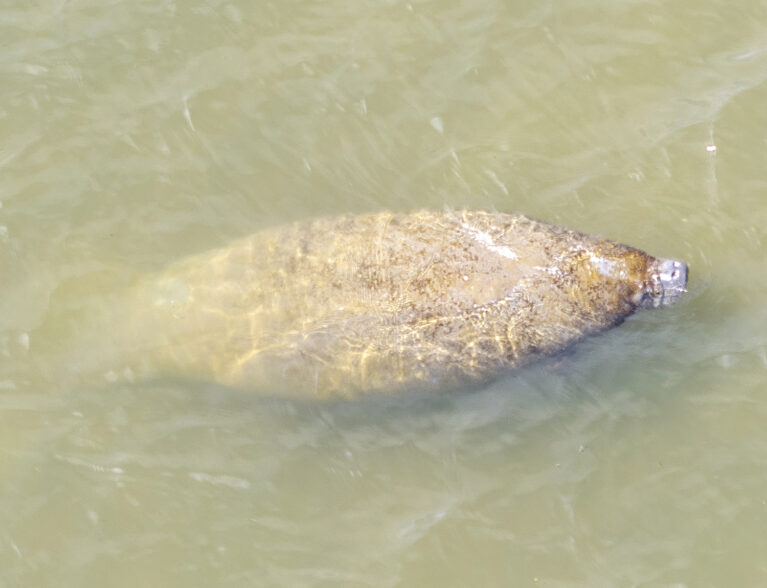
West Indies Manatees – which tie with bottlenose dolphins as the most charismatic and beloved animals in the Indian River Lagoon – had a relatively good year in Indian River County in 2025, especially compared to the fate of manatees in Brevard County waters, which led the state in manatee deaths last year.
Seven manatees died in Indian River County’s stretch of the lagoon in 2025 according to statistics released this month by the Florida Fish and Wildlife Conservation Commission – one from a boat strike, two due to natural causes, and four from undetermined causes.
That is down from nine deaths here in 2024 and fewer than a third as many manatee mortalities as in 2021, when a record 1,100 of the animals died statewide, including 25 in Indian River County and 358 in Brevard County.
The mass die-off in 2021 was driven mainly by the loss of seagrass beds in the lagoon and other Florida waters. Seagrass is manatee’s primary food and many of them starved to death or contracted diseases due to weakness brought on by lack of food.
Seventeen times as many manatees perished in Brevard County in 2025 as in Indian River County, with 119 deaths, including 51 calves. Twelve were killed by boat strikes and other human actions, 13 died due to cold weather, 13 due to natural causes, with the rest undetermined.
The reason for the dramatic difference in deaths in the two counties is mostly a mystery. It can be explained in part by Brevard’s longer lagoon coastline – 70 miles compared to 22 miles of waterfront in Indian River County – but even taking that into account, the per-mile death rate is five times higher to the north.
The primary threats to manatees up and down the lagoon are boats that cause blunt force injury and cut the animals with prop blades, and pollution.
Fertilizer runoff and human waste that seeps into the water from septic systems are the main pollutants that indirectly harm manatees. Fertilizer and human waste are loaded with nitrogen and phosphorus, nutrients that algae feed on.
Excess nitrogen and phosphorous lead to algae “blooms” that cloud the lagoon’s water and kill seagrass by cutting off sunlight needed for photosynthesis.
Manatees may be doing better here, in part, because Vero Beach and Indian River County have undertaken a wide range of practices and programs to reduce nitrogen and phosphorous in the lagoon and restore seagrass beds.
A rainy-season fertilizer ban was put in place by the county more than 10 years ago to reduce runoff pollution, and the City of Vero Beach has been steadily connecting old, leaky septic systems to city sewers with STEP system technology, cutting down on the amount of human waste entering the lagoon.
More than half of the septic tanks in the city have been hooked up to the sewer system so far with pumps and pipes that cost far less than new main sewer lines.
Approaching the problem from another angle, the county, in partnership with the Indian River Lagoon National Estuary Program, planted 23 acres of seagrass last year at two sites in the lagoon in Indian River County – 13 acres in Big Slough and 10 acres at Preachers Hole.
“Initial observations indicate promising growth and expansion at both sites,” said Kylie Yanchula, director of the county’s Natural Resources Department. “During winter, seagrass typically sheds its above-ground structure and remains dormant as rhizomes in the sediment. As conditions improve in the growing season, the project team will have a clearer picture of success.”
Surveys conducted last fall also suggest some natural seagrass recovery in the lagoon, which is an encouraging sign, Yanchula added.
The county’s Living Docks initiative wraps oyster shell matts around dock pilings to stimulate growth of oysters and other tunicates – marine animals that filter pollutants out of the lagoon water. To date, 15 docks have been wrapped, with 25 additional installations scheduled for this spring, Yanchula said.
Indian River County has help from nature and geography, too, in its effort to keep the lagoon clean enough for manatees and other marine animals to thrive.
As much as 10 billion gallons of seawater floods into the Fort Pierce Inlet with the incoming tide every 12 hours, mixing with fresh water from canals and creeks and then flowing back out, taking pollutants with it.
Local scientists have determined that this seawater flush helps keep the lagoon healthy as far north as the 17th Street Bridge. Even during the catastrophic algae blooms in 2012 that killed 60 percent of seagrass beds in the waterway and started the ongoing seagrass crisis, underwater meadows by the Moorings and Harbor Branch stayed lush and green.
Brevard County has launched lots of lagoon cleanup projects of its own, but it doesn’t have an inlet with anything like the flow of the Fort Pierce Inlet. Instead, it has large bodies of mostly stagnant water in the Banana River and Mosquito Lagoon sections of the estuary, which is where the disastrous 2012 blooms began.
The ecological benefits of the Fort Pierce Inlet appear to flow south as well as north, perhaps more powerfully, as there are fewer manatee deaths the St. Lucie County stretch of the lagoon each year than in Indian River County, even though the two coastlines are about the same length.
There were six manatee deaths in St. Lucie’s waters last year and only four the year before. Statewide, 632 manatees perished in 2015, up from 565 in 2024, but below the 5-years average of 731, which includes the die-off in 2021, according to the Florida Fish and Wildlife Conservation Commission.
The ancestors of West Indies Manatees evolved from a grazing land animal about 60 million years ago and the earliest sea cows reached the North Atlantic around 12 million years ago. The gentle giants have lived in Florida for at least 12,000 years, according to multiple sources.