The gunman who ambushed three deputies and a local locksmith at a Bermuda Club home on Nov. 21, we were told, was not on the Sheriff’s Office’s radar.
He was “not someone we were actively engaged with,” we were told. Serving a court-ordered eviction notice at the Governors Way residence was a “standard call” for deputies, who carry out such duties on a regular basis.
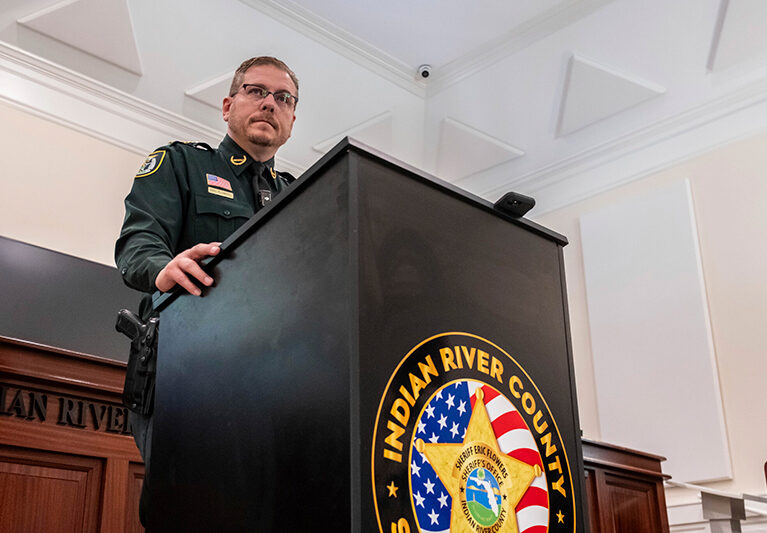
That’s what Sheriff Eric Flowers said during his 10-minute press conference in the immediate aftermath of the shooting that ultimately left three people dead – Deputy Terri Sweeting-Mashkow, locksmith David Long and the perpetrator, Michael Halberstam.
But Flowers also told reporters his agency had received seven calls for service at the Halberstam home in the previous three weeks.
And nobody connected the dots?
How is that possible?
We don’t know – because, as Monday’s deadline for this week’s edition of Vero Beach 32963 approached, Flowers hadn’t provided an explanation.
In fact, Flowers, who usually jumps at any opportunity to put himself in front of TV cameras and microphones, didn’t conduct any follow-up press conferences in the days after the shooting.
Even after Long, 76, and Halberstam, 37, succumbed to their gunshot wounds two days after the shooting – and Deputy Tino Arizpe, who was shot in the shoulder, was released from the hospital – Flowers settled for issuing news releases.
As of Monday, no press briefings were scheduled.
That, too, is puzzling, given the magnitude of the tragedy, which has shaken our community, made national headlines and prompted a groundswell of public support for the victims’ families.
Sweeting-Mashkow, who was 47, became only the second deputy killed in the line of duty in the 100-year history of the county’s Sheriff’s Office, and Long was a well-known figure throughout the Vero Beach area, especially among local realtors and businessmen.
As you’d expect, people here are upset. They have questions. They deserve to know what went wrong and why.
Other than the same-day press conference, however, their sheriff hasn’t been seen – only heard, and by a limited audience.
Three days after the incident on the island, Flowers made his regularly scheduled, Monday-morning, phone-in appearance on a local AM radio show, where he provided more details about the shootings, including background information and what happened inside the house.
But much of what he shared only raised questions that weren’t asked on air or did not address obvious questions spawned by his previous remarks.
“I’m not really talking to the media right now,” Flowers told radio host Bob Soos at the end of their interview, saying the agency’s focus was on honoring Sweeting-Mashkow at a memorial service that was scheduled for this week at the Corporate Air hangar at Vero Beach Regional Airport.
Soos, to his credit, did ask Flowers a direct question that has been haunting many of us since the shooting: Did Halberstam’s mother, who owned the home and sought the eviction, know her son had a gun?
Flowers, after stammering through his initial response, finally conceded, “I don’t know if mom knew he had any weapons.”
Again: How is that possible?
Are we to believe that three days after a 25-year Sheriff’s Office veteran was fatally shot – Sweeting-Mashkow was the agency’s first deputy killed in the line of duty since Richard Raczkoski in 1986 – Flowers didn’t know whether Halberstam’s mother had mentioned that her son had a gun?
Here’s another pressing question: Was Flowers familiar with a 911 call in early November, when Halberstam’s mother requested help and a Sheriff’s Office dispatcher asked if her son had access to any weapons?
That call was included in a nearly six-minute, mother-and-son verbal exchange, a disturbing conversation Halberstam recorded and posted on his Facebook page on Nov. 5.
“Michael, please move out,” Halberstam’s mother can be heard telling her son, later adding, “You’re mentally ill,” and “Go get help, Michael. You’re sick.”
Halberstam repeatedly refused to leave, telling his mother he didn’t care how she felt or what she wanted.
She also told the dispatcher she was so worried her son might harm her that she locked her bedroom door at night.
Particularly alarming, though, was the mother’s reply to the dispatcher’s inquiry about Halberstam’s access to weapons.
“I don’t know what he has access to,” she told the dispatcher. “He locks his bedroom door. … I don’t know what’s in his bedroom.”
Flowers told Soos it didn’t matter what Halberstam’s mother told deputies at the scene.
“Every call that we go on, we assume there are weapons, because we bring one to every call we go to,” the sheriff said. “Whether she knew, whether she didn’t … many people own guns, especially when we serve evictions. It’s not unusual.
“So, we are always in that mindset of: There very well could be a gun.”
Flowers quickly added: “What you’re not expecting is a guy on the other side of that door ready to ambush you.”
But, according to Flowers, that’s what happened.
As the sheriff told Soos, deputies arrived at the home to find Halberstam had placed locks on the doors of his “bedroom area,” and his mother did not have the keys.
The deputies knocked on his door, identified themselves as law-enforcement officers and announced the reason for their presence. But there was no response.
Long was called to the scene and, as he was unlocking the door, Halberstam stepped out with a gun – the type of firearm hasn’t been released – and began shooting.
Sweeting-Mashkow died on the scene. Arizpe and Long were hit by gunfire and were rushed to Lawnwood Hospital in Fort Pierce. Sheriff’s Sergeant Gary Farless, who was not injured, returned fire and struck Halberstam multiple times.
Still, it’s fair to wonder: Given all the red flags that preceded the shootings, including the seven calls for service and the mother’s concerns about Halberstam’s mental health, could this horrific incident have been avoided?
“There was not much that they could’ve done,” Flowers said, speaking of the three deputies who came under fire. “Our team is going to talk about it. We’re going to have these conversations, try and roundtable this.
“But, really,” he added, “it was just a terrible scenario.”
It was heartbreaking.
Was it also preventable?
The sheriff owes it to our community to take a hard look at every aspect of this disaster – from agency policy to the specifics of this particular case – and learn from it.
He owes that much and more to Sweeting-Mashkow, who news reports say had been to the Halberstam home twice in November to post notices, including one the day before the shooting.
He owes a public airing of his review’s findings to Long’s family, as well as to Arizpe, Farless and all the deputies who continue to put their lives on the line every day.
He also owes all of us honest answers to tough questions that need to be asked:
- If it was the agency’s “standard eviction process” to make sure the mother was outside the home when deputies went in, as Flowers said, why was a civilian locksmith allowed to walk into what proved to be an unsecure scene?
- Was a third deputy assigned to the eviction team because of the seven calls for service at the Halberstam home?
- Did Halberstam’s mother know her son was inside the house? If so, did the deputies – whom Flowers said always assume the bad guys are armed – have their guns drawn as Long unlocked the bedroom door?
- Why didn’t a supervisor, who should’ve been aware of the circumstances prompting the seven calls for service, choose to bring in a S.W.A.T. team to remove Halberstam from the home after he failed to respond to deputies when they announced their presence?
- Did the fact that deputies were carrying out the eviction in an otherwise-peaceful community on the northern tier of the island affect how they approached the process?
It’s possible, of course, that our sheriff has already held another press conference earlier this week and answered all the questions raised in this column.
If he didn’t, we need to demand that he do so – because what Flowers told us in his initial press briefing is cause for serious concern.
Seven calls to the Sheriff’s Office in three weeks should have put Halberstam on somebody’s radar.