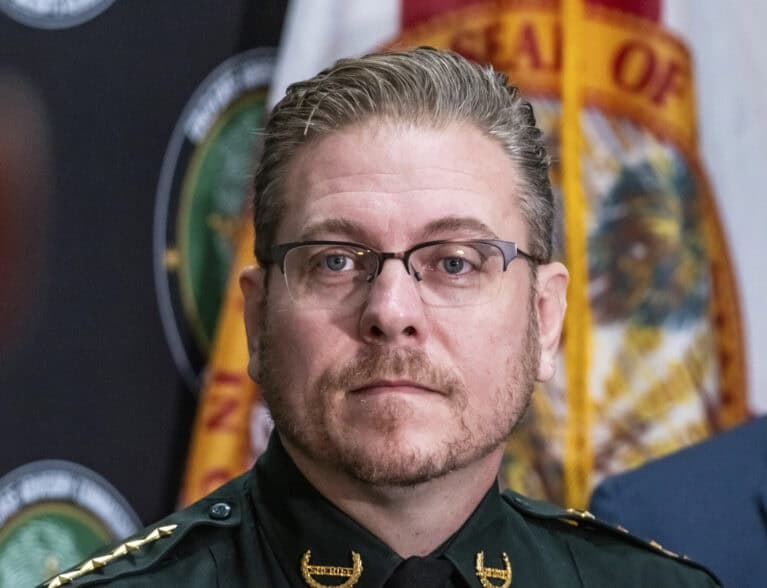
If you’ve been following Sheriff Eric Flowers’ pathetic public whining about the $7 million budget increase the County Commission is trying to give him, you’ve probably heard him and his amen choir of supporters complain:
“The county can spend $34 million on consultants, but it can’t afford to give our deputies pay raises.”
Flowers’ argument is bogus, of course, because he’s trying to connect dots that can’t be connected – and he’s ignoring the other compelling quality-of-life needs that must be addressed in our growing county.
He has even resorted to the use of low-brow rhetoric, trying to scare taxpayers and bully the County Commission by saying our community will become “like Detroit” if he doesn’t get the full $12.2 million budget hike he is demanding.
Fact is, only a small fraction of the money the county paid in consulting fees during the 2022-23 and 2023-24 fiscal years arguably could have gone to the Sheriff’s Office – because nearly all of that money wasn’t General Fund revenue.
Most of this money came not from taxes but from enterprise operations such as utilities, and from fees collected to fund building and permitting services. And Titkanich said nearly $29 million of the $34.8 million cited by the sheriff went for engineering studies and projects pertaining to roads, utilities, land use, construction inspections, environmental concerns, and the like.
“I get it: People don’t like to pay for consultants,” County Administrator John Titkanich said last week. “But we didn’t have a choice. We didn’t have the in-house expertise or workforce capacity to do what needed to be done.”
Surely, Flowers knows that – or he should, after more than four years in office – but the sheriff had painted himself into a corner by choosing to make improving deputies’ pay the headline issue in an unprecedented, all-in campaign for a whopping $12.2 million budget increase.
He needed to find some way to deflect blame for his failure to use any of the nearly $22 million in budget increases he received the past four years to raise the salaries of entry-level deputies.
The $34 million the county spent on consultants became a key part of his refrain.
Indeed, we can expect it to be repeated often on Monday, when the commission – rather than waste time and money defending itself against the fatuous lawsuit Flowers filed two weeks ago – agreed to hold yet another public hearing on the sheriff’s budget.
In all probability, the hearing won’t result in any changes to the sheriff’s budget, but it will require Titkanich to publicly explain the suggested cuts he identified in writing in the Sept. 22 letter Flowers demanded under Florida law.
It will also force the commissioners to endure another potentially hostile public-input session that will almost certainly be dominated by Flowers’ deputies and the sheriff’s other allies in a sure-to-be-stacked audience.
“We believe we’ve fulfilled the intent of the state’s requirement, but we’ve scheduled the hearing to avoid the unnecessary expense of going to court,” Titkanich said, referring to Flowers’ lawsuit seeking the additional hearing.
“We’ll go through what was contained in the letter, and then we’ll simply re-issue it – unless the commissioners decide to do something else.”
That’s not likely.
The commission, which already set the county’s millage rate and approved its overall budget for the 2025-26 fiscal year, would need to tap into reserve funds to fully satisfy Flowers’ requested increase.
“Nothing’s going to change,” Commission Vice Chair Deryl Loar said. “This is just a formality.”
Actually, it’s just another ploy by Flowers as he continues to embarrass himself, his office and our community with his spoiled-brat tantrum, pushing the blatantly false narrative that our commissioners don’t care about law enforcement.
Earlier this month, in fact, Flowers was so desperate for a sound bite to sway public opinion that he posted on the agency’s social-media platforms a four-minute video in which he accused our all-Republican commission of embracing the “Defund the Police” movement.
The tactic reeked of dishonesty, which shouldn’t surprise anyone.
For months now, Flowers has contended that he needs the commission to fully fund his budget because he needs to increase the salaries of entry-level deputies from $50,600 to $60,000 for our Sheriff’s Office to remain competitive with other law-enforcement agencies in the region.
In May 2024, however, he sang a different tune.
While campaigning for re-election against two formidable challengers, Flowers boasted on his personal Facebook page that he had increased the average annual salary of deputies under the rank of sergeant to more than $63,000.
“When I took office, the average salary of a deputy (not including sergeants and higher ranks) was $51,000/year,” Flowers wrote in the post. “Less than four years later, the average deputy now makes $63,800/year, a 25% increase.”
May we assume, then, that while the sheriff’s entry-level deputies started with a base annual salary of $50,600, they were soon offered opportunities for pay raises and overtime?
To be sure, nobody is questioning Flowers’ desire to give pay raises to his lower-ranked deputies, especially in these inflationary times. We’re asking why, when given annual budget increases to increase salaries, he didn’t make it a priority until this year.
Maybe he’ll tell us Monday.
In the meantime, you should tune out all this talk about the $34.8 million the county paid to hire consultants the past couple of years – because it was, for the most part, money well spent.
According to Titkanich: One firm, Medley-based Halley Engineering Contractors has been paid $13.4 million for conducting the engineering inspections on all of the county’s public-works infrastructure projects, including the widening and enhancement of 66th Avenue.
“We’ve spent a lot on engineering, but that’s where we had the most-pressing need,” Titkanich said. “When you’re talking about public projects – especially those with very expensive price tags – you’ve got to get it right.
“To do that, you need to hire consultants with the expertise and track record to do the job.”
Titkanich’s predecessors, Joe Baird and Jason Brown, were devout fiscal conservatives who ran the county on a tight budget, even before the 2008 recession, which forced the administrators to reduce spending and cut staff.
It wasn’t until the just-concluded 2024-25 fiscal year, Titkanich said, that the county finally surpassed the staffing levels it enjoyed in 2007.
“In terms of staffing, we weren’t just undernourished – we were malnourished,” he said. “We were so short staffed, we had people doing three different jobs.”
Since his arrival in April 2023, Titkanich has reorganized the upper tier of his administration and addressed staffing deficiencies. But the county still lacked the expertise and workforce capacity to confront the challenges it faced, especially on the engineering front.
To be fair, a large percentage of the $18.4 million the county spent on consultants during the 2022-23 fiscal year was approved before Titkanich was hired. He reduced that amount by $2 million in 2023-24, when he was fully accountable.
“You spend $34 million, people are going to notice,” Titkanich said. “Is it a lot of money? Yes. Is it an exorbitant amount? Not when you consider that it was spent over a two-year period, when you have a utility, and when you throw in unfunded mandates from the state.
“We do as much as we can on an in-house basis, but in many cases, the engineers we have on staff are already managing other projects,” he added. “In other cases, we need the outside expertise.”
Looking ahead, Titkanich said, the consulting work has provided the county with the studies, reports and recommendations – the “foundation,” he called it – to move forward.
As for the commissioners, Chairman Joe Flescher still isn’t comfortable with the amount of money spent on consultants, and he’s still waiting to see tangible results.
The five-term commissioner continues to question the need to change the culture of the county administration and remains troubled by the staff turnover that he says has resulted in a loss of institutional knowledge.
Loar, who has been Titkanich’s toughest critic on the commission, was more understanding of the administrator’s plight.
“When he got here and began bringing in all these consultants, I kept asking: Why are we outsourcing so many things,” Loar said. “Turns out, we needed to. We needed to bring in outside help because we don’t have the in-house expertise and staffing.
“And it’s not just us,” he added. “You see it in other counties and municipalities, too. But John is catching the brunt of the criticism.”
Commissioner Susan Adams defended the spending, saying most of it is connected to “roadway improvements and other capital projects” that required the expertise consultants provide.
“We have to hire engineers and architects to make sure we’re following all the rules and regulations,” she said. “We don’t want to leave the county open to potentially costly lawsuits.
“So, yeah, $34 million is a big number,” she added, “but when you drill down to what that number means, it’s nothing outrageous.”
Our sheriff wants you to believe it is.
“He’s very media savvy, and the argument that we underfunded him isn’t getting traction,” Adams said. “So now he wants another public meeting where we have to defend what we gave him. It’s all about optics.”
Or as Titkanich put it: “It’s a red herring, but we’re in uncharted territory with the sheriff suing over his budget. This wasn’t in the playbook.”
It’s in Flowers’ songbook, however.