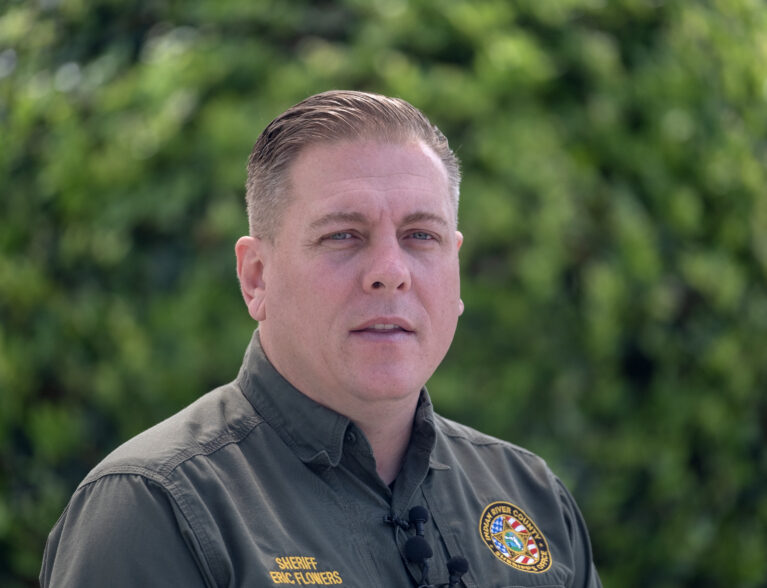
For the moment, anyway, let’s put aside the lawsuit Sheriff Eric Flowers filed last week in connection with his ongoing budget dispute with the County Commission.
Instead, we need to focus on the more-pressing question prompted by Flowers’ puzzling decision – just one day earlier – to drag his bitter budget battle deeper into the political gutter by accusing our County Commission of embracing the “defund the police” movement:
How much dishonesty are we expected to tolerate from the county’s highest-ranking law enforcement officer?
“He’s using buzzwords that are politically charged and purposely divisive,” Chairman Joe Flescher said of the sheriff’s shameful attempt to link the commission to the short-lived campaign launched by far-left extremists after the George Floyd murder in Minneapolis five years ago.
“For him to dredge up that terminology, that sentiment – for him to even suggest that we would endorse, or even entertain, a defund-the-police approach in our budget process – is unconscionable to me,” he added. “It’s appalling.”
It wasn’t surprising, however, given Flowers’ behavior during his scandal-tainted first term.
Throughout his combative, take-no-prisoners demand for the unrealistic $90-million-plus budget he proposed for the 2025-26 fiscal year, Flowers has relentlessly pushed the blatantly false narrative that our commissioners don’t care about public safety.
Flowers, in fact, was at it again on Oct. 1, when he released on the Sheriff’s Office website and social-media platforms a four-minute, video-recorded tantrum during which he alleged the commissioners – because they didn’t fully fund the $12.2 million budget increase he said he needs – aren’t concerned about the safety and well-being of his deputies.
He cited the expenses related to deputies’ mental health, training and ammunition, as well as cost of dog food for his K-9 unit, saying those concerns are “not important” to the commissioners, even though Flescher once wore the agency’s badge and commission Vice Chairman Deryl Loar served three terms as our sheriff.
He raised doubts about his agency’s ability to effectively respond to a “mass-casualty event,” inferring that the commissioners’ refusal to approve his request shows they don’t consider “protecting our schools” to be a priority.
He also warned that criminal cases would be abandoned or lost because this year’s Sheriff’s Office budget lacks the funds to cover DNA testing supplies.
But it was Flowers’ defund-the-police rhetoric that grabbed everyone’s attention, just as he hoped it would.
“I never thought in 2025 – in the United States of America, in the state of Florida, and especially in Indian River County – that we would see the ‘Defund the Police’ movement come to our hometown,” the sheriff said in his video.
The fact that his carefully chosen words lacked even a shred of credibility was irrelevant to him. They were uttered solely for effect. He wanted a sound bite that could sway public opinion.
He wanted to seize upon the gaping political divide that has too many Americans seeing their countrymen as enemies, and he wants to weaponize that venom against the commission.
Don’t let him.
This unnecessarily nasty budget clash should be about what’s best for our community – not about Flowers and his overinflated ego, which was on full display in last week’s video, where he deliberately drew a distinction between himself and County Administrator John Titkanich.
While Flowers referred to himself as the “elected sheriff of Indian River County,” he derisively described Titkanich as an “unelected bureaucrat” in a feeble attempt to diminish an administrator who was merely acting on the commission’s behalf.
But since Flowers brought it up: Let’s not forget that he was re-elected despite receiving only 9,600 primary votes in a county with a population of 170,000 and nearly 120,000 registered voters, more than 60,000 of whom were card-carrying Republicans.
He was able to do so because we live a Republican-dominated county, and Florida’s wrongheaded election laws allowed an unaffiliated, no-chance, write-in candidate to close the party’s August 2024 primary, preventing Democrats and independent voters from participating in the balloting that would effectively decide who would be our sheriff.
Flowers also benefitted from having two strong primary challengers – then-Sheriff’s Captain Milo Thornton and now-former Fellsmere Police Chief Keith Touchberry – who split a very strong anti-incumbent vote.
More than 60 percent of the 26,000-plus Republicans who voted in the primary wanted one of Flowers’ opponents to replace him.
In other words: Flowers, who almost certainly would’ve lost an open primary, stumbled across the finish line with the support of only 8 percent of the county’s registered voters.
The outcome was hardly a vote of confidence for Flowers, who survived a tumultuous first term that included the fallout from the public exposure of a clandestine extramarital affair, and it certainly didn’t provide him with anything resembling a mandate.
The sheriff, though, was unfazed.
Full of himself from the moment he walked into the commission’s first budget workshop in July, Flowers arrogantly attempted to dictate terms, saying he needed to be fully funded to give his deputies pay raises and would not compromise.
He didn’t bother to attend the commission’s next three budget sessions – a special-call workshop scheduled specifically to address his budget in August and two public hearings last month.
When Flowers did speak, he conveniently avoided the fact that the commission had increased his budget by nearly $22 million over the previous four years, including a $7.2 million hike in 2022.
“He said he needs this money to increase the starting salary for entry-level deputies to be competitive with other agencies in the area,” Loar said. “Why didn’t he use the money we gave him?”
Commissioners were also perplexed by Flowers’ failure to meet individually with all five of them before or during the budget process, choosing instead to take his case directly to the community via videos and social media.
“He came into these proceedings wanting the full amount, but he did not communicate with us in the customary fashion,” Flescher said, calling Flowers’ refusal to negotiate the “most unique process for a budget request that I have seen in my 19 years as a commissioner.”
The chairman was quick to add: “His videos have taken things to a whole new level.”
Also at a whole new level is the sheriff’s budget approved by the commission last month, when he was given nearly $86 million to cover the operations of his agency for the next 12 months.
According to Titkanich, the sheriff now accounts for 53.6 percent of the county’s General Fund budget, including 72 percent of all new General Fund revenues resulting from higher property values.
In addition, the 8.7-percent budget increase – from just under $79 million – provides the sheriff with the funding he said he needed to bump up deputies’ starting salaries from $50,600 to $60,000, give across-the-board raises of $9,000 to each of his deputies, and hike the salaries of civilian employees by $3,500.
“Yet there’s still the misperception that we cut the sheriff’s budget,” Flescher said. “We did not reduce his budget. We increased it. We just didn’t give him as much as he requested because he asked for more than is available.”
Truth is, Titkanich did an impressive job in putting crunched together a fiscally responsible budget. Then, at the commission’s behest, he revisited his original spending plan, and found ways to give Flowers an additional $2 million-plus.
Anything more, however, would’ve required the commissioners to gut our growing county’s overall $600 million budget by imposing severe staffing cuts, noticeably reducing services and postponing much-needed projects.
Still, Flescher opened the final budget hearing by raising the possibility of tapping into the county’s reserve funds to fully cover the Flowers’ request. The commission, however, wisely rejected that suggestion.
Thus, the sheriff – who early in the process reduced his budget-increase demand from $14.6 million to $12.2 million but has since refused to budge – remains dissatisfied and determined.
“We will not stop here,” Flowers said in his video last week. “We are going to do everything legally possible to ensure the operations of the Indian River County sheriff are properly funded and that the money goes where the taxpayers meant for it to go …”
The next day, Flowers filed a lawsuit claiming the commission failed to conduct public discussions on the specific budget reductions identified by Titkanich in the administrator’s state-mandated, Sept. 22 letter to the sheriff.
The sheriff is asking the court to order another public hearing at which Titkanich would be required to explain why he chose the cuts cited in his letter and community members would be given the opportunity to comment.
Or, the complaint states, the judge could “order the commission to fund the sheriff’s proposed annual budget in full.”
Both the commission’s chairman and vice chairman said they were surprised by the lawsuit. While Loar compared the court filing to a “kid suing his parents because they didn’t triple his allowance,” Flescher said he was “trying to figure out the sheriff’s end game.”
Flescher isn’t alone.
Does Flowers believe he can bully the commissioners into fully funding his budget request by forcing them to defend – during a public hearing with a sure-to-be-stacked audience – the specific cuts identified by Titkanich?
That’s not going to happen.
The commissioners have already held four budget sessions, all conducted in public, and they’ve heard from the community. They understand the reasons for Flowers’ request, but they also recognize the county has other compelling needs.
And for those who haven’t been following this saga: The commission was unanimously opposed to a tax increase that would have put an additional financial strain on the county’s many seniors who are living alone and on fixed incomes, especially during these inflationary times.
Besides, the lawsuit makes no sense. Those specific cuts Titkanich identified in his letter to Flowers? They’re nothing more than suggestions.
Under Florida law, sheriffs have unfettered control of their funds, once their county commissions approve their budgets. That means Flowers can use the $86 million he has received in any way he sees fit.
“It’s not our job to tell the sheriff how to manage his money,” Loar said.
Also, the commissioners have publicly agreed to entertain requests for amendments to Flowers’ budget after March 31 – six months into the fiscal year – if he presents a legitimate need for additional funding.
Be honest: Do you really believe that our all-Republican County Commission wants to defund the police?
If our sheriff can’t effectively enforce the law and protect our community with an $86 million budget, we need to get one who can.