The ocean is full of surprises – some breathtaking, others terrifying. For Eddie Jarmakowicz, a day of spearfishing in the Bahamas turned from sport to survival when a reef shark mistook him for the catch of the day.
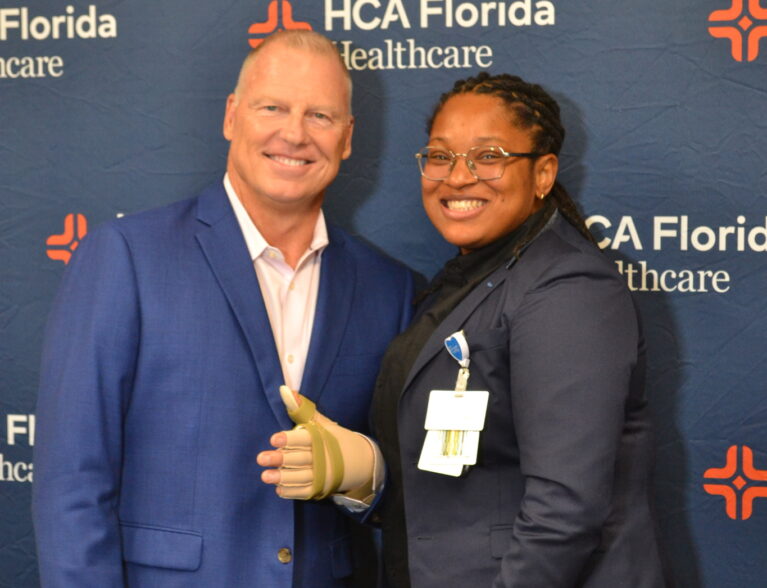
On what should have been an ordinary trip with friends, same as he had done taken many times before, Jarmakowicz instead found himself in a fight for his life. Thanks to the quick action of his friends – who pulled him from the water, applied a tourniquet, and coordinated emergency transport from the remote island – and the treatment provided at HCA Florida Lawnwood Hospital in Fort Pierce, he is expected to make a full recovery with complete use of his arm, hand and fingers.
“I was spearfishing in about 25 feet of water just past Grand Cay and had just shot a mutton snapper,” Jarmakowicz recalled. “I was ascending to the top and reached down to grab the fish when the shark grabbed my hand. I never even saw it, but my dive buddy said it was a 6-foot reef shark. I looked down and saw my wrist hanging, flesh exposed. I was just thankful I could still see my fingers.”
Once back on the boat, it took about 45 minutes to reach shore, where emergency personnel were waiting. From there, Jarmakowicz was flown by private plane to Stuart, then airlifted by Trauma Hawk to Lawnwood – the nearest trauma center to Grand Cay.
He was met by trauma surgeon Dr. Aleta Paschal, who immediately assessed the wound and rushed him into surgery.
“It’s hectic in the trauma unit, as you can imagine,” Jarmakowicz said. “But Dr. Paschal was calm, steady and in control. I remember her checking for a pulse in every finger to make sure the blood flow was still good.”
Dr. Paschal also remembers that day vividly. “We got an alert that a shark bite victim with extensive injuries was in route from the Bahamas,” she said.
“When he arrived, he had a tourniquet and bandage that had been in place for over four hours.
Because he was on blood thinners, we were very concerned about blood loss – I estimated he’d already lost at least a liter. When we removed the dressing, we saw a major injury classified as a mangled extremity. Multiple muscles and tendons were exposed, and the bone in his forearm was visible. Thankfully, when I slowly released the tourniquet, his vascular flow was still intact.”
Knowing the repair would be complex, she called in a plastic surgeon, and together they wheeled him directly to the operating room.
“It was a very intricate surgery,” Dr. Paschal said. “We had to repair at least eight tendons in his forearm, as well as several smaller tendons in his wrist and hand. He appeared to have been bitten at least twice, maybe three times. The operation lasted four to six hours, but we were able to restore function to his hand – and incredibly, he was able to leave the hospital the very next day.”
Dr. David Rubay, trauma medical director at Lawnwood, said the hospital is well equipped for these kinds of emergencies.
“We keep operating rooms ready at all times,” Dr. Rubay said. “We often see patients injured during water activities – jet ski accidents, shark bites, even alligator attacks.
“Eddie’s surgery required microscopic repair of the tendons to restore movement and sensation in his hand. Without that level of repair, he might have kept the hand but lost its function. Our goal is always for patients to fully recover and return to normal life.”
The case was further complicated by Jarmakowicz’s blood thinner medication, which increased the risk of bleeding.
“We were able to provide him with the blood and blood products he needed,” Dr. Rubay said. “We also had to be vigilant about infection. Shark bites and water wounds carry a high risk of bacteria, including Vibrio vulnificus, sometimes called flesh-eating bacteria. In Eddie’s case, we prevented all those complications and achieved a remarkable outcome.”
Dr. Paschal agreed. “Seeing him now, with full function of his hand and fingers, I think he’s a miracle,” she said. “I’m proud of our team and proud of him. We did the initial work, but he’s put in the effort to recover. Watching him move his hand today – it’s everything we hoped for.”
Complete recovery will take up to seven months, but Jarmakowicz is already looking forward to returning to the water. “For me, being in the ocean is about connecting with nature and God’s creations,” he said. “It’s beautiful, calming and relaxing. Despite this recent adventure, I’ll go back as soon as I can. I can’t say enough about the care I received at Lawnwood – it was fabulous from the start, especially Dr. Paschal’s calming voice.”
As for advice to fellow spear fishermen, he said: “Always be aware of sharks and barracudas and always keep a tourniquet on the boat along with a way to call for emergency help. It saved my life.”
HCA Florida Lawnwood Hospital is the region’s primary trauma center, providing 24/7 emergency care for patients across the Treasure Coast, from Hobe Sound in Martin County north to Melbourne, and from the Atlantic Ocean west to Okeechobee County.
Jarmakowicz knows the sea can be both beautiful and brutal, but he refuses to let fear keep him from it. After all, he says, even though the ocean gave him one of his worst moments – it’s also where he finds his greatest peace.
Dr. Aleta Paschal received her medical degree from Meharry Medical College School of Medicine. She completed her residency at Georgia Health Sciences University and her fellowship with Baylor College of Medicine. She is a trauma surgeon at HCA Florida Lawnwood Hospital, Fort Pierce. 772-461-4000.