Educating the youth of today is like putting together a giant jigsaw puzzle, and getting those pieces to stay in place and create a complete picture is a challenging dilemma for modern educators. Gone are the days when the three Rs – Reading, ‘Riting and ‘Rithmatic – were the sole curriculum focus. As the world has grown and society has changed, so too have educational needs.
In 2001 educators began to realize the U.S. was falling behind other countries in the S.T.E.M. (Science-Technology-Engineering-Math) fields; all vitally important in an ever more technologically-based world. It didn’t take long for educators to realize there was something missing from S.T.E.M., prompting the incorporation of Arts into a S.T.E.A.M. formula to enhance academic learning.
Examples of S.T.E.A.M. integration at its best include the works of Leonardo da Vinci, who utilized art to explore other fields of study. And what child didn’t learn the alphabet through music, singing their ABCs to the tune of “Twinkle, Twinkle Little Star.”
The Vero Beach Museum of Art has long embraced art integration in education, understanding that a landscape painting can add another dimension to a geography lesson, or a painting of Galileo can spark discussions on the stars and history.
During the museum’s summer literacy program in partnership with The Learning Alliance, the recent “Out of this World: The Art and Artists of NASA” exhibit was employed as a springboard for a variety of space exploration lessons.
Seeing the merits of a school-based S.T.E.A.M. program, museum staff presented the concept to The Circle, a philanthropic group of more than 100 women formed in 2009. The Circle has provided close to $200,000 to support the museum’s Community Engagement Programs in an effort to ensure the visual arts are accessible to everyone in the community.
“The Circle will provide seed money to different museum programs that enable the museum to expand its programming rather than simply focus on underwriting ongoing programs,” explains Circle Chair Nancy Edmiston. “We feel that enhances the museum experience for the community as a whole and particularly for school children who benefit from the programs. So the S.T.E.A.M. program provided a marvelous opportunity.”
With the backing of The Circle in place, the museum approached Vero Beach Elementary School and invited second- and third-grade teachers to work with museum staff and receive S.T.E.A.M.-related online professional development. The teachers learned how to use art and the museum itself as a resource to transform traditional academic subject areas.
“The teachers took what they learned and ran with it,” says School, Youth and Community Impact Manager Shanti Sanchez.
“They have been creating lesson plans and themed units using upcoming museum exhibitions with their science, technology, engineering and math curriculum,” she explains. “The plans were implemented in the fall of 2016 and will be again in spring 2017.”
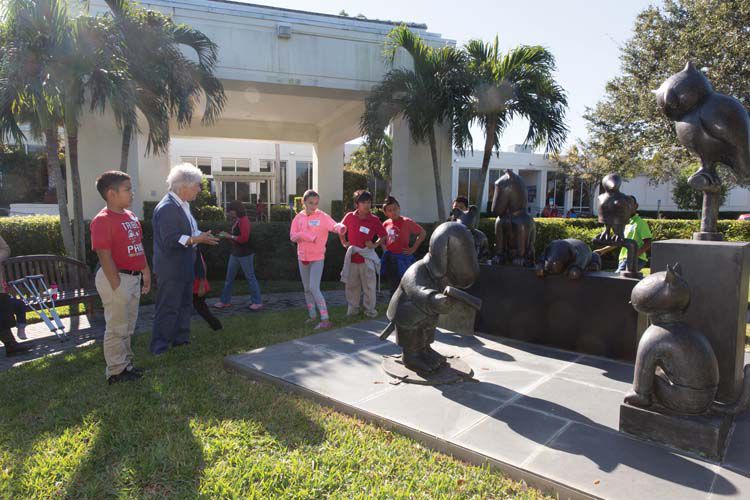
Museum docents look at the lesson plans to determine which exhibits might best relate. In addition to the unit, they show students how to look at art in general and how to use the museum in its entirety to compare and contrast concepts. Then museum staff and a teaching artist work with students through museum visits, exhibition tours and hands-on studio art projects that are related to the academics they are learning at school.
“We build our unit plans on our science standards and the Bruce Marsh Exhibit worked perfectly into our unit,” explains Vero Beach Elementary third-grade teacher Amy Poplar. “We read the book ‘The Mangrove Tree’ by Susan Roth and learned all about mangrove trees, how they are unique and how one man used this tree to save a village in Africa. We studied plant structures and how they respond to stimuli and the students were able to see the mangrove trees during our Environmental Learning Center excursion.”
Introducing the concept of art imitating life, students learned about Florida landscape artist Bruce Marsh and compared his paintings to what they saw during their ELC field trip. To apply what they had learned, students then created their own watercolor landscape paintings of a mangrove tree.
“This model integrates the arts into the curriculum, giving it equal time with instruction instead of just as an afterthought or activity that is tacked on,” adds Poplar.
One student described the experience saying, “I painted my mangrove tree like a home, because when I saw the tree in real life, I could see the little animals that were living in the tree. It is their home, like an apartment with lots of renters.”
“The art museum has been planning with us from the beginning and giving us ideas on how to integrate the art standard into our unit. They taught us how to paint using watercolors and helped to create the lesson plans for the art piece. They also purchased all of the supplies we needed and offered transportation to get our students to the museum to see the exhibits. This unit would not have been successful without them,” stresses Poplar. “This was such an amazing experience and we can’t wait to do it again in February. This was so meaningful for the students and brought them a real-world experience they have never had before!”
Pleased with the outcome, Edmiston says, “They’ve shown that the skills children or young people learn through S.T.E.A.M. programs enhances critical thinking and communication skills and develops collaboration as well as creativity. It was a natural connection because so very often many of the museum’s exhibitions apply directly to how art intersects with science and technology.”
Museum staff and volunteers are fully invested in the effort to provide teachers with the support and resources they need to go full S.T.E.A.M. ahead with art integration.
“The museum’s mission is all about showing how art makes a difference in all aspects of life,” Sanchez sums up.